What brands and types of machines are dominating Irish agriculture?

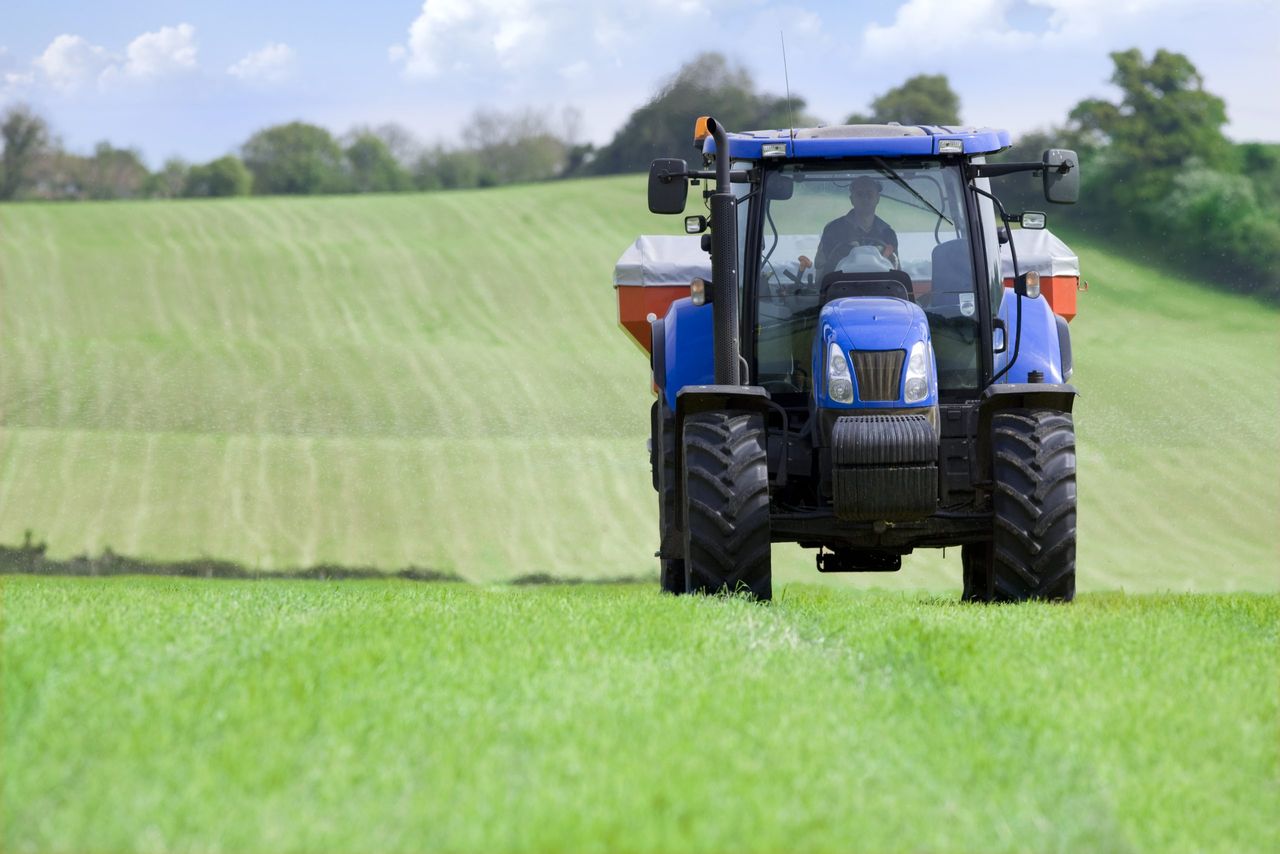
John Deere, New Holland and Fendt dominate European fields, but Ireland's grassland focused farming sector tells a slightly different story.
In Ireland, several agricultural machinery manufacturers are carving out strong positions in one of Europe's most specialised machinery markets.
While the likes of John Deere and New Holland are some of the most popular brands here, the likes of Massey Ferguson and Case IH also make up significant market shares.
Tractor comparison
One of the main differences we see between mainland European and Irish farms is what size machinery farmland can support.
German and French farms generally hold much larger fields, and thus have a need for bigger machines, such as a Fendt 1000, New Holland T9 and John Deere 8R series' (400-550+hp).
Those tractors are much bigger, heavier, and pack a lot more hp than is realistically practically in rural Ireland.
From soil compaction to the width of rural road, those larger tractors simply do not have a place in much of Irish agriculture.
In Ireland, it would be far more common to see a Claas Arion 600, John Deere 6M or New Holland T7 series tractor (150-250hp range).
So while we see similarities brand-wise, though size and scale is slightly different; what about Ireland's use of machinery?
Eurostat (the statistical office of the European Union (EU)) released information on EU farms' use of conventional farm machinery and the ownership status of said machines.
Machinery usage
About 84% (5,143,840) of EU farms use conventional farm machinery, which includes tractors and machinery for tillage, planting, fertilisation, application of plant protection products and harvesting activities.
When it comes to Ireland, 87% (111,570) of Irish farms in the dataset use conventional farm machinery.
Tractors naturally stand as the most used conventional farm machine used across the EU, featuring on 79% (4,851,230) of farms.
108,660 Irish farms are using tractors, which makes up 85% of the Irish dataset.
The data groups tillage machinery, seeders and planters, spreaders, pulverisators or sprayers for fertilisers and equipment for application of plant protection.
Combined, those machines are used by just over 65% of EU farms (4,001,190), of which, roughly 1% were Irish (73,010). This equates to 57% of Irish farms.
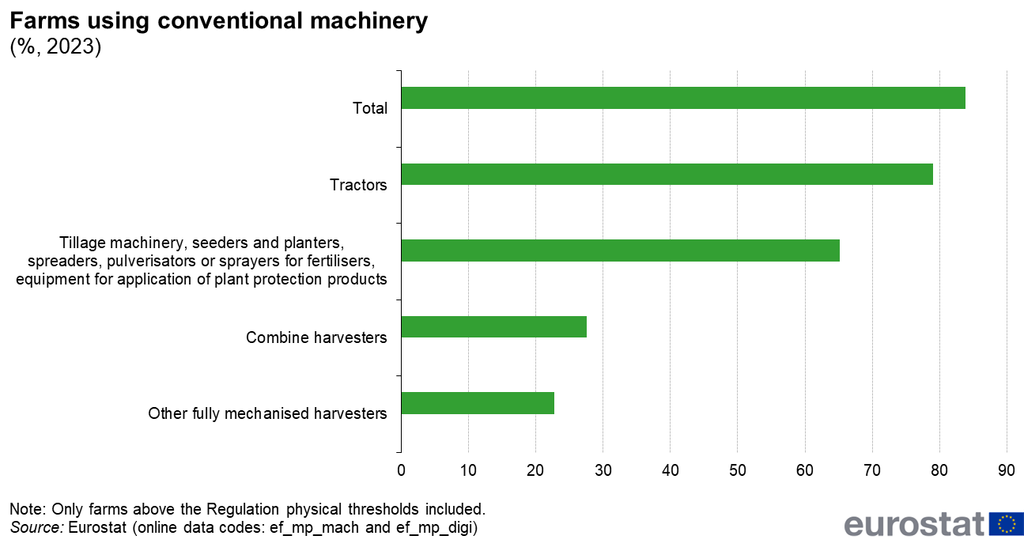
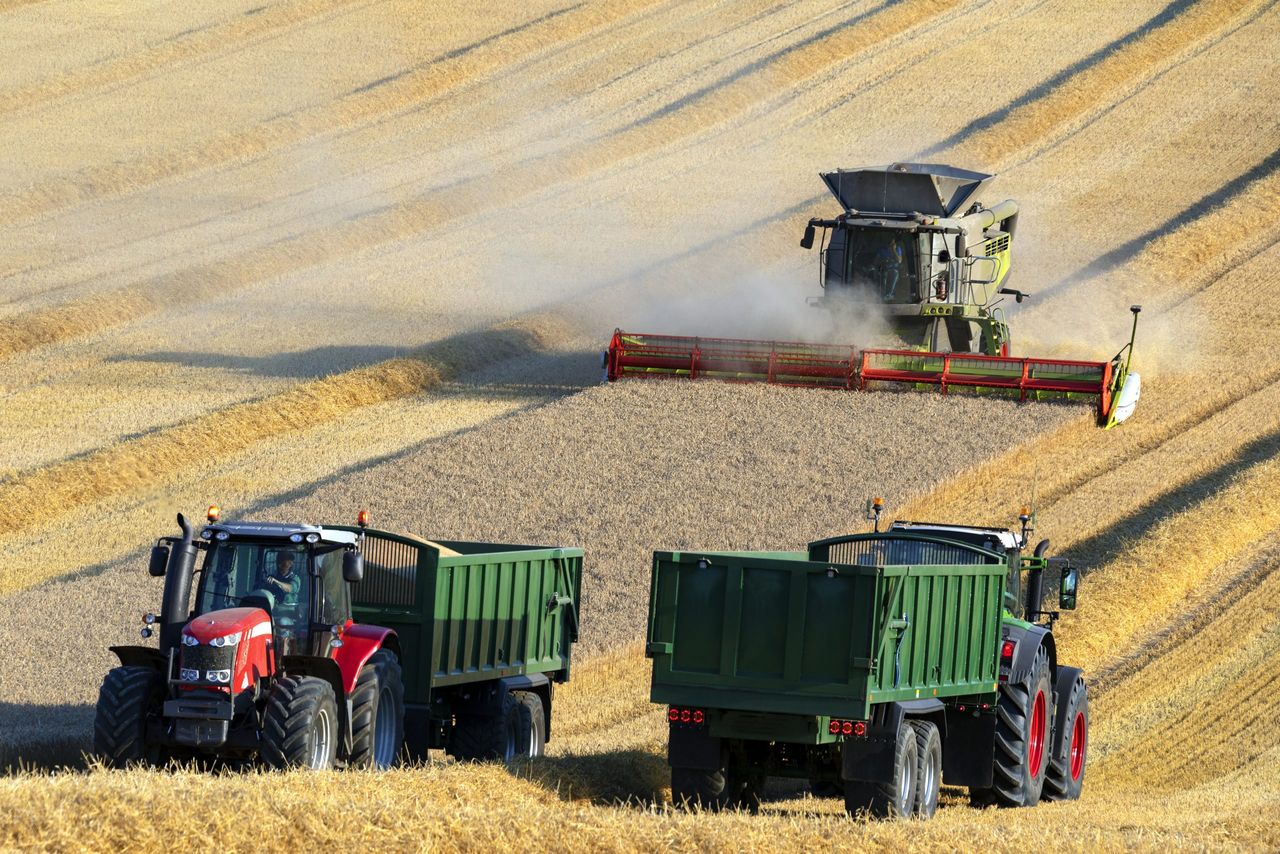
Combine harvesters were used on 27.6% of EU farms (1,691,780) and other fully mechanised harvesters were found to be used on 23% of EU farms (1,400,040).
Combine harvesters can be found in use on 4% of Irish farms (5,490) while other fully mechanised harvesters were in use on 3.7% of Irish farms (4,710).
This dataset shows that both Polish and Finnish farms are in the top percentile for conventional farm machinery usage, meaning less than 1% of farms in those countries do not use this type of machinery.
On the other end of the spectrum was Slovakia and Greece, where only 68% and 65% respectively of farms use conventional farm machinery, the lowest shares among EU countries.
Machinery ownership
Eurostat notes that sole ownership is the most common machinery ownership model in the EU, with about 35% of EU farms owning solely all of their conventional machinery.
Roughly 27% of EU farms use a combination of their own machinery and machinery that is used/owned by several other agricultural holdings.
Farms that did not own their machinery and purely rented and shared from others represented a fifth of EU farms at 21%.
Sole ownership of conventional machinery was particularly common in both Ireland and Slovenia.
Farms across the two countries clocked in around 83% sole ownership.
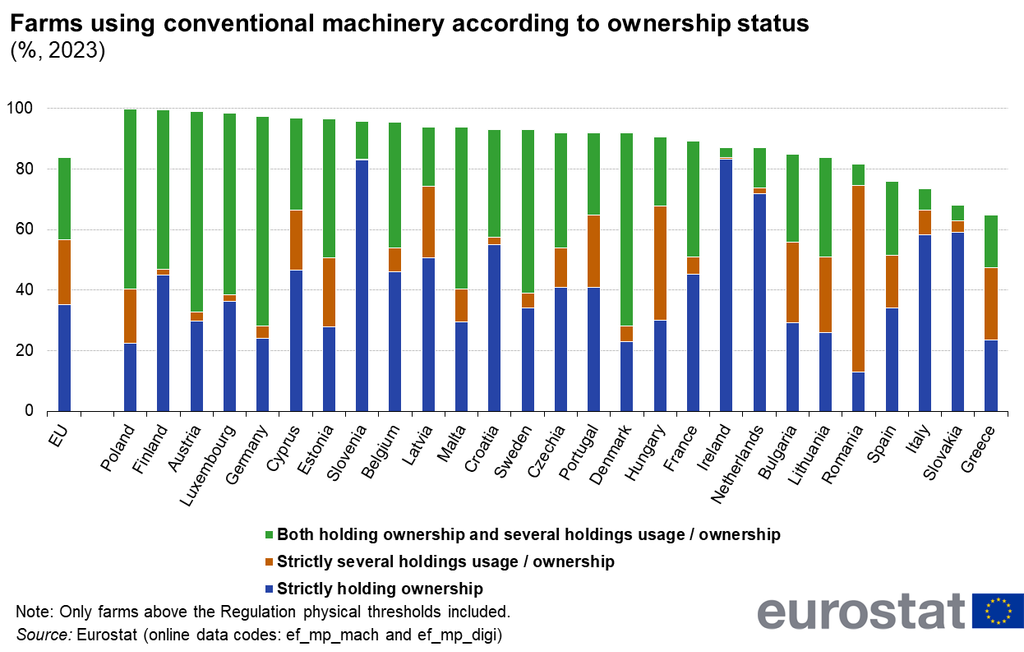
Of the 87% of Irish farms using conventional farm machinery, 83% of that is made up of sole ownership farms and 3.3% used the mixed ownership model.
The model of sharing and renting conventional machinery was the least prevalent of the three in Ireland, adding just 0.7%.
Farms reliant on sharing and renting conventional machinery was the most common model in Greece and Hungary, with 23.7% and 37.6% respectively.
The use of machinery of the mixed ownership model was the most common model found in Germany, Austria, Denmark and Luxembourg, with the practice reportedly found in at least 60% of farms.
Dataset
The dataset included 6,138,070 farms, corresponding to at least 98% of the total utilised agricultural area (UAA) and 98% of the livestock units (LSU) in each country in 2023.
Ireland contributes 128,050 farms to the dataset, representing just over 2% of the agricultural holdings surveyed.
This dataset represent an estimated 98% of utilised agricultural area (UAA) and 99% of the livestock units (LSU) of all EU farms in 2023.
While the statistics themselves come from 2023, Eurostat processed this data in May 2026.
The data report by Eurostat that refined this dataset is planned to be updated in December 2032.