Ireland 'exceptionally exposed' to volatility in global dairy market


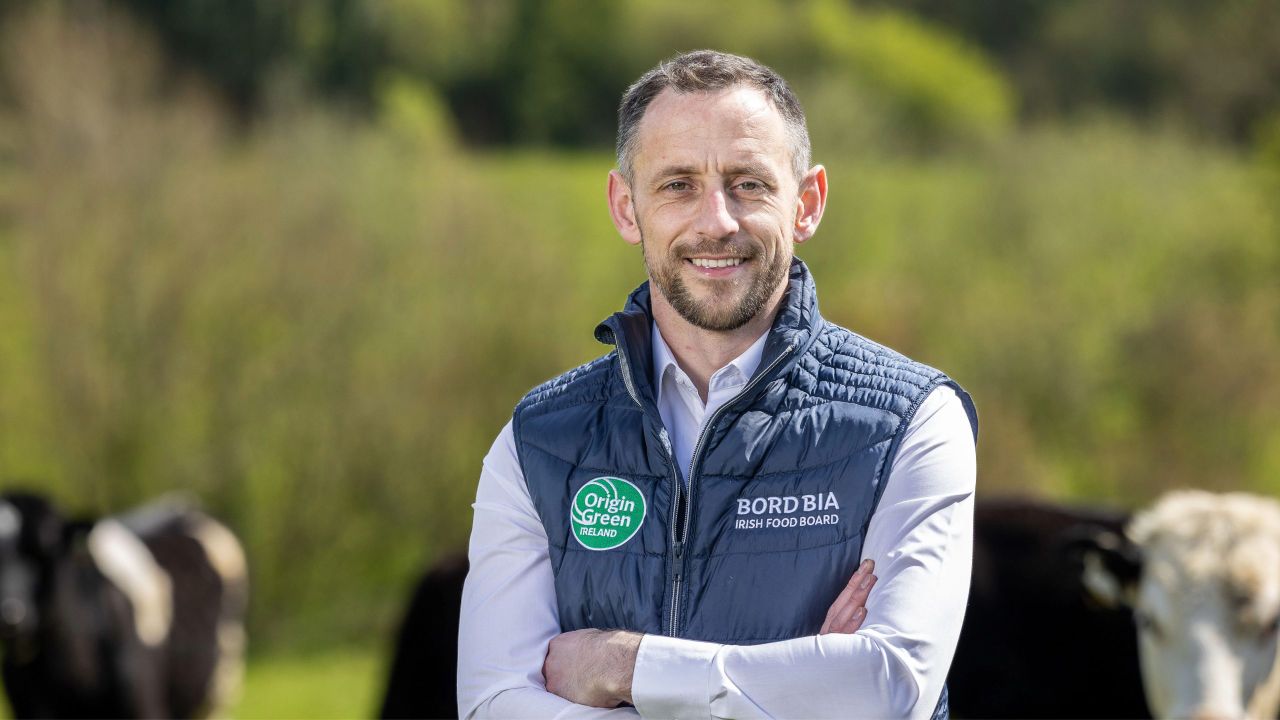
Agriland caught up with the director of Dairy Industry Ireland (DII), Conor Mulvihill at the National Ploughing Championship.
Mulvihill highlighted how Ireland is "exceptionally exposed to global volatility" due to our small global market.
He noted how 19L out of every 20L of milk produced has to get off the island, which leaves us paying the global price.
A year in review
Mulvihill acknowledged how 2025 was a "Carlsberg year for dairy", with the majority of milk supplied before prices began to deteriorate.
He highlighted how the international over-supply of milk and rapid change in demand for different products - with butter prices declining while demand increased for proteins - all played a role in declining milk prices.
However, with global milk production down, Mulvihill feels there is "a lot of green shoots at the minute".
He said: "When there's less milk, prices go up, simple as that"
"The biggest corrector of low prices is low prices; the biggest corrector of high prices is low prices."
Mulvihill said there are dark clouds ahead, but the "trojan work" of Irish dairy farmers and the changing markets mean there is still a positive outlook for the Irish dairy industry.
The DII director highlighted how we must start thinking as a nutrition industry rather than a dairy industry.
Especially when you look at the nutrition aspects of the industry, as there is an 'explosion of interest' in the Irish market, driven by products such as GLP1s, which are weight-loss medications derived from whey proteins.
Mulvihill said: "Butter will always be fanatastic for us, but the protein boom has huge opportunities for Irish farmers."
He added that if the industry, farmers, and the government can double down on the protein boom, Ireland's dairy industry will be very well positioned.
This is especially the case when considering its unique selling points, such as the pasture-based systems, the family farm model, and the co-op models.
Future of dairy
A recent survey conducted by Opinions, and commissioned by Agriland and the Irish Creamery Milk Suppliers’ Association (ICMSA) saw that 1-in-3 farmers intend to exit farming within the next five years.
The findings also showed that 68% of farmers see rules, regulations or bureaucracy as a major obstacle to farming, while a further 48% find environmental constraints to be a major obstacle.
With a hard fight to achieve the current nitrates derogation, there will be major uncertainty about a derogation in 2029.
Speaking on the topic, Mulvihill said he hates calling it a derogation as it seems as if "we are looking for something we shouldn't have", when Irish farmers are actually applying the nitrates directive in full.
Mulvihill said the industry must keep the foot down, as we have a "brilliant case" for when negotiators return to Brussels.
He said: "We have some of the best water quality in Europe; we have some of the lowest nitrates levels in Europe; we have a grass-based system that takes up the nutrients."
Mulvihill is appealing to farmers to support DII and further the industry in gathering the data which will make the case for an nitrates derogation beyond 2028.