Watch: Students showcase a low-cost solution to detect lameness at Young Scientist 2026

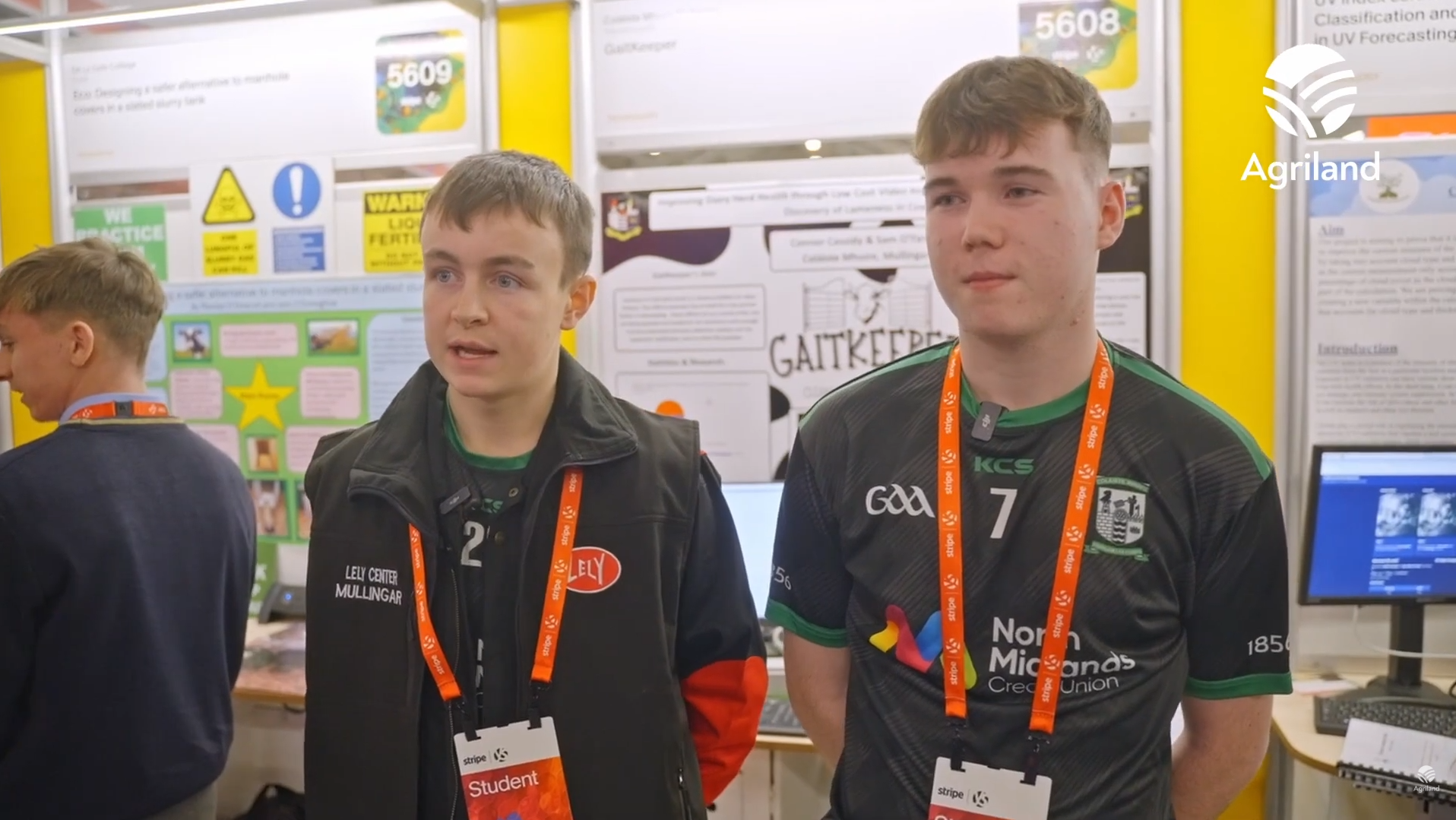
With lameness reportedly being an issue in over 10% of the national dairy herd, two students at this year's Young Scientist and Technology Exhibition (YSTE) showcased a low-cost solution to one of the most costly and persistent problems on Irish dairy farms.
Speaking to Agriland at this year's exhibition, students Sam O'Farrell and Connor Cassidy from Coláiste Mhuire, Co. Westmeath explained that their project GaitKeeper is designed to automatically detect cows who are showing signs of lameness through video analysis.
The project's technology can identify whether a cow is lame or not and alert the farmer immediately, all at a fraction of the cost of existing systems.
Connor said: "I come from a dairy farm myself, so I see firsthand the lameness on the farm, and as a result, what is being affected."
He highlighted the impacts of lameness in cows, such as higher vet fees and a drop in milk yield, which can be reduced by as much as 70%, according to the students' research.
"In our investigation, milk yield went down from 33 litres to only 10 litres of milk, so farmers are losing 70% of milk each day if they milk a lame cow, which is an incredible drop off," Sam noted.
While other commercial systems to detect lameness already exist, the students found that cost is a major barrier for farmers to adopt these systems, especially for larger herds.
Sam explained: "We also did surveys with local farmers and we found that what they want in a product like this is low cost and extreme simplicity."
Keeping affordability at the centre of their design, the group of students successfully built GaitKeeper for just €139.48.
GaitKeeper
The system runs on a Raspberry Pi microcomputer, which acts as the "brain" of the device, and it is linked to an infrared (IR) sensor that is able to detect when a cow passes, triggering a camera to record a 30-second video clip of the cow.
The students showcased that the camera can analyse the cows' legs to detect the presence of lameness, and through scanning a QR code attached to the cow's ear, the system can identify each cow and record its lameness status.
The data is then displayed on an app that farmers can access on their phone.
"Each cow has its own record and number so no matter what size of a herd, the farmer can easily access this data, which is compiled into easy-to-understand graphs that the farmer can then use to take fast action," Sam outlined.
Looking ahead
Sam and Connor's project has already caught the attention from industry bodies such as Teagasc and VistaMilk, who have helped the students develop better ideas for the project in the future.
Connor added that they hope to find a suitable alternative to replace the project's current method of identifying each cattle through scanning a QR code.
He said: "Through our research, concerns were brought up that the QR code can get slightly dirty, or maybe it won't be in a suitable place to read.
"So we would like to develop that, but we are just trying to keep the cost as low as we can, so that farmers - no matter who they are - can afford our product."
Further ideas for the project include expanding its system to include other livestock, such as sheep, and also the implementation of a drafting gate.
Connor explained that after each cow is videoed, the drafting gate could filter them into a yard, separating the lame cows to allow for immediate treatment.