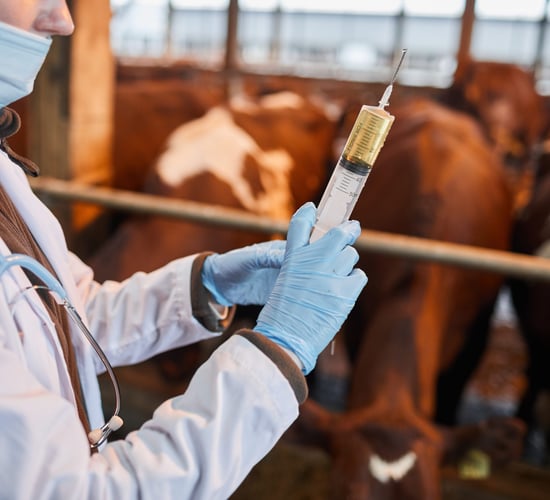
Is a synchronisation programme worth the cost?


Many winter milking herds may only begin breeding after Christmas, which means considering a synchronisation programme may be worthwhile.
If we consider the average gestation length of 285 days, then ideally winter milking herds should begin breeding on December 20 to make the most out of their liquid milk contract and calve down in early October.
However, it can be hard to kick off the breeding season during Christmas week, as many farms aim to only carry out the bare essentials on the bank holidays.
Therefore, many farms push the start of the breeding season until the week of the new year, but this then narrows their breeding window.
Therefore, implementing a synchronisation programme may improve the farm's breeding programme, especially if using sexed semen.
Synchronisation programme
The cost of a synchronisation programme is typically in or around €25-€30/cow, as well as a vets call out fee if required.
However, this cost is dwarfed by the benefits as syncing cows as it allows for a more compact breeding season, meaning cows will be in milk for longer.
For example, if you get a cow back in calf 10 days earlier than her usual oestrus cycle, a cow giving 20L/day at a maximum attainable milk price of 40c/L will make an additional €80 over those 10 days that she is in milk, at a time where every cent matters.
A synchronisation programme can help eliminate the difficultly of pinpointing the first onset of heat in a cow, especially for farmers who are not using heat detection technology such as collars.
Remember, if you do end up missing a cycling cow, you will have to wait another 21 days to serve her - that is 21 days where she is out of milk.
For a cow who should be producing 20/L a day at 40c/L, if she slips to her following oestrus cycle it will result in a loss of €168.
That may not seem like much, but if 10 cows were all to slip, that would cost a farmer €1,680 in lost milk production alone.
Then think about wasted straws and other breeding costs on top of that.
Fixed-time artificial insemination (AI) also eliminates most of the risk involved with sexed semen, and mitigates any risk of reduced conception rate impacting on six-week calving rate the following season.
Protocols
When setting up a synchronisation programme, as usual you must first pick a team of bulls suitable for delivering genetic gain to your herd.
Choose what cows need to be targeted, ideally focus on cows in their first to third lactation who are of a correct body condition score (BCS) and have not displayed issues such as lameness, mastitis, uterine diseases, and more.
Always breed your replacements off of your best and highest Economic Breeding Index (EBI) cows to increase and accelerate your herd's genetic gain.
Consult your vet or breeding adviser before carrying out the following protocols;
| Day | Protocol Step |
|---|---|
| 0 | Scan cow, insert progesterone (CIDR/PRID) device and administer GnRH injection |
| 7 | Administer Prostaglandin (PGF2α) injection |
| 8 | Remove CIDR/PRID device and administer second Prostaglandin (PGF2α) |
| 9 | Administer GnRH injection 36 hours after PGF2α |
| 10 | Perform fixed-time AI 16-22 hours after the second GnRH injection |
Timing is crucial with this system; any errors or non-compliance with the protocol can severely impact the fertility of the animal at the time of insemination.
Therefore, prior to implementing the programme careful planning and organisation is crucial to ensure its success.
For dairy heifers, Teagasc recommends the following fixed-time AI eight-day protocol;

At the end of the day, a synchronisation programme does take work and is costly, but in the long run is proven to save time and labour and make back its costs plus more in the spring.