22% of farms with fewer than 100 days feed available

One-in-five of farms surveyed by Teagasc have fewer than 100 days feed available, the National Fodder and Food Security Committee (NFFSC) heard.
The committee met today (Friday, August 21) in Teagasc, Oak Park following a request from Minister for Agriculture, Food and the Marine, Martin Heydon.
The committee, chaired by Mike Magan, includes representatives from the Department of Agriculture, Food and the Marine (DAFM), Teagasc, Bord Bia, farm organisations, banks, industry representative bodies and the farming media.
The meeting heard that while some farms are under pressure as a result of poor grass growth, particularly in the east, there are fodder supplies in the country.
There were numerous calls from those at the meeting for the introduction of a subsidised transport scheme to allow fodder move to where it is needed.
Many of those present also urged for a fertiliser scheme to be brought forward without delay.
Feed
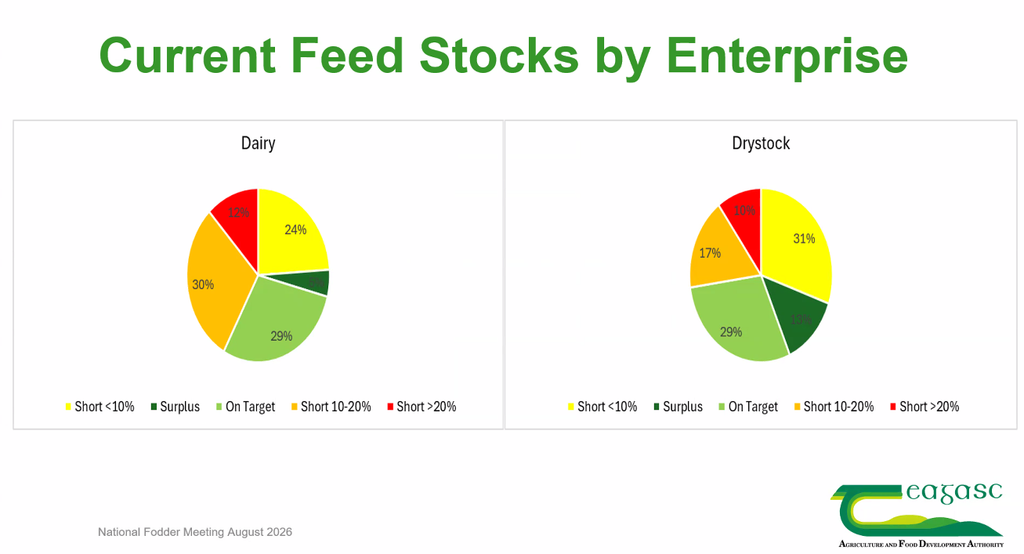
Dr Joe Patton, head of Dairy Knowledge at Teagasc, told the committee that overall 12% of farms in the country are currently 20% short of fodder.
This figure is based on a survey carried out by Teagasc of 396 dairy and drystock farms spread across regions.
"In any given year, that figure is generally around the 6% or 8% mark or even 10% of farms at that level, but it is higher than other years," he said.
Dr Patton said the biggest difference in this survey compared to other years is not those with the most severe shortage, but those who are between 10-20% short.
"Those are farms that probably had a feed reserve coming in to the year, have used it up, have done everything right from a farm management perspective, but just have hit maybe extra feeding in the spring, but certainly over July and the first couple of weeks of August, they have ate into their reserves.
"That 10% to 20% group is an interesting group, and I think it has to form part of our advice and our narrative," he said.
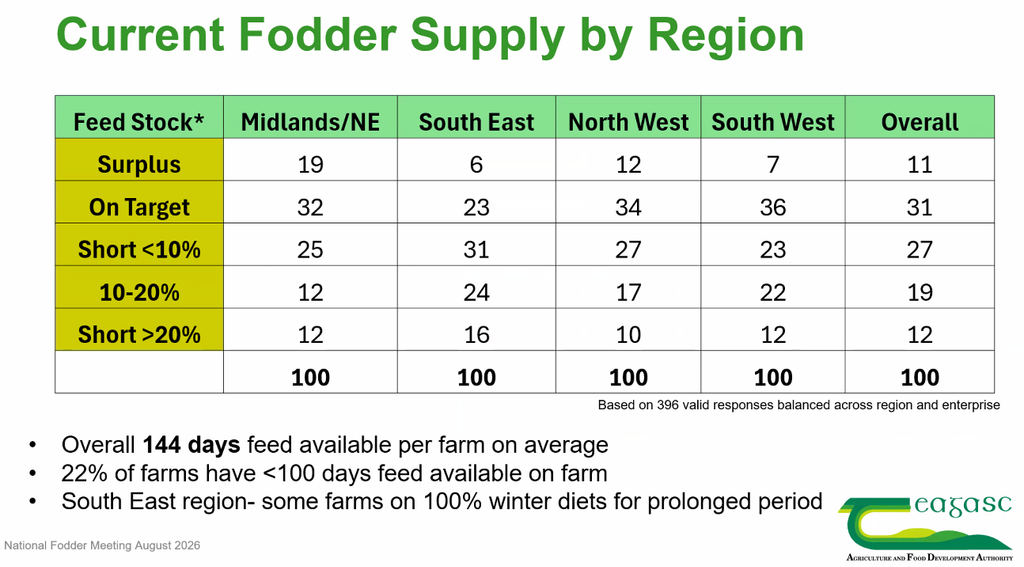
As expected, the survey shows the impact of the dry weather is being most keenly felt in the south-east where some farms are on full winter diets "for a prolonged period".
16% of farms in the region are more than 20% short of feed, while 24% are between 10-20% short.
While the situation is less severe in the north-west, midlands and southwest, Dr Patton noted there are certain farms in each region that need to be careful.
"There's feed in the country, but it's the distribution of it that's an issue.
"There's about 22% of farms in the survey had fewer than 100 days of feed available on farm as of last week, that's a concern," he said.
The survey shows that overall there was an average of 144 days feed available per farm.
Ailish Byrne, chief agribusiness officer at Tirlán, told the meeting the impact of the dry weather on farms has been an issue in the co-op's catchment area since the end of June.
A recent survey carried out by Tirlán showed that of the 852 respondents, 93% said there was "little or no grass" in their animals' diet.
82% of farms are currently eating into their winter fodder stock, while 77% do not have their full fodder requirements.
Tirlán is planning a further survey on Friday and is expected to repeat the survey on a fortnightly basis after that.
Fodder
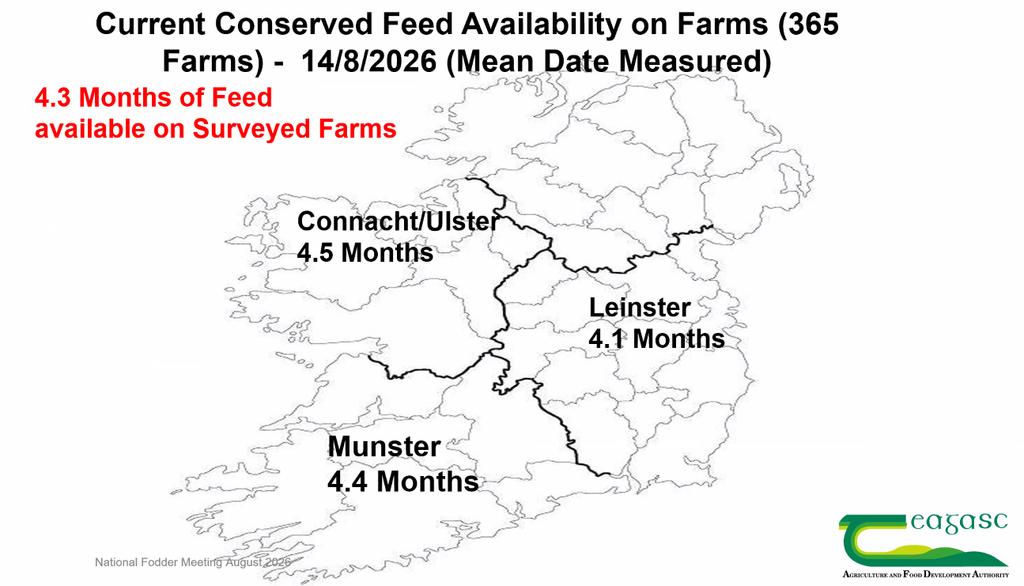
Michael O'Donovan, head of grassland science at Teagasc, said the latest data from another recent survey of 365 farms shows there is an average of about 4.3 months worth of feed available on these farms at present.
These figures breakdown on a provincial basis as 4.1 months for Leinster, 4.4 months for Munster and 4.5 months for Connacht and Ulster.
Feeding costs are running at around €4/cow/day, with that figure closer to €6/cow/day on the worst affected farms.
O'Donovan advised farmers to assess their feed stocks and plan for the winter period.
He said farmers should have a minimum of 5 months' worth of feed, with that figure increasing to 6 months in wetter areas.
He said farmers should begin sourcing feed where possible, identify stock to be retained for the winter and move saleable stock.
Teagasc advised farmers that the most important grazing management decision now is to be on a long rotation of 30-35 days.
This will ensure that farms are able to capatilise on nitrogen (N) mineralisation when rain arrives and that over-grazing does not impact grass growth.
O'Donovan said fertiliser should be spread on farms growing over 35kg/DM/ha, where rain has fallen and swards are green.
Teagasc said watery slurry should be applied at lower applications a rate of 2,500 gallons/ac or less to match grass growth requirements.
The meeting heard that slurry has built up on farms where cows are being buffer fed or housed early for feeding.
Farmers were urged to try empty slurry tanks before the closed period begins in October to avoid any capacity issues in the winter.
Committee
Mike Magan, chair of the NFFSC, told the meeting "we have the benefit of every warning system".
"We have a known risk. We don't have a crisis. We will have a crisis if we don't react to the known risk.
"I think that's not something that we would let happen because we are a responsible industry, and I think the fact that the minister is taking such an active role in this, we have to build on the minister's interest in this and use that commitment to our best effect," he said.
The committee recognised the additional workload, financial pressure and stress that these conditions are creating for farm families.
"Farmers should make use of the advice and supports available to them and talk to their adviser, their co-op, their bank and, importantly, to family, neighbours and fellow farmers," Magan said.
Magan recommended the committee meet again in the next two weeks.
Supports
Minister for Agriculture, Food and the Marine Martin Heydon told the meeting that "everything remains open on the table" in terms of supports for farmers impacted by the prolonged dry spell.
"My door always remains open in terms of any other suggestions or ideas or perspectives that people want to give to me," he said.
Earlier today, the minister announced increases in advance scheme payment rates in response to the prolonged dry spell.
The rate of advance payments has increased from 70% to 75% for the Basic Income Support for Sustainability (BISS), the Complementary Redistributive Income Support for Sustainability Scheme (CRISS) and the Eco-Scheme.
Minister Heydon also confirmed flexibilities on requirements for certain actions in the Agri-Climate Rural Environment Scheme (ACRES) and the Scheme of Investment Aid for the Development of the Commercial Horticulture Sector.
When asked about bringing forward the date for advance payments, the minister warned about the potential impact on the delivery of other scheme payments to farmers.
"I am very mindful that increasing to the maximum, the advanced payment percentage is a safer thing to do right now.
"It does address and it does acknowledge that challenge around the cash flow.
"But, again, everything remains open on the table, and we deal with this in real time," he said.