Sponsored
Dial Before You Dig: An essential first step to take before breaking ground

Sponsored by

Taking the time to ‘Dial Before You Dig’ will make your farm not just safer, but more efficient in the long run, according to Gas Networks Ireland.
Farm work is fast-paced, with tight deadlines, seasonal pressures and plenty of competing priorities. In that environment, it's easy for health and safety to slip down the list.
But taking shortcuts can have consequences, from costly delays and damage to farm infrastructure to serious injuries.
Gas Networks Ireland helps farmers and landowners manage these risks through its free Dial Before You Dig service.
The service provides advice and maps showing the location of gas pipelines, so excavation work can be planned safely.
Whether you’re a farmer, a landowner, or a contractor, this makes it easy to check whether there are underground gas pipelines on a site before you commence work.
Niamh Ryan, land and consent management manager at Gas Networks Ireland, works at securing the land agreements for gas infrastructure projects, including those crossing agricultural land.
A key responsibility for Niamh and her team is maintaining a clear and positive relationship with the landowners throughout construction and into the long-term operational phase.
The team also includes regional agricultural liaison officers who are available to assist landowners with any planned works on their farms.
“We don't want to stop landowners from progressing developments on their farms. We just want to make sure it's done safely," she said.
Wayleaves
Ireland's gas network stretches over 14,700km, running beneath towns, public spaces, and farmland.
Any work that breaks ground, from fencing and drainage to construction, carries the risk of striking a buried gas pipeline if its location has not been checked in advance.
When weather conditions are favourable, farmers and contractors often move quickly to get work done.
But underground infrastructure can present hidden risks, particularly where underground gas pipelines are involved, which are easy to overlook.
Information about their location can be lost when land changes hands or landscapes change, while the network itself remains out of sight.

Landowners should be aware of any wayleaves crossing their landholding. A wayleave is the agreed strip of land where a gas network transmission pipeline crosses your land.
Niamh explained: “A wayleave or easement is a legal agreement between Gas Networks Ireland and the landowner that allows Gas Networks Ireland to construct, lay, operate, inspect and maintain the gas pipeline.
“What's important to note is once we lay the pipeline, we reinstate the land and the land remains in the ownership of the landowner.
"Landowners can do their normal farming activities over the wayleave strip.”
However, when it comes to wayleaves, landowners need to be mindful that many everyday farming activities carry some risk, including:
- Installing fencing, gate posts or entrances;
- Carrying out drainage after wet weather;
- Deep cultivation or land improvement works;
- Ditches and drain cleaning;
- Forestry planting or removal.
Any damage to the pipeline under the wayleave strip may not just impact infrastructure - it can affect safety, lifestock, and day-to-day farm operations.
If a pipeline is damaged, farm work could be brought to a standstill until the damage is repaired.
The consequences can be severe, including serious injury or loss of life, disruption to critical energy supplies, environmental damage, and significant costs.
One mistake can affect not only those carrying out the work, but also neighbouring communities and businesses.
This is why checking with Gas Networks Ireland is so important.
Misconceptions
While farmers are acutely aware of the dangers of their work, pipeline markers at property boundaries should be viewed as indicators only.
Information about pipelines on the land needs to be clearly communicated to all parties.
Niamh stressed: “Most landowners know their land. They know there's a gas pipeline there; contractors will not know that.
“So never assume that a contractor is aware that there's a gas pipeline beneath the ground.”
There can also be confusion when it comes to tasks when working in the vicinity of a gas pipeline.
The Gas Networks Ireland representative highlighted that pre-work clarification is needed when it comes to ditch clearing or ditch cleaning.
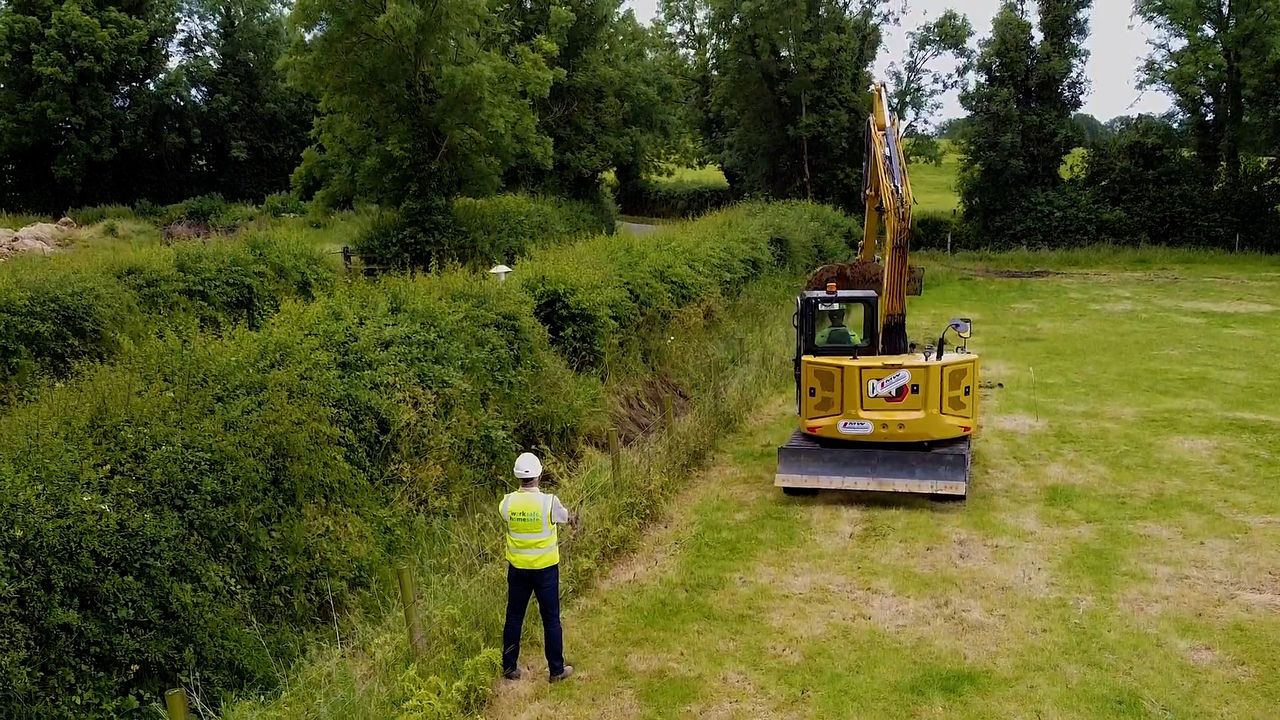
The most common agricultural encroachments involve drainage, ditch clearing, and drain clearing close to pipelines.
These may seem like normal farm maintenance, but they require particular care and planning when excavators and diggers are working near high-pressure gas infrastructure.
“There is a misconception out there that this doesn't require a contact to our Dial Before You Dig service,” she said.
“But it's absolutely a requirement any work that involves an excavator or a machine where you would have a bucket and clearing it does require a contact with Gas Networks Ireland, particularly where it's in the vicinity of the gas pipeline.”

Additionally, Niamh clarified that pipelines “don’t always run in straight lines between the two marker posts”.
She added: “Because of the topography, the pipeline can take a different route between the marker posts, which are simply there as a marker to say ‘there's a pipeline here in the vicinity’.
“But you really can't assume the exact location of the pipeline.
“Plus marker posts can be damaged: hedge cutters can sometimes clear them, and they can be overgrown by hedgerows.”
When should you dial?
Gas Networks Ireland shared eight steps when it comes to digging and dialling.
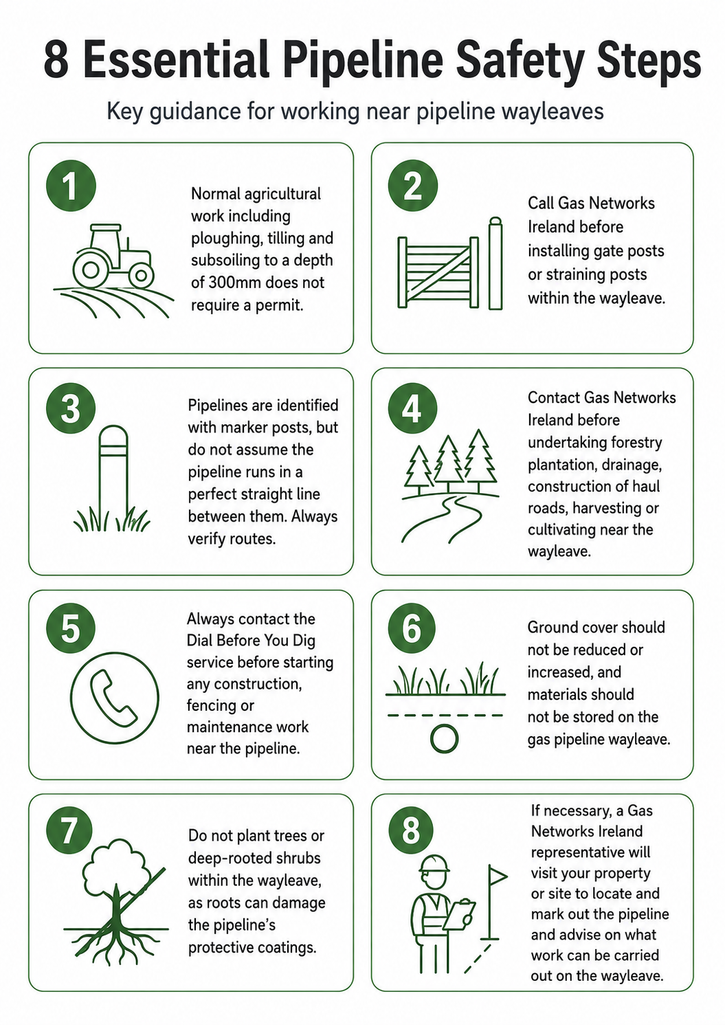
Easy and free
Checking for underground gas pipelines before you dig is quick, easy and free.
A call, email or online enquiry to Gas Networks Ireland is all it takes to find out whether there is a gas pipeline on your land before work begins.
"It's really an essential step to take those few moments before breaking ground and checking with Gas Networks Ireland," Niamh said.
Once you get in touch, the process is straightforward. Regional agricultural liaison officers can visit the site, provide advice, mark the location of gas pipelines, and supervise works where needed.
Maps are also available, along with practical advice tailored to the job you're planning.
"The key is to engage with Gas Networks Ireland early," Niamh said.
"We'll make sure we're out there and we'll help landowners as best we can.
"No matter what the job is, big or small, we're not there to prevent works. We're there to make sure the work is carried out safely.
“And it's a free service.”
When it comes to gas pipelines, Niamh said: “Ultimately, never assume you know its location.”
Remember the simple message to Dial Before You Dig.
It's a small step that can make a big difference, helping to avoid disruption, delays and unnecessary expense.
Gas Networks Ireland's Dial Before You Dig service provides information, advice and maps on the gas pipeline network.
If you’re planning or undertaking any excavation work, it is essential to check for the location of gas pipelines by calling 1800 42 77 47, emailing [email protected] or registering for a Dial Before You Dig Online account.
Dial Before You Dig Online makes it easier than ever to check whether there are underground gas pipelines on a site before you commence work.
Sponsored by