TU Dublin architecture students win FII timber design award

Forest Industries Ireland (FII) has announced the TU Dublin winners of its Future Timber Design Awards programme.
The awards have been developed by FII to encourage sustainable and innovative timber design and construction.
The programme, supported by the Department of Agriculture, Food and the Marine (DAFM), aims to "bridge the gap" between academic learning and real-world application when it comes to using timber in construction.
Timber design
The TU Dublin students were asked to explore the potential of timber as a primary structural and architectural material.
The projects had to focus on using homegrown timber as the main structural element, while responding to real-world constraints and design challenges.
Applicants were given 18 weeks to conceptualise and design their projects and were supported with drop-in sessions during the design phase.
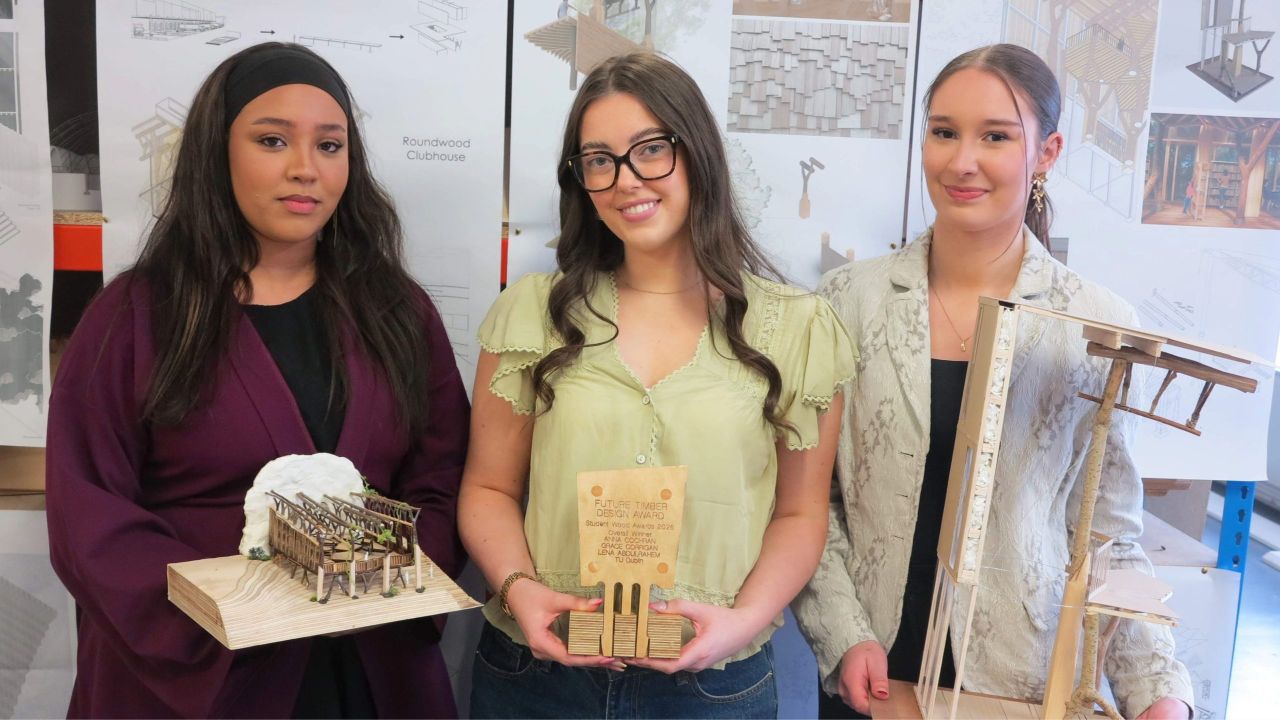
Architecture students, Lena Abdulrahem, Grace Corrigan and Anna Cochran were selected by the judges as the overall TU Dublin winners of the Future Timber Design Awards 2026.
For their joint project, the students took "as found" lengths of Irish-grown roundwood to create a freestanding building design, and created an abstract design generated through a system of timber elements that behave like a forest canopy.
The judges noted that by using locally sourced Irish timber, the project reduces processing, material waste and embodied carbon while maintaining strong structural performance.
The full list of winners at the TU Dublin Future Timber Design Awards is as follows:
- Overall winner: Architecture students Lena Abdulrahem, from Balbriggan, Co. Dublin, Grace Corrigan, from Tallaght, Co. Dublin, and Anna Cochran, from Greystones, Co. Wicklow;
- Best Architectural Concept: Architecture student Iulia-Maria Chiorean, from Dublin 9;
- Best Use of Homegrown Timber: Sustainable timber technology students Una Duffy, from Lea, Portarlington, Co. Laois and Cael Chanders, from Naas, Co. Kildare;
- Best Technical Realisation: Architectural technology student Aran Gahan, from Ardclough, Co. Kildare;
- Honourable Mention 1: Architecture students Anna Frawley, from Rush, Co. Dublin, Carlise Caffrey, Killarney, Co. Kerry and Henry Sexton, Skerries, Co. Dublin;
- Honourable Mention 2: Sustainable timber technology students Christopher McCann, from Stillorgan, Dublin and Seppyoggi Rutendo Mutetwa, Kildare;
- Honourable Mention 3: Architecture student, Conor Drinane, from Swords, Co. Dublin;
- Honourable Mention 4: Sustainable timber technology students Padraig Lowry, from Dublin, and Evan Farrell, from Athlone, Co. Westmeath;
- Trophy Design: Architecture student Clarenz Pedoche, from Mullingar, Co. Westmeath.
The entries were judged by TU Dublin lecturers and FII representatives.
The overall winner received a Future Timber Design Awards trophy and a €600 prize, while runners-up across different categories received cash prizes, with certificates presented to all participants.
Dr Sameer Mehra, programme coordinator of the BSc Sustainable Timber Technology and a lecturer in Timber Technologies and Wood Manufacturing at TU Dublin, said they were "extremely proud of all the winners"
"Their projects are powerful examples of how the next generation of architects, architectural technologists, and timber technologists are rethinking sustainability through timber design.
"By using homegrown Irish timber in creative and expressive ways, the overall winners have demonstrated how locally sourced materials can reduce environmental impact while helping to create a built environment that is both sustainable and deeply connected to place," Dr Mehra added.
Awards
Mark McAuley, director of Forest Industries Ireland, congratulated all of the award winners.
"This awards programme highlights the enormous potential of Irish-grown timber in the future of construction.
"Locally sourced timber can deliver not only sustainability and strong structural performance, but also ambitious, innovative design.
"Projects like these from our next generation of architects, engineers, manufacturing and timber processing professionals demonstrate why it is so important to cultivate skills development and to continue investing in and supporting Ireland’s forestry and timber industry," he said.
Des O’Toole, head of marketing and promotion at Coillte Forests, presented the awards to the TU Dublin students.
"The Future Timber Design Awards highlight the importance of industry and academia working together to support undergraduate learning and nurture the next generation of talent.
"By connecting education with real-world industry experience, we can provide students with stronger opportunities to grow and succeed.
"We’re also delighted that next year the awards will expand to welcome entries from other universities, broadening the reach and impact of the programme," he said.