‘Soil Cycle’ project aiming to boost slurry use in tillage farming

Teagasc's ‘Soil Cycle’ project, which aims to foster greater co-operation between the tillage, livestock, and farm contracting sectors, was officially launched at the organisation’s 2026 Crops Forum.
It is anticipated that the end result of the project will be the greater use of animal slurries as a fertiliser source for growing cereal crops.
Work to this end is already underway, with one year’s full results to be analysed over the coming months.
A final report will be published in 2029.
While a significant number of tillage farmers already apply slurry to cereal crops, the Soil Cycle will take this principle to the next level by actually quantifying the amounts of organic nitrogen applied to growing crops in real time.
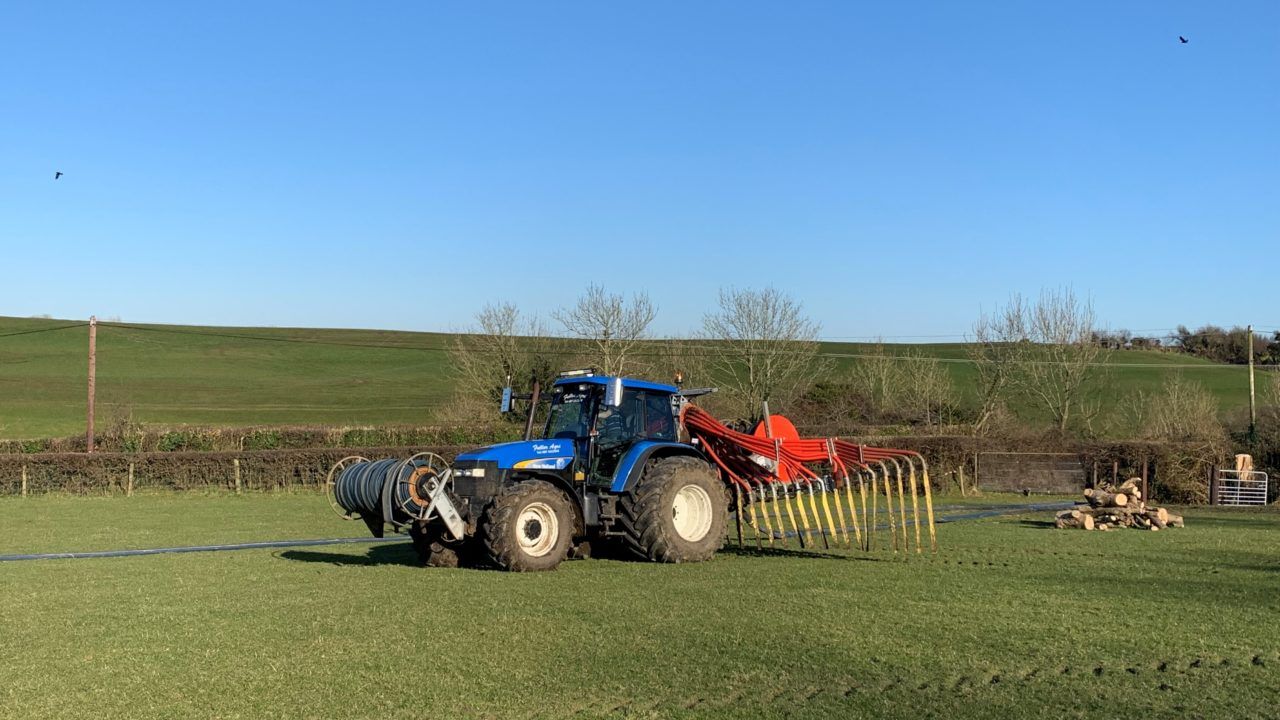
Slurry is applied using a low emission umbilical spreading system.
Soil Cycle is focussed on boosting nutrient recycling in Irish tillage by applying organic manures in-crop so as to improve yields, reduce chemical fertiliser usage, and cut environmental loses.
Farmer participation
Co. Kilkenny cereal grower, Andy O’Donnell, is one of the farmers participating in the project.
He runs a mixed farm near Gowran, focussing on tillage, sheep and horses.
The cropping enterprise comprises: wheat, barley, oats and beans. O'Donnell has been using min-till establishment techniques for the past number of years.
At the forum, he confirmed that applying slurry to cereal crops has paid a dividend, something he wants to build on for the future.
Slurry is applied to winter crops in the spring, aiming for growth stage 30, subject to conditions.
He values the slurry used at approximately €50 per 1,000gals applied. This figure comes down to €35 when spreading costs are deducted.
O'Donnell will use the savings accrued in fertiliser nitrogen costs to pay for a strategically located, aboveground slurry store on the farm.
Soil Cycle
Soil Cycle is funded under the European Innovation Partnerships (EIP) initiative.
It aims to improve nutrient efficiency, reduce nitrogen losses, and strengthen tillage-livestock nutrient recycling by shifting liquid manure application from autumn application to spring to coincide with peak crop growth.
Contractors are regarded as key contributors to the project as they will have the specialised slurry spreading equipment needed to ensure that organic manures will be applied in a precise manner.
The initiative will also see the trialling of these techniques using real time near-infrared (NIR) nutrient analysis under Irish conditions.