Plough-shaped chapel aims to reconnect people with horticulture

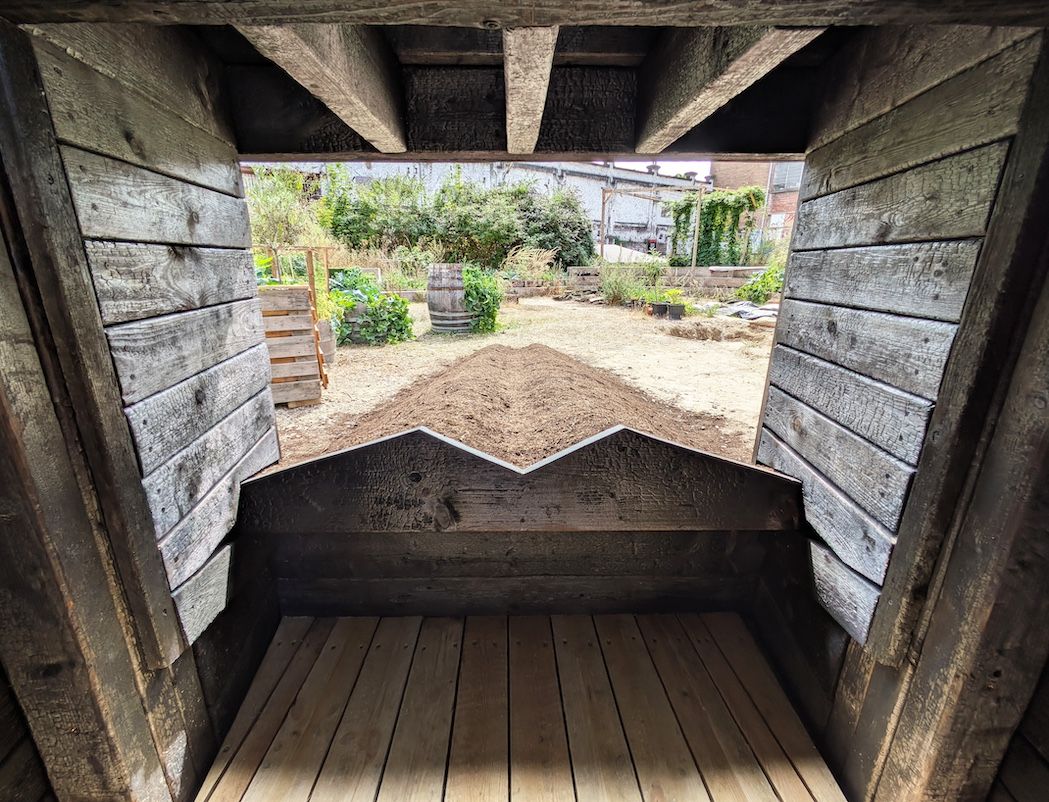
A Co. Clare designer who grew up immersed in farming has built a small chapel in Brussels shaped like a plough.
Kieran Donnellan from Newmarket-on-Fergus remembers his uncle, John Meehan, once hosting the local ploughing championships on his farm in Ralahine.
He said: "As kids we sometimes picked stones with him to improve the soil quality as he turned it.
"His father, and my grandfather on that side, was Mazo (Martin) Meehan, who was involved with setting up Macra in Newmarket and helped manage the agricultural shows (SJAI) in Newmarket and Clare."
Donnellan said his parents, Conor and Kathleen were involved with Newmarket agricultural show for years before the younger generation took over.
"My brother Michael and my cousins are still involved with the Newmarket show," he said.
Farming has been an importance influence on Donnellan's life, with both his parents coming from farming backgrounds, and his father keeping cattle for beef.
He said: "My grandfather used to have a wider variety of animals with a small amount of vegetables. I was working on the farm since I was a kid."
Chapel
These experiences are reflected in some of his work.
The chapel he designed on a voluntary basis for an international design event, MEDS workshop, was built by a team of volunteers.
"It is clad in timber that we charred black with blowtorches, the way the earliest wooden ploughs were darkened by the soil," Donnellan said.
"There's no altar in the usual sense: the ground outside is raised up and runs in through an opening as a bed of earth, with two furrows built into it.
"Local gardeners will sow and harvest it, so what you see from the seat changes with the seasons," he said.
The church stands in a community garden in an old industrial yard in Anderlecht.
It is located beside a rave bar which Donnellan said facilitated them by giving them somewhere to build it and access to electricity and services.
"It was built for almost nothing from donated, reclaimed timber or recycled from demolished wooden structures, by a team from 16 countries, most of whom had never used tools before," the designer said.
"The idea came from Irish traditions where soil and cultivation are something close to sacred, and the plough as the tool that shaped our landscape.
"The old lazy beds you still see on hillsides in the west are part of the same story."
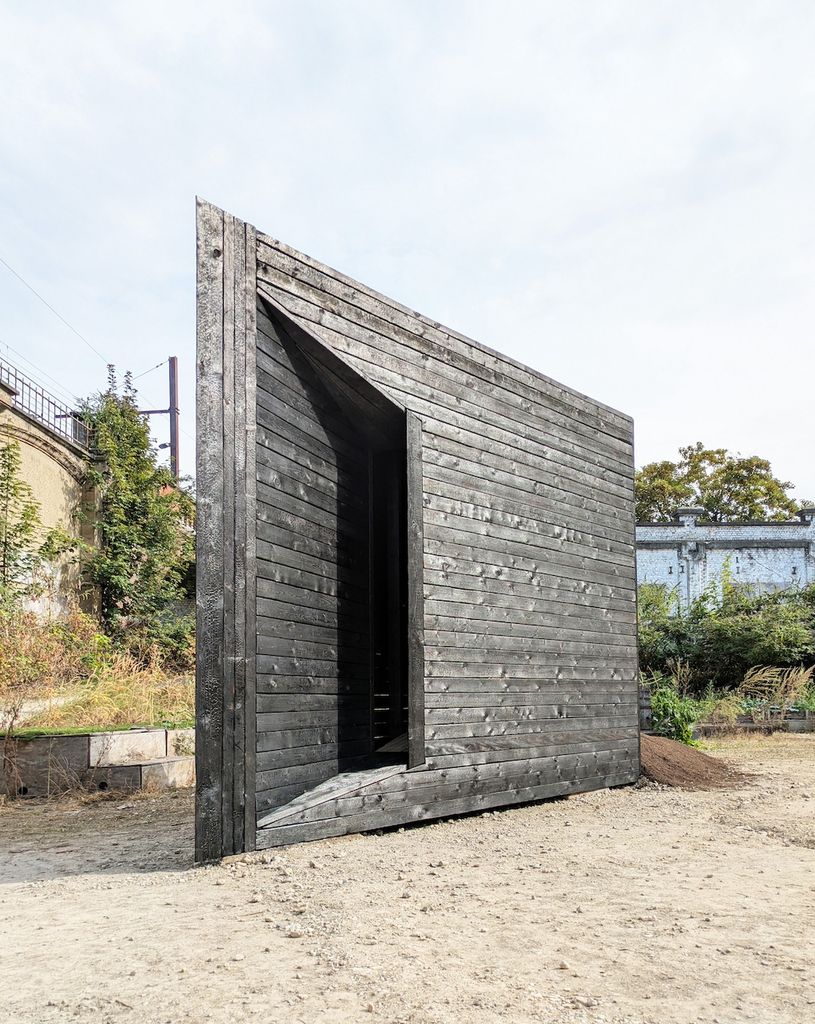
This is a non-denominational chapel, or place for reflection and meditation, that aims to reconnect people with horticulture.
It is a sequel to Donnellan's previous hilltop and sliding chapels, which featured on ArchDaily.
The sliding chapel was also listed as one of the best small chapels by ArchDaily in 2019.
The Anderlecht region of Brussels is now occupied by artists, musicians, craftspeople and the Fabriek rave-bar.
The chapel was built as part of an initiative to expand a hobby garden and re-green the harsh industrial landscape.
Layout design
The chapel's wedge-shaped form resembles a plough. Approached via a downward-sloping path, foliage obscures the view until visitors arrive at the sharp point of the charred wooden structure.
A narrow entrance with a ramped floor constricts the visitor, requiring them to turn sideways to enter, as they are simultaneously lifted upwards by the ramp.
"This was inspired by how a plough moulds earth, and the physical pressure involved," Donnellan explained, who had to compete in an open competition run by local organisers to get a place in the line-up.
At the top of the ramp, the floor plunges to become the backrest of a seat with a view to the garden.
The earth immediately outside is raised up and into the interior, presenting the ground surface like an altar, with the earth and living plants like offerings.
The shape of the furrows is built into the structure.
Local gardeners will plant and maintain the furrows based on their changing needs. As the vegetation grows, is harvested, and replanted, the view will change each season.
Overhead, the ceiling beams feature holes for the suspension of gongs and other meditative aids.
"Although flexible, the original suggestion was to have at least one meditative gong at each end of the interior space, activated by pulling natural sisal ropes in the viewport and utilising wooden pulley wheels.
"Local musicians and artists will install and change instruments over time," Donnellan said.
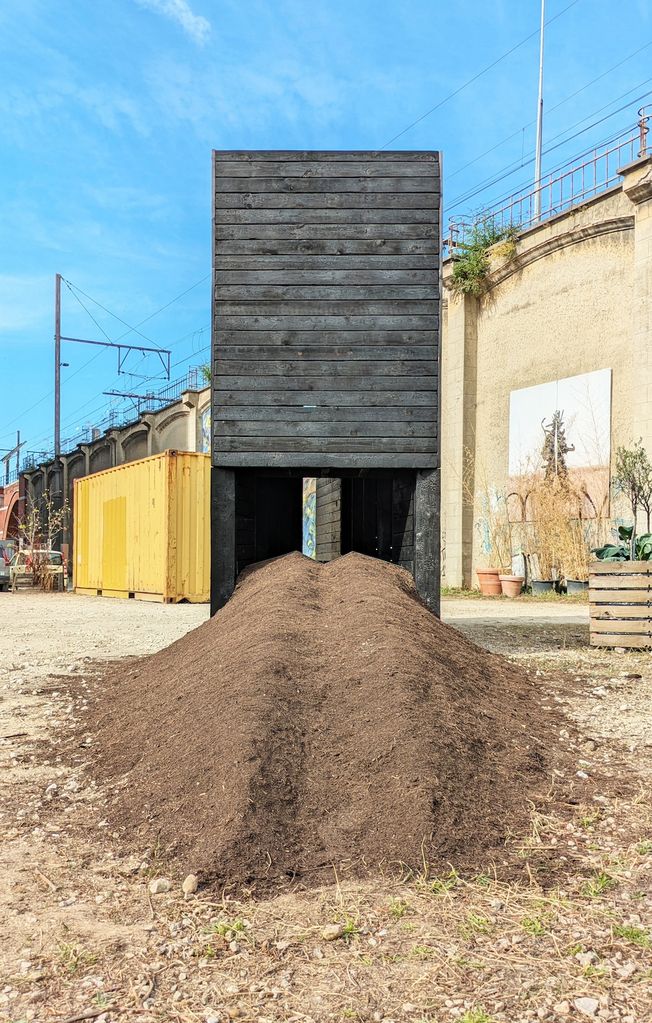
The external form has an intentional ambiguity, inspired by the circular nature of horticulture, he outlined.
"Although the sharp point suggests movement in one direction, the viewport at the other side resembles the mouth of a harvester and suggests movement in the other.
"This leads to the question - is this object creating the landscape behind it, or consuming it?
"This sense of latent energy is reinforced using charred wood. This also references prehistoric ploughs.
"The earliest were made from wood, absorbed grains of soil and took on a dark, earthy appearance," the Clare designer said.
Potted plants can be placed in two pits on the roof, to give the impression of a machine which has become covered in pockets of earth, and home to opportunistic vegetation.
MEDS workshop
The pavilion was designed by Donnellan in phases over many years and built at the MEDS workshop in Brussels by a team led by him of people from 16 countries and five disciplines.
A core group of 12 participants was supported by 10 tutor-support helpers, plus two main event organisers. During the workshop, the team designed plant layouts and other meditative instruments.
Donnellan who has ideas for a sequel to the plough chapel, is also a software engineer and is looking at the potential of robots in agriculture for his own company, Dakido.
"I'm just dipping my toe in by making a robot that I'm still designing," he said.