Next Water Action Plan an 'opportunity to turn the tide' on quality


Ireland's next Water Action Plan is an "opportunity to turn the tide on water quality".
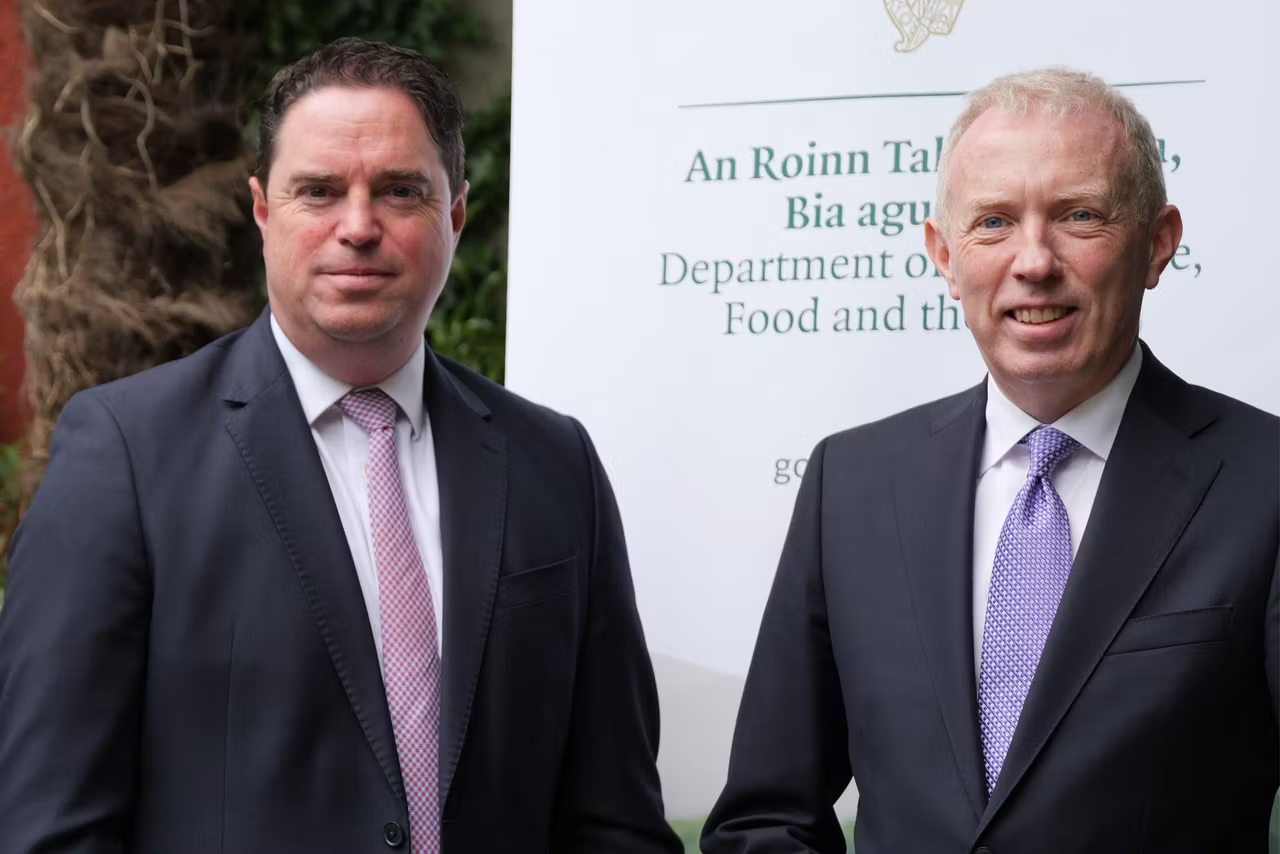
This is according to Minister of State for Nature, Heritage and Biodiversity, Christopher O’Sullivan, who spoke at the Environmental Protection Agency's (EPA) Water Conference today (Wednesday, June 17).
His comments come as the EPA has called for "faster action" on water quality as indicators show "little overall improvement in 2025".
The agency's Water Quality in 2025: An Indicators Report found overall water quality "remains unsatisfactory in many areas".
The EPA said that nutrient levels remain too high in "a large proportion of water bodies" and while improvements do occur, they are not being sustained.
"In some places the quality has improved, but these gains are being cancelled out by declines elsewhere," the report said.
'Wrong direction'
Minister Christopher O'Sullivan said that there have been "some pretty bad news stories" in relation to water quality over recent months and EPA reports that have indicated a lack of improvement.
He said that "when it comes to water quality, the ecological status of water, we have so much to do".
"That said, there are champions out there," Minister O'Sullivan added.
"There are organisations trying to fight that fight and who are trying to make improvements.
"There are developments and there are success stories that I think if we build on, we can see the tide being turned."
Nitrates Action Programme
The minister said "if the measures are followed and if tracked properly" the sixth Nitrates Action Programme (NAP) "can gain successes, as long as we ensure that there's enforcement, compliance, and that we support farmers in particular in terms of targeted measures".
Local authorities inspected 4,315 farms last year under the Good Agricultural Practice (GAP) for Protection of Waters Regulations.
This represents a 66% increase on 2024 and is 96% of the annual target of 4,500 inspections set by the EPA.
Minister O'Sullivan said that it must be ensured "that enforcement follows as well, and that everybody has adequate measures in place".
The minister said that "where targeted measures are taking place, where we're working with landowners, where we're incentivising landowners to put in place measures, we're seeing improvements in water quality".
"That's one of the big learnings," he said.
Water Action Plan
Ireland is currently in the early stages of preparing the fourth cycle of the Water Action Plan.
Minister O'Sullivan said this is a "key opportunity to learn from the failings of the third Water Action Plan and there were some - some things didn't work - but also learn from the successes".
"This is the best opportunity we will have to turn the tide on water quality," he added.
Dr. Triona McGrath of the National Water Forum spoke about the forum's vision for the next Water Action Plan.
The forum is a national stakeholder body set up by the government to facilitate stakeholder input to water policy development and to water management.
Dr. McGrath said the forum had a lot of discussions focused on agriculture and what should be proposed for the sector for the next action plan.
She said: "For agriculture, we'd like to see more training on non-derogation farms, aligning messaging from farm advisors, and supporting the family farm model".
She said the forum is seeking for any agricultural measure to be "linked to specific outcomes, to specific pollutants, so that it's very transparent for farmers, farm advisors, for stakeholders looking in what it is those measures are intended to achieve", she explained.
Derogation
"We think that there's a lot of focus on derogation and is a missed opportunity for targeting education and advice to non-derogation farmers," Dr. McGrath continued.
"We would like to see more training and advice on nutrient balances and water-based nitrogen use efficiency for non-derogation farmers, particularly those higher-stocked, for example over 130kg of nitrogen per hectare."
She said the forum would also like to see "more education for every farmer across the country", and an "education campaign on catchments, on water quality, on the targeting of measures to deal with specific issues".
"We think the best opportunity to do that is through the Basic Income Support for Sustainability (BISS) applications, that almost captures every farmer in the country," she explained.
"I'm told that every February, every farmer receives an envelope in the post with a detailed map of their farm and what we would like to see is in that same envelope a map of the catchment, and information about local water quality issues and the types of measures that would be needed."