Is it Elon Musk vs farmers in the next EU Budget?

Taxing large technological companies, such as the one owned by Elon Musk, operating within the European Union, could potentially contribute to farmers receiving better funding under the Common Agricultural Policy (CAP).
The proposal to generate more money for the EU bloc of 27 member states has been suggested by the European Parliament.
The European Commission, on the other hand, is suggesting a fee on all large corporations with an annual turnover of more than €100 million.
A second suggestion from the commission is that the EU should introduce a 'tobacco tax'.
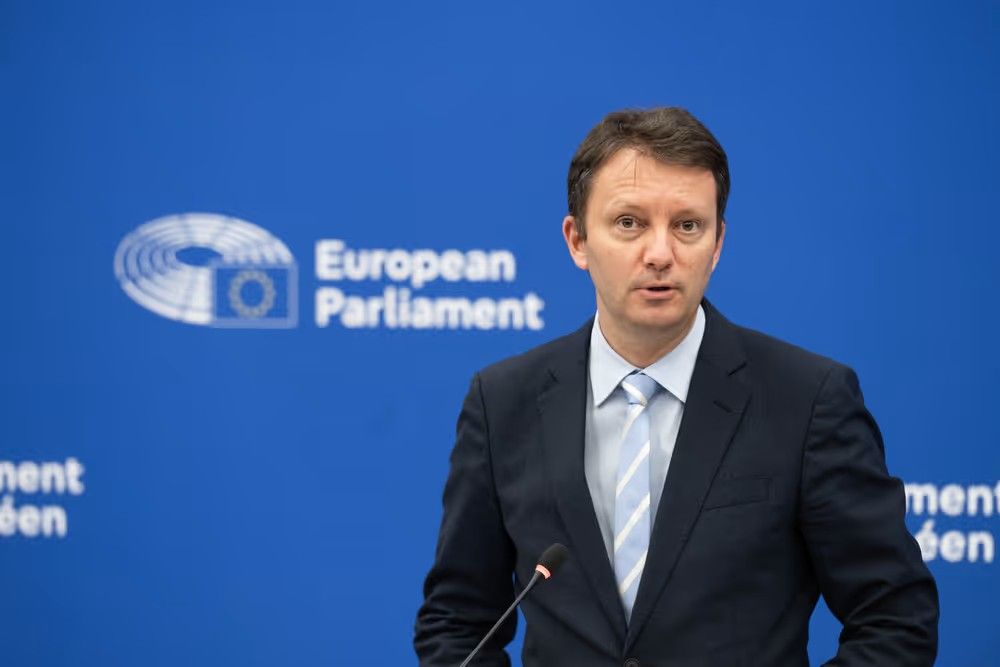
However both of those proposals have been described as "controversial" and "counterproductive" by MEP Siegfried Muresan, a Romanian politician who is the European Parliament's co-rapporteur for the post-2027 long-term EU budget, known as the Multiannual Financial Framework (MFF).
Speaking to Agriland at the European Parliament in Strasbourg this week, Muresan said the only way to ensure CAP funding remains the same, without cuts, is if the EU can generate new income from its "own resources".
EU Budget
Essentially, the EU does not have enough money for the period 2028-2034 to fund all of the demands being placed upon it, especially with priorities such as competitiveness and security.
Therefore, certain areas of the EU Budget will have to be cut, or alternative sources of additional income will have to be sourced.
The suggestion of the EU raising its own money has been recommended because several member states have outlined that they are not in a fiscal position to increase their contribution to the EU - which, up to now, has been the main source of income for the MFF.
Muresan said: "If there are to be own sources of revenue, they have to be uncontroversial and accepted by all member states."
In relation to the fee on all big companies with an annual turnover of €100 million, Muresan said: "€100 million sounds like a big amount, but in fact, when companies would fall under that threshold... we can't be serious about improving the competitiveness of the Union while at the same time we charge all of Europe's larger companies.
"We think such a measure would be counterproductive and I think it's impossible to get an absolute majority in the parliament in favour of such a proposal."
In relation to a potential 'tobacco tax' Muresan said that many member states, particularly in southern Europe, oppose this proposal.
"It looks like the proposals of the European Commission are controversial," Muresan explained.
Alternative ways to raise EU funding
In contrast, the European Parliament has put forward three ideas which its MEPs have recommended to raise more money for the EU Budget.
The three proposals are as follows:
- A digital levy, basically on tech companies;
- Tax on gaming and gambling online initially, then moving to offline gaming and gambling;
- Tax on profits from cryptocurrency transactions.
"The digital levy could be done in different ways. For the time being we, as the European Parliament, have asked the commission [about] potential ways to do it," Muresan said.
"We have to look into different possibilities; whether there is a leaner way to introduce it.
"Our aim is to produce predictable sources of revenue without affecting the investments that digital corporations are doing in Europe," he added.
If member states do not have the fiscal space to pay more into the EU Budget, Muresan said that the choice should then be "easy"."
"Either we look into charging the global technological giants, which are the biggest global corporations right now, a tiny little fee for their free access to the single market, or we reduce funding to farmers, to research, to innovation, to our security.
"We think cutting farmers will weaken Europe, will weaken our Union and we think that's a mistake and I think many people wouldn't understand why we would cut funding to farmers... just to allow Elon Musk free access to our single market."
The co-rapporteur said that new funding for the EU Budget via a digital levy should be sourced in a way that does not endanger growth or job creation.
Agreeing EU Budget during Ireland's presidency?
Ireland is now hosting the presidency of the EU until the end of December this year.
During that time, Ireland will act as an 'honest broker' in terms of negotiations on myriad issues, not least of which us the agreement on an EU Budget.
While agreeing a budget among all member states by the end of the year, so as to allow work on drafting legislation to begin next year, seems challenging, Muresan said it would be far better to get it agreed as soon as possible.
"The sooner we agree on it in Brussels, the better," he continued.
"2027 will be an electoral year in four of the five largest member states in the Union.
"[It would be] very difficult to agree on a budget while four of the five largest member states in the Union are campaigning, this is why the Irish Council Presidency comes at an essential time."