How can agri-innovation be made more inclusive for Irish women?


Nine policy priorities have been identified to help unlock the potential of women-led innovation in Irish farming and rural areas.
New research from the University of Galway, Longford Women's Link and Teagasc has identified the areas in which more support is needed by women farmers and innovators to make agriculture more inclusive.
The research sets out recommendations across nine key areas, including: finance; skills; digitalisation; gender inclusion; the Common Agricultural Policy (CAP); generational renewal; representation; women's empowerment; and work-life balance.
The policy priorities come against a backdrop of persistent gender inequalities in agriculture.
According to the European Commission, women account for 31% of CAP beneficiaries, but receive just 15% of total CAP payments, while men, who account for 63% of beneficiaries, receive 69% of funding.
Farm income statistics also show female-run farms earned an average of €18,700 per worker in 2023, 42% less than male-run farms, with the income gap widening that year.
Women’s experience
The research is presented in a series of policy briefs, developed as part of the three-year Female-Led Innovation in Agriculture and Rural Areas (FLIARA) project, which was funded under Horizon Europe.
The policy briefs were launched by Maria Walsh, Fine Gael MEP for Midlands-North-West.
She said: "As the European Parliament's lead negotiator on generational renewal in farming, I see every day how much we need the evidence in front of us if we're serious about building a fairer future for Irish and European agriculture.
“These policy briefs put women's experience and innovation at the centre of that conversation, and I'm proud to launch a series that gives policymakers like me the tools to act, not just acknowledge the problem."
The policy briefs are published to coincide with the United Nations International Year of the Woman Farmer.
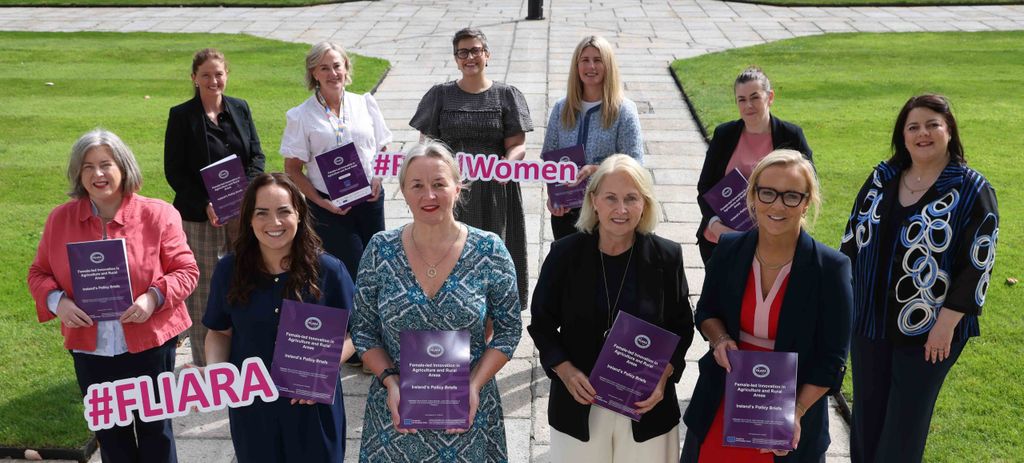
They will be shared with the Department of Agriculture, Food and the Marine (DAFM) and the Department of Rural and Community Development, as well as local action groups, the Irish Farmers’ Association, the Irish Creamery Milk Suppliers’ Association (ICMSA) and women’s farming organisations
FLIARA
The Irish FLIARA team is led by University of Galway’s Prof. Maura Farrell and includes Dr. Aisling Murtagh and Louise Weir (University of Galway), Tara Farrell (Longford Women's Link) and Anne Kinsella (Teagasc).
Prof. Farrell said: “In this year of the International Year of the Woman Farmer, we are delighted to produce a policy brief series that reflects not only the needs of women farmers in Ireland but also what is needed by women engaged in innovation both on and off farms.
“This series translates the lived experience of the women who took part in FLIARA into clear, actionable recommendations, and we hope it gives policymakers the evidence they need to make Irish and European agriculture a genuinely more inclusive place to work and innovate.”
Policy issues
The recommendations arising from the research reflect the following policy issues:
- Access to finance at the right level and at the right time described as important to the development of women-led rural and farm innovation;
- Education and skills training opportunities should be better tailored to the needs of women-led rural and farm innovation;
- Women's empowerment: Greater policy focus needed to address barriers to equality between men and women and support women's participation in rural and farm innovation;
- Strengthening the voice of rural and farm women: Better representation of women in governance and decision-making is needed to improve gender equality;
- Work-life balance: Policy action is needed to support women balancing work, family and wider life demands.
Other policy requirements were in the spheres of technology and innovation. These include:
- Better leverage of digitalisation: Policy should better support women in agriculture and rural areas and use digitalisation to empower them;
- Improved gender inclusion in agricultural knowledge and innovation systems (AKIS): Services should better recognise women's needs and the gender-related impacts of AKIS interventions;
Policies that are topical in Brussels were also mentioned, specifically:
- CAP and gender: Women should be recognised as equal partners across each element of the CAP Strategic Plan 2023-27, to incentivise and recognise their current and future roles and potential;
- Generational renewal: Addressing the gender gap is part of the wider challenge of generational renewal and the future sustainability of Irish farming.
Co-researcher on the FLIARA project, Dr. Aisling Murtagh said: "Women are already driving innovation across Irish farms and rural businesses, often without the recognition or support to let it flourish.
"These briefs give policymakers a concrete starting point for closing that gap."
The recommendations draw on research and engagement with women farmers, rural innovators and other stakeholders throughout the FLIARA project, including case studies, policy assessment and future foresight research.
Prof. Farrell continued: "Combining foresight work, case studies and direct engagement with women farmers, we offer recommendations that are grounded and forward-looking, not a list of problems, but a roadmap for more inclusive agricultural policy.”