What is the expert advice for dry-off?

It is hard to think that dry-off is only around the corner, but there is no denying how quickly it is creeping up, so it is best to get prepared now.
Realistically, a lot of farmers do not think about drying-off procedures until it is time to actually carry out the task, as they follow the same routine year in and year out with the mindset that it is a straightforward task.
However, if farmers are not prepared before drying-off commences, they could face some difficulties with procedures such as selective dry cow therapy (SDCT), and find themselves left dealing with somatic cell count (SCC) issues in the following lactation.
Munster Bovine recently held a webinar for farmers highlighting some top tips for a successful dry-off ahead of the dry period.
Successful dry-off
The majority of cows need a minimum of six weeks dry, but farmers should aim to give them eight weeks to build energy reserves and condition before calving.
Cows which are under conditioned with a body condition score (BCS) below 3.0 to 3.25 at drying off may need up to 10 weeks to fully recover; the same goes for first lactation heifers.
If they do not get this time, they are liable to have a difficult calving and end up in a negative energy balance post-calving, which will in turn deplete their production.
Therefore, early planning is required to ensure you have a successful start to the milking season next year.
The best farms in terms of SCC will tell you preparations begin in March, when the first milk recording of the year analyses the success of the previous dry period, and where they need to improve for the coming season.
This early milk recording is something Don Crowley of Teagasc emphasised during the webinar.
Without milk recording, farmers essentially are working blind when using SDCT, which as a result may cost more than the €10-€17 per cow it costs to milk record in the first place.
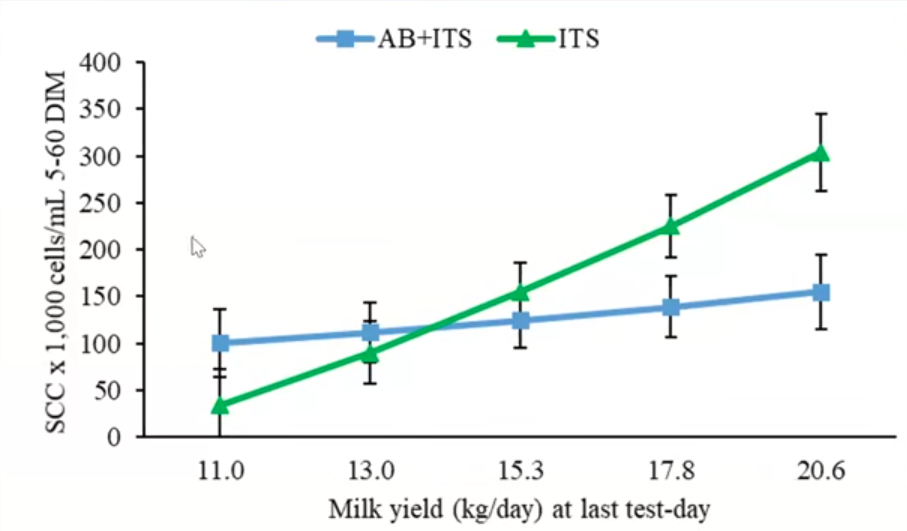
Previous Teagasc studies have shown that herds being milk recorded have a gross margin of approximately €39 higher compared to those that do not record, with higher yielding cows producing lower somatic cell counts (SCC).
By reviewing the results from these milk recordings and following the traffic light systems, you can determine which cows may need to be culled; which cows should be dried off early to rebuild tissue in the udder; and which cows will and will not need antibiotic treatment.
When speaking about the first milk recording, Crowley said: "I think there is a real lack of understanding of the importance of this recording."
He noted how many farmers are waiting until May when the majority of the herd is calved down, but they are not getting the full analysis of how the dry-off went, meaning improvements are never made.
Best practices
Once these results have being recorded and read to suit dry-off and cull cow strategies, farmers must begin to plan around the best practices when drying-off.
Farmers need to be aiming to dry cows at a production level of 9L per cow/day.
However with some farmers still pushing to finish out the rotation and supplementing with concentrates, a lot of the herd may be up around, if not over, the 15L/day mark.
It is important to quickly reduce that production level for any cows ready for dry-off by ceasing concentration feed and moving to once-a-day milking.
Before bringing cows in for drying-off, you need to ensure hygiene is at a top standard by thoroughly cleaning housing, holding yards, milking parlour, and even the cows themselves, such as clean udders and clipped tails.
Crowley also highly recommended taking milk cultures to find out which bacteria is the enemy.
He noted that the tube should not be held under the cow, instead the milk should be squirted out to meet it to prevent contamination.
When dry-off comes around, milk the cows as usual in the morning and carry out Californian milk testing (CMT), then draft them out in small batches afterwards to be dried off, ensuring you have enough help for the task.
When drying, use a pair of white gloves to show up any dirt, thoroughly wash all teats and sterilise with a cotton ball and surgical spirits.
The front two teat (furthest away) should be sterilised first to avoid any contamination, followed by the back two, then the tubes should be administered starting with the back two and working to a front two in a routine pattern, but follow the pattern which suits you best.
Do not touch the nozzle of the tubes when opening them; once opened insert into the teat canal, remember antibiotics should be massaged into the quarter but teat sealant should not.
Dip all teat after sealing, then leave cows in a clean dry yard for at least 30 minutes while the teat seal, before heading to clean housing.
Remember, hygiene and patience are the most important factors to maintain during drying-off.
Selective dry cow therapy
Both Crowley and Dennis Howard of Munster Bovine noted that they regularly get asked what the SCC threshold for selective dry cow therapy should be set at.
First things first, any persistently infected cows, recently infected cows, or recently cured cows, should all go forward for antibiotics and teat sealer.
Crowley reminded farmers to look through reports thoroughly and be smart with decisions when it comes to SDCT.
He noted how there is no point in choosing risky cows which could put your business at risk.
In terms of healthy cows, the threshold for SDCT depends on the farm, but the rule of thumb is, the higher the bulk tanks SCC, the lower the threshold should be.
For example, a farm with a bulk tank SCC of 200,000 cells/ml should set their threshold at 40,000-60,000 cells/ml.
However, a farm with a bulk tank SCC of only 80,000-100,000 cells/ml could stretch their threshold out as far as 100,000 cells/ml.
If everything is done properly, there should be less than 10% of the whole herd calving down infected next spring.