Watch: Could livestock be vaccinated to reduce emissions?

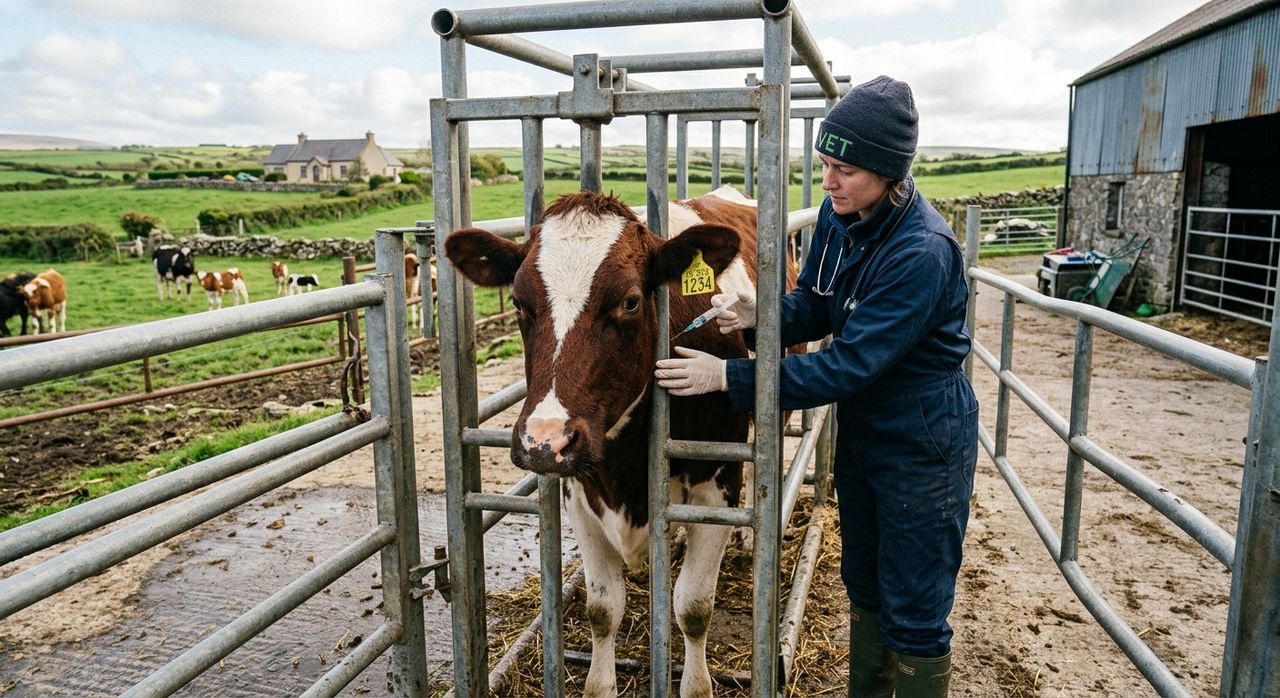
Could livestock be vaccinated to reduce emissions? This is just one question being explored by scientists in the bid to address climate change and help agriculture reduce its carbon footprint.
Dr. Sinéad Waters, principal investigator and lecturer at the University of Galway is involved in ground-breaking research which has the potential to help agriculture address its methane emissions.
Her work centres on ruminant microbiomes, with a particular focus on improving productivity while reducing greenhouse gas (GHG) emissions.
She leads and is involved in a number of research projects looking at methane reduction in Irish beef and dairy farming.
Agriland visited Dr. Waters at her laboratory at Univesrity of Galway to find out what farmers need to know about how science is trying to help them - see video below.
One of the projects which Dr. Waters is involved in is the MAGS (Methane Abatement in Grazing Systems) project, which is looking at different ways of reducing methane from cattle in Irish grazing systems.
This includes looking at genetics, diet, feed additives and manure management.
Other research also looked at feed additives and dietary approaches, including seaweeds, fats and 3-NOP, as well as newer technologies such as slow-release supplements and boluses.
There is also research into alternative dietary approaches, including the use of rapeseed cake and oil to reduce methane without affecting animal performance.
Science in a practical way
Dr. Waters grew up on farm and with a deep interest in science, she secured a degree in biotechnology from the University of Galway.
She also undertook a PhD around probiotics in conjunction with Alltech and subsequently completed a postdoc at the University of Illinois, before returning to Ireland to work at Teagasc, where she spent almost 20 years.
At this time, Dr. Waters also completed a higher diploma in statistics at Trinity College Dublin.
Around two years ago, the researcher moved to the University of Galway to become principal investigator, researcher and lecturer in microbiology.
"My particular research interest is rumen microbiology or digestive microbiology," she told Agriland.
"Looking at that in the context of discovering new methane mitigation strategies for agriculture."
The researcher explained that methane production in cattle and sheep is a microbiological process that "we cannot lose sight of".
"We need to understand the microbes involved and the biological processes involved in the production of methane gas, so that we can interrupt that process in a way that is not detrimental to the animal or doesn't affect digestive feed or animal health," she said.
"By understanding that process we can devise potential strategies, be it... breeding strategies, the feed additives or direct fed microbials, that can reduce that methane production process."
Waters explains that research has already led to practical on-farm measures which farmers have adopted to reduce methane emissions.
These include feed additives such as Bovaer and others, breeding programmes, which are a little more longer term but are already seeing progress and manure additives which have proven to be successful.
Rumen research
University of Galway is part of a new European Union research project that will advance sustainable ruminant agriculture through microbiome science.
Rumen-Innovate is a consortium including 11 universities and research bodies as well as farming organisations and industry in eight countries across Europe to support the training and development of the next generation of ruminant microbiome scientists.
With EU funding of €4.8 million, the project’s focus is on cleaner air, more sustainably produced food, and healthier animals.
"Bringing [research projects] together for the life cycle of an animal to see how much methane we can reduce over the lifetime of the animal will be successful in getting proof that they work, giving us insight into the levels of reduction and building these into the national inventory," Dr. Waters explained.
She added that methane reduction is possible with various research projects underway, natural attrition of the national herd, the nitrates derogation regulations.
Vaccinating for emissions?
Dr. Waters has admitted that the suggestion of vaccination in Ireland to help animals produce less methane would be "ideal".
"Of course vaccination would be ideal. It would be really good for a country like Ireland or New Zealand, where you could vaccinate your calf or lamb very early in life and the animal is potentially vaccinated with antibodies against methanogens," she said.
Basically, a methanogen is a microscopic, single-celled organism that produces methane gas as a by-product of how it gets energy.
Potential vaccines could stimulate a cow’s immune system to produce antibodies in its saliva, targeting and suppressing methanogens in the stomach without harming other beneficial gut microbes.
Dr. Waters said that there is research ongoing internationally on such an approach which would allow farmers not to have to worry about methane after early life of the animal.
Interested in finding out more?
This year University of Galway will attend Ploughing 2026 to showcase the ongoing research that is underway at the college.
"We're going to be talking about all the projects, MAGS, Rumen Innovate and others and we'd love the public to come in an meet us," Dr. Waters said.
There will also be information on agricultural education as well as farm safety, in conjunction with the Ryan Institute.
University of Galway will be located at Block 4 Row 10, stand 190 at Ploughing 2026 in Screggan, Co. Offaly from Tuesday, September 15 to Thursday, September 17.