Record 1m calves genotyped in 8 months


Ireland’s National Genotyping Programme has surpassed one million calf genotypes in 2026 alone, according to the Irish Cattle Breeding Federation (ICBF).
The programme has seen rapid uptake since its launch in 2023, with nearly half of all calves born this year now genotyped.
In 2025, the year finished up with a total of 866,781 calves genotyped.
In March 2025, the programme surpassed a total of one million genotyped calves since its launch, a milestone which has now been smashed in the duration of eight months.
As it stands, 2,080,085 calves have been registered in 2026, which is just over 92% of 2025's total calf registrations figure, which stood at 2,254,133.
National Genotyping Programme
ICBF said the programme is the first of its kind globally, as it integrates DNA results directly into calf registration, and is now one of the largest cattle genotype databases in the world.
The federation said the strong uptake is a sign of progression towards full national genotyping, where every calf born in Ireland will have DNA-verified parentage and sex at birth.
Genomic information is said to allow for increased accuracy of breeding values, especially for young animals with limited performance records.
As well as that, genotyping allows for earlier identification of high-potential animals and accelerated genetic gain.
The programme also allows farmers to make more informed breeding decisions, and identify major genes and traits of economic importance.
The federation has said all of these factors and its continuous innovation in genetic evaluations is helping to strengthen Ireland's national herd performance, while also helping farmers to meet the evolving challenges of sustainable and efficient farming.
ICBF has said one of the most significant benefits it sees with calf genotyping is the identification and correction of registration errors.
The following graph published by ICBF shows the level of parentage and registration errors identified across the 1 million calf samples processed this year so far.
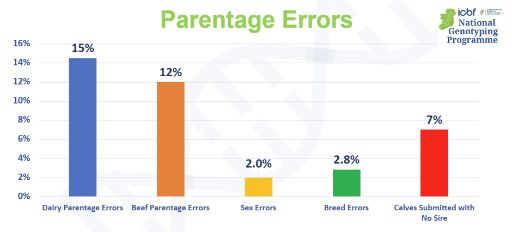
The graph shows that 15% of dairy calves born in 2026 were detected to have parentage errors, while 12% of beef calves born were also detected to have parentage errors.
This means that either the sire or dam predicted by DNA differed from the parentage recorded at calf registration.
The graph also highlights how 2% of calves born so far this year have also had a DNA-predicted sex that differed from the sex recorded at registration.
ICBF noted that by incorporating DNA results directly into the calf registration process, both parentage and sex errors can be identified and corrected quickly, helping to avoid additional paperwork and reducing the need for passport amendments.