Sponsored
Now's the time to think about seed

Sponsored by
With harvest upon us and decisions on cropping to be made, whether that is a cover crop or a winter crop, ordering high quality seed is vital.
Seed is the first input in crop production. It should be pure and clean from invasive weed seeds.
Ordering Irish certified seed is an insurance policy for your farm. It makes up a small percentage of the cost per acre.
Blue label seed multiplied in Ireland has a zero tolerance for grass weeds.
Irish Seed Trade Association (ISTA) members adhere to a Higher Voluntary Standard above European Standards for blue label seed and for any cover crop seed they assemble.
Ensure any seed for cover crops that you sow on farm is ‘Higher Voluntary Standard’ – it has been assembled by an ISTA member and tested for the presence of grass weeds.
Check it states that it adheres to Higher Voluntary Standard on the label.
Never risk bringing in a weed problem by compromising on seed quality.
Grassweeds
Farmers must now be very vigilant to the possible presence of grassweeds in crops and the resistance of some of them to herbicides.
The first incidence of resistance to glyphosate was confirmed in Italian ryegrass by Teagasc Oakpark in the spring of 2025 and blackgrass was made a noxious weed in May 2025. Wild oat resistance to herbicides is now also evident in certain areas.
Farmers and all in the industry should be able to identify problem weeds and task their agronomist also with monitoring and management.
Walking crops on a regular basis between final fungicide and harvest is vital.
Waiting for the problem to become so widespread that the crop can not go to harvest or patches must be destroyed incurs serious losses.
Badly affected land ends up in grass to try control grassweeds, meaning a loss to the tillage sector.
Quality seed
It may not be immediately obvious but post-harvest is an ideal time to start addressing weed problems on farm.
Cultivating problem areas will encourage growth of seeds present so they can be destroyed ahead of sowing.
If incidences involving grass weeds such as Italian ryegrass, blackgrass and canary grass become established, a comprehensive plan must be developed with professional advice to guide a way out.
Farms need a proactive approach to preventing these weeds entering or becoming established on farm.
One key measures in this is the use of certified seed at sowing. Irish certified seed has a zero tolerance to these grass weeds along with wild oats and sterile brome.
This is contrary to imported seed, which often has higher tolerance levels of certain weed seeds.
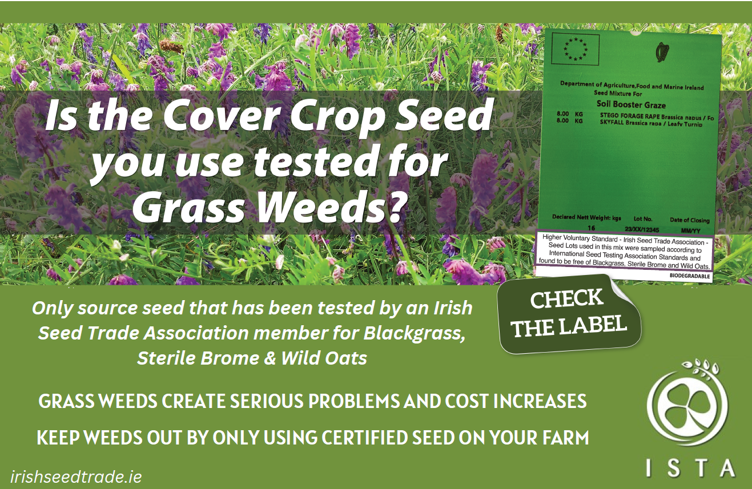
Native Irish cereal seed is first generation blue labelled seed. Higher Voluntary Standard Cover Crop seed states this on the green certification label.
Certified seed growers, under their growing protocols with the Department of Agriculture, Food and the Marine, must adhere to previous cropping and boundary requirements and as no weeds are tolerated in seed fields they must make a significant time commitment to rogueing weeds.
The crop undergoes a series of inspections including multiplication seed lots used, inspections during growing, at harvest and ahead of final certification when bagging seed.
Preventative measures
There are several other preventative measures to protect crops. It is widely accepted that combines and balers are the biggest spreaders when moving from farm to farm and even field to field.
Machine hygiene can have massive impact on spread of grass weeds, which have tiny seeds with extremely high numbers per head.
As farmers, we must have processes in place to properly clean down machinery before leaving a field.
Where contractors or hauliers are in use, it is vital they have the same processes in place. They should also made aware of problem areas.
Farmers should also monitor any inputs brought onto farm, such as knowing the source and possible content of farmyard manure.
The Irish Seed Trade Association represents licensed multipliers of certified seed. Our members are proud of the massive investment they make into trialling and testing varieties of seed suited to our growers and end users. The association promotes the use of certified seed and advocates for further development of the tillage sector though its contribution to policy and investment in plant breeding and research.
Sponsored by