New EU Livestock Strategy: What you need to know

The European Commission today (Tuesday, June 7) unveiled its first-ever Livestock Strategy.
The strategy aims to set out a roadmap to help the livestock sector thrive across Europe.
It intends to do this by helping farmers to boost profitability and competitiveness and by helping to drive sustainability, and improve the prevention and management of animal diseases.
According to the Commissioner for Agriculture and Food, Christophe Hansen, Europe's livestock sector is a success story.
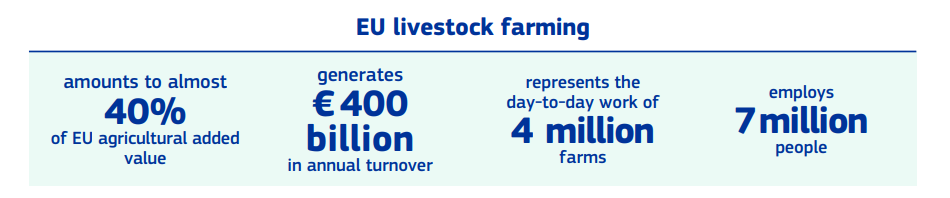
But Hansen has also acknowledged that today "it is a success story at risk".
Livestock farming is facing a range of interconnected challenges that are putting increasing pressure on the sector's long-term profitability and resilience - and not just in Ireland.
These include rising input costs, including feed, energy and fertiliser while at the same time, climate change is increasing the frequency of extreme weather events.
The threat of animal disease also remains a significant risk to production and market stability and these challenges are compounded by an ageing farming population and difficulties attracting the next generation into the sector.
On top of this farmers must also meet costly, high EU standards on animal welfare, food safety and environmental protection.
Livestock Strategy
The new strategy aims to tackle these challenges by:
- Building a more resilient livestock sector – Helping farmers better prepare for crises such as disease outbreaks and extreme weather;
- Boosting competitiveness and profitability – Supporting innovation, improving access to finance, ensuring fair incomes for farmers, strengthening sustainability, and creating new market opportunities;
- Promoting sustainable livestock farming – Improving animal welfare, reducing greenhouse gas emissions, encouraging better nutrient management and resource efficiency;
- Supporting all farms and rural regions – Maintaining livestock farming in vulnerable/remote areas, strengthening local supply chains and improving access to local slaughter facilities;
- Showcasing excellence in EU livestock production – Promoting high-quality, sustainable livestock products through stronger origin labelling and quality assurance schemes.
The strategy also also sets out the commission's agenda to "modernise" EU animal welfare legislation and continue raising standards.
As a first step, the commission intends to present by the end of this year a proposal to update animal welfare rules for laying hens and broilers, followed by a proposal on pig welfare in 2027.
As part of these proposals the commission will ensure that there are "equivalent animal welfare requirements for imported products in the EU" to ensure a level playing field and protect EU farmers from unfair competition.
In addition to this the commission has also put forward proposals to "simplify and streamline" EU rules in the area of food and feed safety, to support farmers and agri-food operators while continuing to ensure a high level of food safety in the EU.
According to the commission the new strategy identifies that "a combination" of targeted public support, private investment and effective use of EU and national tools will be needed to support livestock farmers.
The European Commission today also confirmed that it will work on a dedicated "risk-management financial scheme" under the next Multiannual Financial Framework, together with the European Investment Bank and financial institutions, to cover climate-related insurance and reinsurance needs.
In addition to this it will provide member states with a "specific manual" with operational guidance on risk management, to complement the Common Agriculture Policy (CAP) recommendations.
According to the commision the EU will support the development and uptake of practical tools, "such as more efficient feeding techniques, reducing emissions, breeding strategies, water use efficiency, or precision livestock farming" to support farmers.
It now intends to make "recommendations" to member states in the upcoming recommendations for the next CAP 2028-2034 to ensure that these tools are part of their CAP proposals.
Nitrates Directive
According to the European Commission "sustainability" has a strong potential to deliver additional income for farmers.
The Commission wants to support the better use of manure and organic waste and encourage practical measures such as more precise animal feeding and improved manure management, helping farmers reduce waste, lower emissions and use nutrients more efficiently.
As part of this approach it is reviewing existing EU rules to make sure they are practical and proportionate.
This includes looking at ways to simplify the Nitrates Directive by promoting best practice in areas such as nutrient management, sustainable livestock farming and more flexible approaches to applying regulations.