Meet the humanoid robot designed to do 'the 3 D's' on farms in near future

What if a ‘humanoid’ robot could take on the ‘three Ds’ of farm work - dirty, dull and dangerous - in Ireland and beyond?
Agriland got a sneak peak of what the future might look like in Croatia.
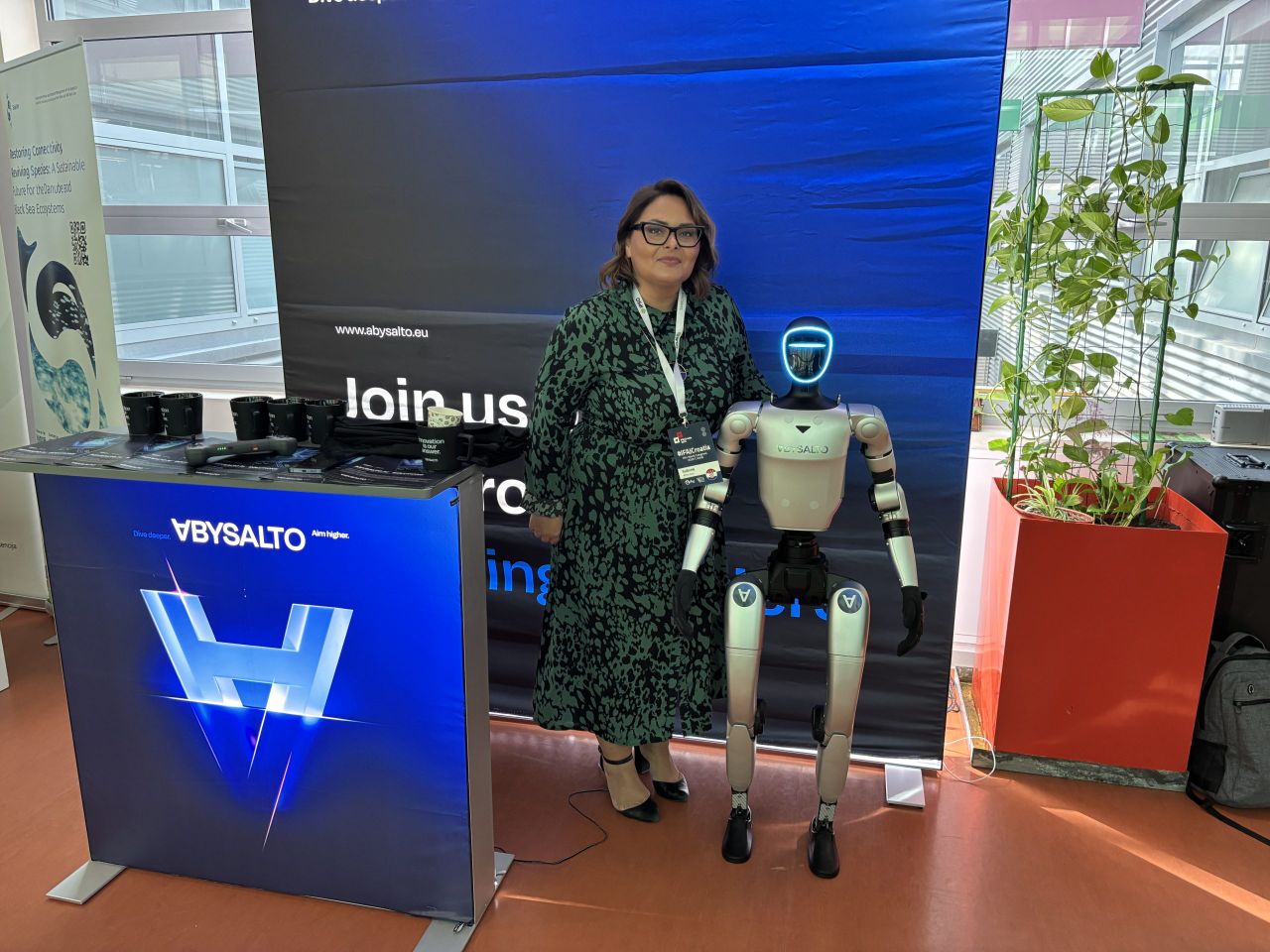
A product of Croatian-based tech company Abysalto, the robot prototype was walking around the corridors of the International Federation of Agricultural Journalists (IFAJ) World Congress in Osijek, Croatia, on Thursday (September 17), and was even shaking hands with some of the delegates in attendance.
Head of marketing at Abysalto, Maja Pavlinusic said that the robot was made in China and is a Unitree G1 humanoid robot.
She said that the robot has not been rolled out yet for commercial use but can be purchased by labs and tech research companies.
She added: "You can purchase it if you have a lab or are some kind of a company that's doing research and development with robots and with artificial intelligence."
What will the humanoid robot be able to do?
She explained that it is envisaged that the humanoid robots will be used to do work relating to 'the three D's'.
The three D's involve work that is deemed:
- Dull;
- Dangerous;
- Dirty.
The Abysalto marketing lead said that the humanoid will be used to help in tasks that are deemed 'dull' such as "picking and placing from one place to another".
Also, the humanoid will be able to assist humans in work that is dirty, such as in cases where work is unsanitary or not easy for people to manage.
How soon before this will be rolled out in the industry?
Agriland also asked Abysalto's head of artificial intelligence (AI), Nenad Mandic for more information on the humanoid robot and when he expects they could be seen working in industry or even on farms.
He said that currently the number of these humanoid robots in the world is somewhere in the "hundreds" but all of these are being used as research.
He said these are mostly in China but there are also some in the US and the EU also.
While these humanoid robots are currently being used for research, he expects they will be working in industry in the "very, very near future".
"I would say in two to three years we will see many more in the industry including in agriculture and in 5-10 years, this [robot] will become a standard."
He went on to say: "Many people ask me why this humanoid form and why not just a robotic hand - it's more efficient and this is definitely true, a robotic hand is more efficient for one task but so many jobs are designed to be done by humans."
He said that work is underway on voice command for these robots but that research is also being carried out on these robots working from gestures.
"If you can imagine standing in a field, one human and one robot. You can gesture to the robot how to help you," he explained.
Safety
According to Pavlinusic, people should have no reason to be afraid of the humanoid robots.
She said: "When we say they are autonomous, we say that we train them and we give them instructions what to do but when we want them to stop.
"If we want them to have some limitations within space or what they are doing, we set that as operators, as people that are engineering them and they won't do that so we shouldn't be afraid of them."
Models
She explained that, currently, the robot batteries last for approximately two hours if they are active but that this is expected to improve in time.
While the robot on display at the event was a Unitree G1 humanoid robot, there are other models also.
She said: "You have a taller one, a more heavy one, and a completely different model.
"This one is G1 and it's very easy to manage because its not very tall, not very heavy."
She said that the robot weighs approximately 40kg, with this model having a lift capacity of up to 15kg.
Mandic emphasised: "Humanoid robots are designed to help humans and to act in human space. This is something we always need to remember."
What price are they?
Mandic said that these humanoid robots are not yet a "commodity" like a car or a tractor or a combine and currently are only being purchased for research.
He said that demo models can be bought at approximately $50,000 but added that, as a general rule of thumb, the hardware costs tens of thousands of dollars, with the software involving considerable investment also.
He concluded by saying that he expects that the "price will go down as the market grows".