Lack of funding main barrier to peatland restoration for NI farmers - survey

A lack of funding/government incentives were the "biggest barriers" to the uptake of peatland restoration among Northern Ireland farmers and landowners, according to a new survey.
Launched today (Thursday, June 18) by the Ulster Farmers’ Union (UFU), ‘Barriers to Uptake of Peatland Restoration for Farmers and Landowners’ draws on farmer feedback gathered through surveys and discussions.
It explores the practical, financial and cultural challenges affecting farmer participation in peatland management schemes.
The report also sets out recommendations aimed at informing future agri-environment policy and supporting a more collaborative approach to peatland restoration that works for both farmers and the environment.
According to the UFU, peatlands play "a vital role in biodiversity, carbon storage, water quality and flood mitigation".
However, the report found that many farmers and landowners face barriers to engaging in peatland restoration and management, including concerns around long-term funding, uncertainty over future land use, and management prescriptions.
The findings emphasise that successful peatland management cannot be achieved through environmental objectives alone.
Instead, the report found that future policy must recognise the "economic realities" of farming businesses and "the importance of building trust and further collaboration with those who live and work on the land".
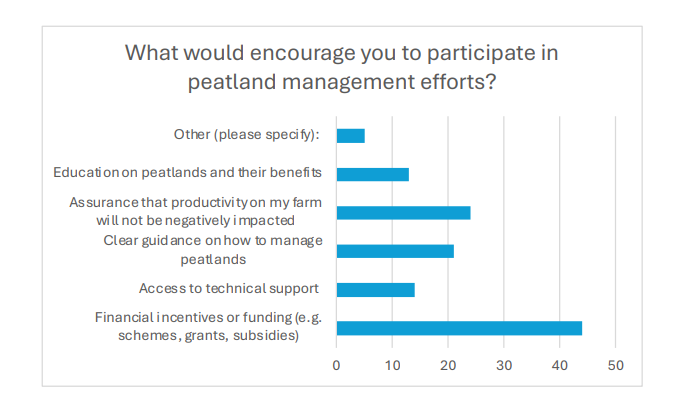
Key recommendations include the introduction of a dedicated long-term peatland fund for farmers and landowners, along with a results-focused agri-environment scheme to replace previous schemes and locally based support and training.
The report also identifies opportunities to improve engagement through innovative approaches that strengthen links between peatland management and rural communities.
Findings
For the farmers surveyed; a large portion manage farms where peatland makes up more than half of their land, with most managing over 50ac.
Engagement in agri-environment is mixed, almost half having never taken part in peatland management schemes.
The survey found: “This low uptake in schemes is significant considering the large acreage covered by farmers surveyed, further highlighting the scope for expanding participation amongst farmers in the future.”
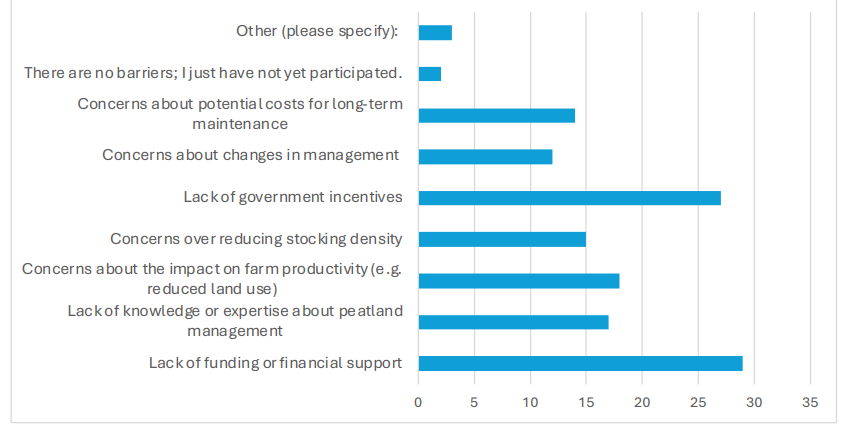
Financial concerns were the primary factor in this low uptake, with a lack of funding/government incentives cited as the biggest barriers.
A “significant number” pointed to lack of knowledge or expertise about peatland management being a barrier, highlighting knowledge gaps, with the vast majority claiming not to have access to support or resources on peatland management.
Respondents also expressed, in relatively equal parts, worries about impact on farm productivity, reducing stocking density, and changes in management, reflecting practical implications for their farm being an issue.
When considering how long they would be willing to wait on reimbursement, there was a range of responses.
Most responded that they would be comfortable with waiting up to around three months for repayment if they cover upfront restoration costs.
Issues
Many of the issues highlighted in this report were brought to the attention of delegates of the International Union for Conservation of Nature (IUCN) UK Peatland Programme Conference in Swansea last week (June 9 - 11).
At the event, Sperrin’s hill farmer John Wauchob spoke about his experiences of farming within a protected peatland site and importance of ensuring a collaborative approach to peatland management that disenfranchises rural communities.
Speaking on the launch of the report, UFU deputy president, Clement Lynch said: “This report is about listening to those who live and work on our peatlands every day and understanding the challenges they face in engaging in peatland management.
“The message that came through clearly is that farmers recognise the importance of healthy peatlands, but that we need to create the conditions that allow them to engage with confidence.
“By addressing barriers around funding, support and trust, we deliver meaningful environmental and agricultural outcomes while strengthening the communities that manage these landscapes.”
The full report can be found under the ‘consultations’ section on the UFU website.