Is your milk being collected often enough?

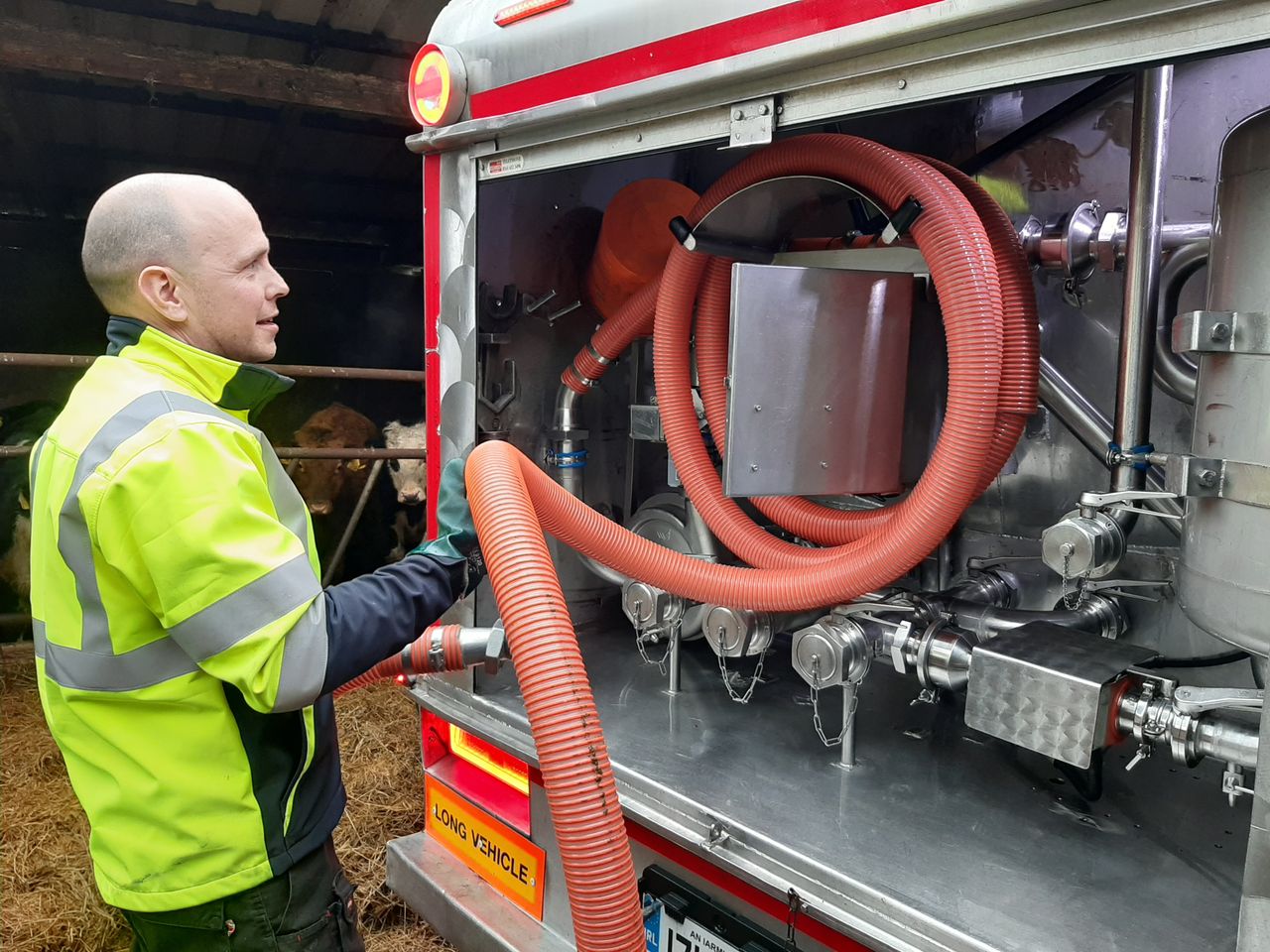
Milk production begins to significantly drop at this time of the year, meaning it takes longer to fill up the bulk tank.
With that, many farms may see milk collections go from daily or even twice daily, to once every two days.
Meanwhile, other farms will only have their milk collected every third day. But how often should your milk be collected?
Milk collections
According to the Department of Agriculture, Food and the Marine (DAFM), there is no specified frequency in which co-ops must collect milk from a contracted supplier.
The majority of co-ops will collect within a three day window to ensure they are processing a high quality product.
However, some farms have reported that collections can be less frequent than every three days in the shoulders of the year.
Studies have suggested that milk can be stored in a bulk tank for up to four days when in the right conditions.
However, minimal deterioration of quality relies on uncontaminated milk entering the tank.
Realistically, even with all the proper precautions in place, the total bacteria count (TBC) in the bulk tank will rise at this time of the year, as unfavourable environmental conditions see the likes of somatic cell counts (SCC) rising.
Safe storage.
There is a number of rules under EU legislation in place for farmers to ensure milk is stored safely ahead of collection.
Under Regulation (EC) No 853/2004, farmers are first obliged to carry out milking hygienically.
Then immediately after milking, the milk must be held in a clean place designed and equipped to avoid contamination.
For daily collections, it must be cooled immediately to 8oC or lower, or a maximum of 6oC if collection is not daily.
Milk leaves the udder at approximately 35°C, the ideal practice to maintain quality is reducing that temperature to 4-5°C within 30 minutes after milking finishes.
Having milk pass through a plate cooler can half the temperature instantly, brining it down to approximately 18°C before entering the bulk tank.
When it is collected, the co-op is then obliged to ensure milk arrives at the processing plant at a temperature no higher than 10oC.
TBC
EU legislation indicates that total bacterial count (TBC) in milkmust be less than 100,000/ml, with the majority of Irish co-ops penalising suppliers if their TBC is above 50,000/ml.
Realistically, TBC should be sitting in or around the 1,000/ml mark as it leaves the udder, and rising to approximately 5,000/ml by the time it reaches the bulk tank.
According to Teagasc, if this milk sits in a well cleaned tank for two days at 4°C, that level is expected to rise to approximately 10,000/ml.
As collections push out to three days, the TBC is expected to rise to 30,000/ml.
However, during diet transitions and tricky environmental conditions, the TBC on many farms will be higher than 5,000/ml by the time it reaches the bulk tank.
That means if collection are only every three or four days, TBC may be bordering penalisation figures, and posing the question, how often should your milk actually be collected?