Irish whole milk powder trade surges 166.2% in EU


Ireland saw its intra-EU trade in whole milk powder (WMP) increase by 166.2% in the first five months of 2026.
According to the latest figures from DCA Market Intelligence, Irish intra-EU volumes of WMP increased to 9,283t, though intra-EU volumes overall rose only by 2.9% to 91,997t for the period.
Trade of WMP outside the EU rose by by 2.2% to 78,051t, with Germany seeing the largest increase (71%).
DCA Market Intelligence - which monitors developments in global food and agricultural commodity markets - noted that European powder markets have strengthened considerably this year, led by a sharp rally in skimmed milk powder (SMP).
Despite higher production, expanding exports have helped absorb additional volumes, while prices reached their highest level since 2022.
Europe’s narrowing price advantage is also bringing international competitiveness into focus, the analysts said.
September levels
According to DCA Market Intelligence, on September 10, food-grade SMP stood at €3,205/t, up 9.6% on the previous month and 44.4% year-on-year (YoY).
Feed-grade SMP increased to €3,225/t (+41.1% YoY), moving slightly above food-grade SMP.
Strong annual gains also continued across the whey complex, with sweet whey powder food and feed 79% (€1,880/t) and 94.4% (€1,750/t) above last year respectively.
Lactose stood at €1,670/t (+59% YoY).
Whole milk powder remained the main exception to the strong annual increases.
At €3,750/t, prices were up 5.2% over the previous month but remained 1.3% below last year.
SMP production
Through July, European milk production followed an upward trend, providing more raw material for processing, though Ireland remained more stable at 5.80 million tonnes (-0.4%).
Germany reached 20.16 million tonnes (+6.4% YoY), while France produced 14.66 million tonnes (+2.2%).
Production also increased in the Netherlands (+4.5%) and Poland (+3.1%).
DCA Market Intelligence noted that skimmed milk powder appears to have particularly benefitted from the additional milk supply.
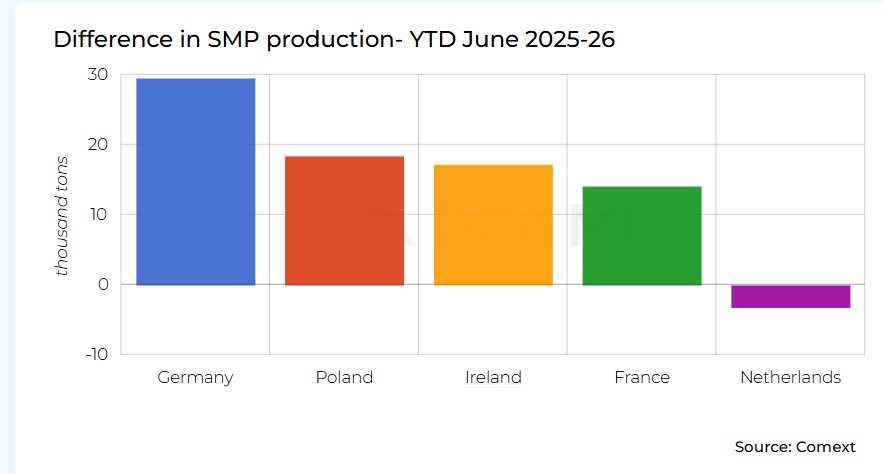
In the first half of 2026, EU production of SMP increased by 11.7% YoY to 865,019t.
Germany produced 218,020t (+15.7%), while Poland (+21.6%) and Ireland (+19.4%) also expanded strongly.
In contrast, Dutch production declined by 7.0%.
This growth was not shared across the wider powder market, as milk and cream powders excluding SMP declined by 3.4%, indicating different allocation across powder streams.
For whey powder, production is closely linked to cheese manufacturing, as whey is a by-product.
EU cheese production increased by 3.5% to 5.20 million tonnes in H1, supporting greater whey availability.
In Germany, where direct whey powder data is available, output increased by 5.3% to 193,170t .
EU powder trade
EU milk powder trade strengthened in the first five months of 2026, according to the analysts.
SMP intra-EU trade increased by 13.5% YoY to 286,920t, while extra-EU trade grew by 10.6% to 367,628t.
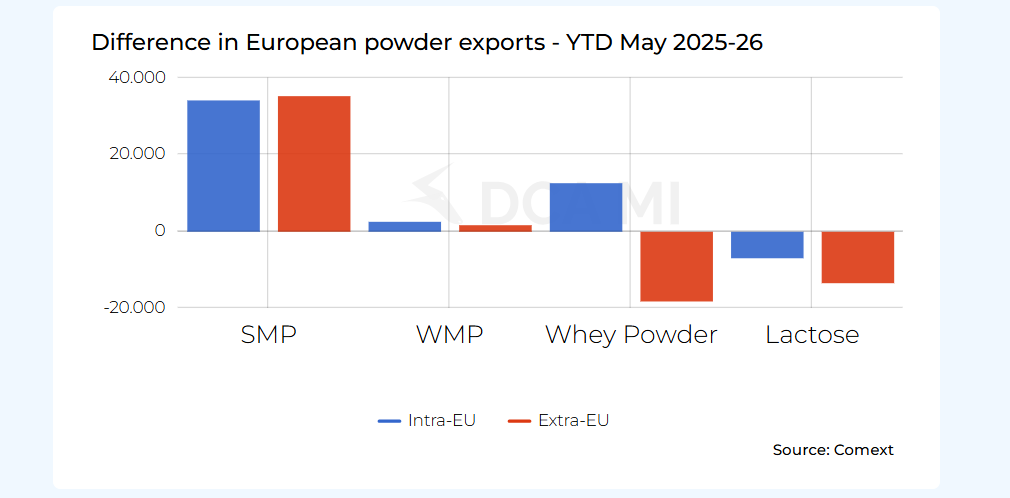
Germany remained the largest intra-EU supplier at 89,922t (+11.8%), while France increased by 31.3% to 51,790t and Poland by 35.3% to 19,662t .
Extra-EU trade was led by Belgium at 70,803t, followed by Germany at 66,222t (+21.8%) and France at 62,469t (+16.4%).
Whey moved in different directions: Intra-EU trade increased by 3.6% to 362,198t, while extra-EU exports declined by 5.9% to 291,133t.
The Netherlands reflected this divergence, with intra-EU shipments up 26.5% and extra-EU exports down 21.5%, while Germany increased its extra-EU shipments by 27.7%.
Lactose weakened across both markets, declining by 4.9% intra-EU and 12.5% extra-EU.
Export destinations show diverging demand
SMP trade was geographically diversified.
Within the EU, the Netherlands was the largest destination at 97,040t, up 31.3% YoY, while Italy increased by 31.1% to 42,159t .
Outside the EU, Algeria remained the largest market at 44,512t, despite a slight decline.
Growth was particularly strong in Egypt, where shipments more than doubled to 37,339t.

This is alongside growth in Indonesia, Malaysia and Thailand, while shipments to the Philippines, Vietnam, Nigeria and China declined.
WMP exports remained strongly orientated towards the Middle East, with Oman remaining the largest extra-EU destination at 21,058t.
While shipments to Oman declined slightly, Saudi Arabia (+53.0%) and Lebanon (+41.2%) recorded strong growth.
Whey showed a more mixed picture. Shipments to China, its largest external market, declined by 20.3% to 68,441t, while several South-East Asian markets moved higher.
Lactose demand was weaker more broadly, with shipments to the major Asian markets of China, India and Japan all declining.
EU competitiveness
According to the analysts, the recovery in European SMP prices is beginning to affect international markets for the product.
The DCA SMP benchmark reached €3,205/t, slightly above the latest Global Dairy Trade (GDT) price of €3,186/t and the latest available US SMP price of €3,176/t.
This leaves European product less competitive than earlier in 2026.
However, DCA Market Intelligence found that the three regions have considerably different export portfolios.
US SMP exports are heavily concentrated in Mexico, which accounts for 60.5% of volumes, while New Zealand is more exposed to Asia, led by China at 37.2% of exports.
EU exports are more diversified, with Algeria and Egypt among the largest destinations alongside South-East Asian markets.
European powder market
The research that the picture differs across products in the European powder market.
DCA Market Intelligence said that for SMP, the strength of the rally is notable given the 11.7% increase in EU production during H1.
It said: “Additional output appears to have been well absorbed, with the latest June data showing extra-EU exports increasing by 16.3% YoY.”
Despite higher production, European stocks are reportedly tighter than expected by industry participants, while the seasonal decline in milk supply and reduced powder capacity following closures in north-western Europe could also play a role.
At the same time, the broader protein trend is providing additional support.
DCA Market Intelligence said: “Looking ahead, international developments will be key to whether this strength can be sustained."