Irish cattle prices under pressure as GB gap widens

Irish cattle prices have come under renewed pressure in recent weeks, widening the gap with Great Britain (GB).
A new report shows that the steer differential reached 66p/kg in the final week of August.
According to the UK's Agriculture and Horticulture Development Board (AHDB) short-term supply recovery has "pressured prices in recent weeks".
AHDB's Sebastian Abbott also pointed to the record-dry summer that scorched Irish pastures and has led to serious questions about winter fodder supplies in some counties.
“Ireland has fared only marginally better than England, recording its driest July on record at 17% of average rainfall, compared with just 10% across England.
“These difficult grazing conditions are adding to the longer-term contraction in Irish cattle supplies, which continues to be reflected in slaughter volumes," Abbott added.
Cattle slaughter
According to AHDB latest figures for 2026 to date - up to the end of week commencing August 24 - prime cattle slaughter in Ireland totalled 802,000 head, a fall of 4% year-on-year.
Research from Department of Agriculture, Food and the Marine (DAFM) shows 2026 in line with the five-year average.
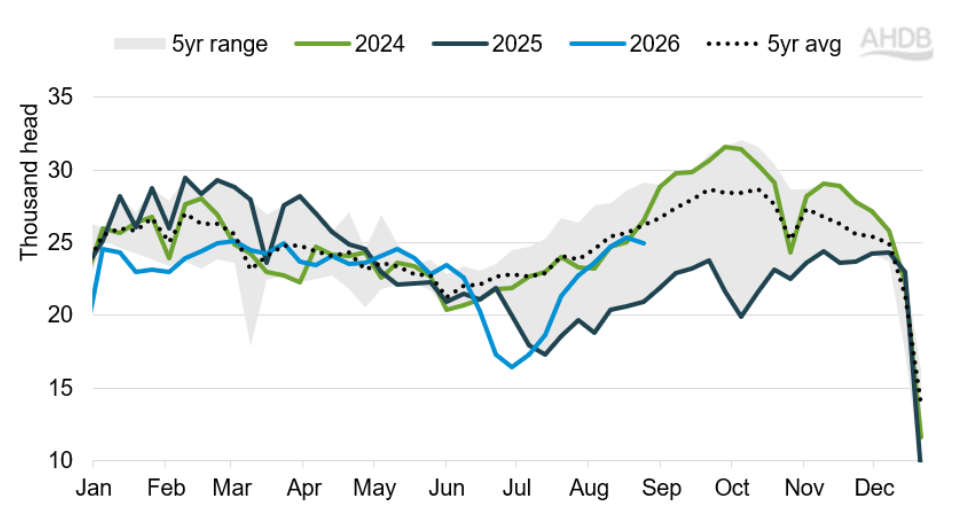
This graphic (above) shows the number of weekly Irish prime cattle kill for 2024,2025, 2026, the 5 year average and the 5 year range.
So far 2026 (light blue) is in line with the 5 year average (black dotted line) until June where it falls below the 5 year range (grey area), and recovers back by last week of August.
However, according to AHDB greater declines have been seen in cow slaughter, back by 6% on the year to total 226,000 head for the same period.
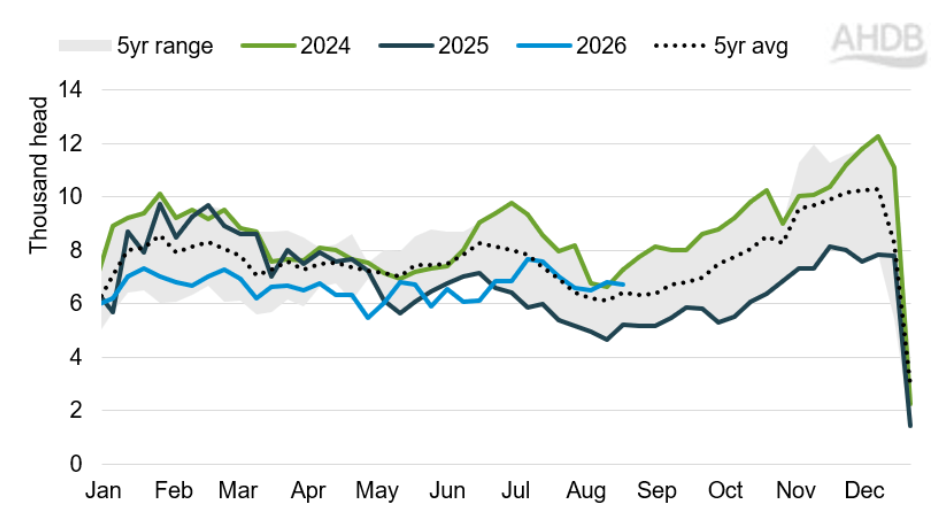
The 2026 (light blue) line sits below the 5 year average from January 2026 until July, where it has stayed in line until the last week of August.
According to AHDB prime cattle carcase weights have grown across all categories for the first half of 2026, with steers and heifers up by 21kg and 15kg on average, versus last year.
It said this had been driven by a combination of factors, including "a heightened focus on genetics, a push on value per head, and lower feed costs".
But AHDB warned that these increased weights are "somewhat negating" the impact on production of reduced throughputs, similarly to the situation in the UK.
Prices
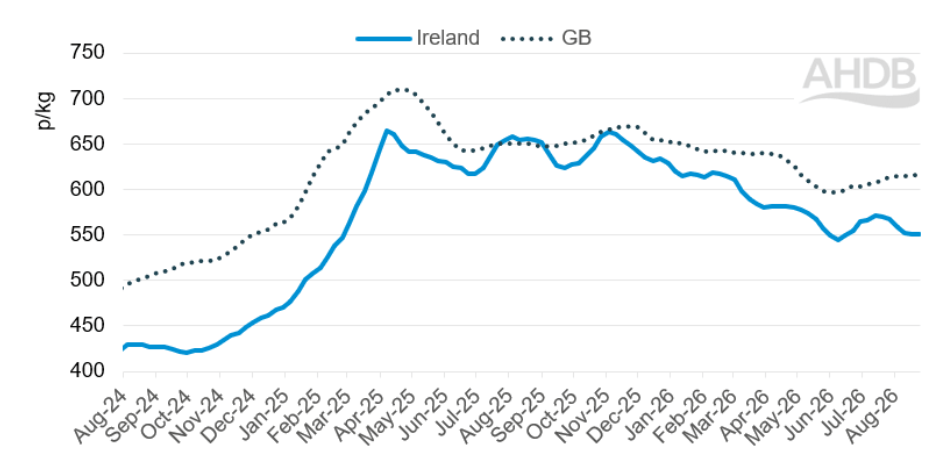
According to Abbott the Irish steer price sat at 551p/kg for the week commencing August 24 2026, down 103p/kg year-on-year from 654p/kg.
He said: "Following the price surge from 2024 to mid-2025, which peaked at 664p/kg in March 2025, Irish beef prices have tracked at comparable levels with the GB price, which has historically sat above Irish pricing.
"Since December 2025, the two have begun to diverge, with Irish prices declining faster than GB.
"This comes as Irish beef exports into the UK and EU have faced competition from southern hemisphere producers and weaker consumer demand for beef, likely putting downward pressure on prices".
Trade
According to AHDB's latest analysis Irish total beef (fresh, frozen, processed and offal) exports fell by 10.4% in the first half of 2026, compared to last year.
It found that the proportion exported to each destination country “remained near constant” but UK exports fell by 10.5% in the same period.

Abbott has outlined that exports declined across all product categories - with frozen and processed beef falling away the most, 18.7% and 14.2% respectively.
Fresh and offal beef fell away the least, by 6.3% and 8.6% respectively.
Overall however Irish beef imports increased by 20.2% in the first half of 2026.
Abbott said: "Growth was found in fresh and offal, growing 42.1% and 35.2% on last year’s volumes, respectively, with frozen remaining unchanged and processed beef falling 19.2%".
Outlook
According to Abbott Ireland's recent price easing has been driven by “softer demand and a modest recovery in cattle availability”.
He said that forecasts indicate “a more normal seasonal supply pattern in the second half of 2026 relative to the exceptionally low levels of autumn 2025”.
"While this may continue to weigh on prices in the near term, the longer-term outlook remains shaped by a structurally declining cattle supply base.
"Teagasc has highlighted the difficult start to the 2026 Irish grazing season, due to poor weather, which is likely to delay the supply of cattle off grass and reinforces its forecast of a further 4% fall in Irish prime beef production this year," Abbott added.
AHDB has highlighted that summer typically lifts demand for manufacturing beef and barbecuing products.
However it has also found that volumes in retail have been impacted by price-conscious shoppers switching to cheaper protein sources.
UK imports
Abbott expects that in terms of UK imports, there is likely to be "less Irish beef to draw on over time" and believes pull towards southern hemisphere suppliers looks "structural rather than short-term".
"This could leave UK imports more exposed to global shocks than to Irish conditions alone.
"For UK exports into Ireland, the price competitiveness seen in the first half of the year seems to have been lost as the GB–Irish spread widens back out.
"The export outlook stays tied to that spread, as a sustained gap keeps British beef on the back foot into the EU market, while any renewed convergence, potentially as tightening Irish supply firms prices, could reopen the window," he added.