CAP 2023-2027: The impact on family farm incomes


The Common Agricultural Policy (CAP), and the support payments farmers receive through it, is a major contributor to farm incomes in Ireland.
Indeed for most sectors, depending on weather and market conditions year-to-year, it is the most important aspect of a farmer’s income.
We are currently over half-way through the 2023-2027 CAP programme; and a new and potentially radically different CAP programme is set to come into effect from 2028.
Debate on how that next CAP will work will intensify sharply in the coming months, with the aim of agreeing a new CAP by the end of 2026, so that the sector has time to prepare for a new programme kicking in on January 1, 2028.
This was not the case for the current CAP; negotiations on what should probably have been known as ‘CAP 2021-2027’ were delayed.
The previous programme was then rolled over to 2022, with the current CAP beginning from 2023 instead.
What exactly will replace it from 2028 remains to be seen, but if the original proposals from the European Commission, published in summer 2025, end up being the final version, then the next CAP will be significantly underfunded compared to the present one.
The commission has proposed allocating €290 billion for agricultural interventions over the course of the next CAP, some 20% less than what it allocated to the already shortened current CAP.
These proposals have been slammed by farm organisations across the EU, providing an unlikely common cause with many in the environmental movement, who see the proposed cuts as shortchanging climate and biodiversity measures.
However, a great deal has changed for the EU and for the world since the current CAP was being designed: we’ve seen the outbreak of a major war in Europe for the first time in decades; recurring trade tensions with major global economic powerhouses (namely China and a Trump-led US); and a renewed focus on migration in the EU.
These issue and more are competing with agriculture and food production – previously a mainstay of the EU budget – for money.
All this will be debated intensively at EU-level in the coming months, with Ireland playing a key role; we currently hold the presidency of the Council of the EU (also known and the council of ministers), and will do so until December 31.
As the council is one of the two bodies that can make amendments to the commission’s proposals (the other being the European Parliament), Ireland has an opportunity to exercise a level of influence on this issue that, for a country of our size, we normally wouldn’t have.
However, it is important to note that we will be expected to act at ‘honest brokers’, taking account of the concerns and demands of all member states equally in finalising the next EU budget, and with it, the next CAP.
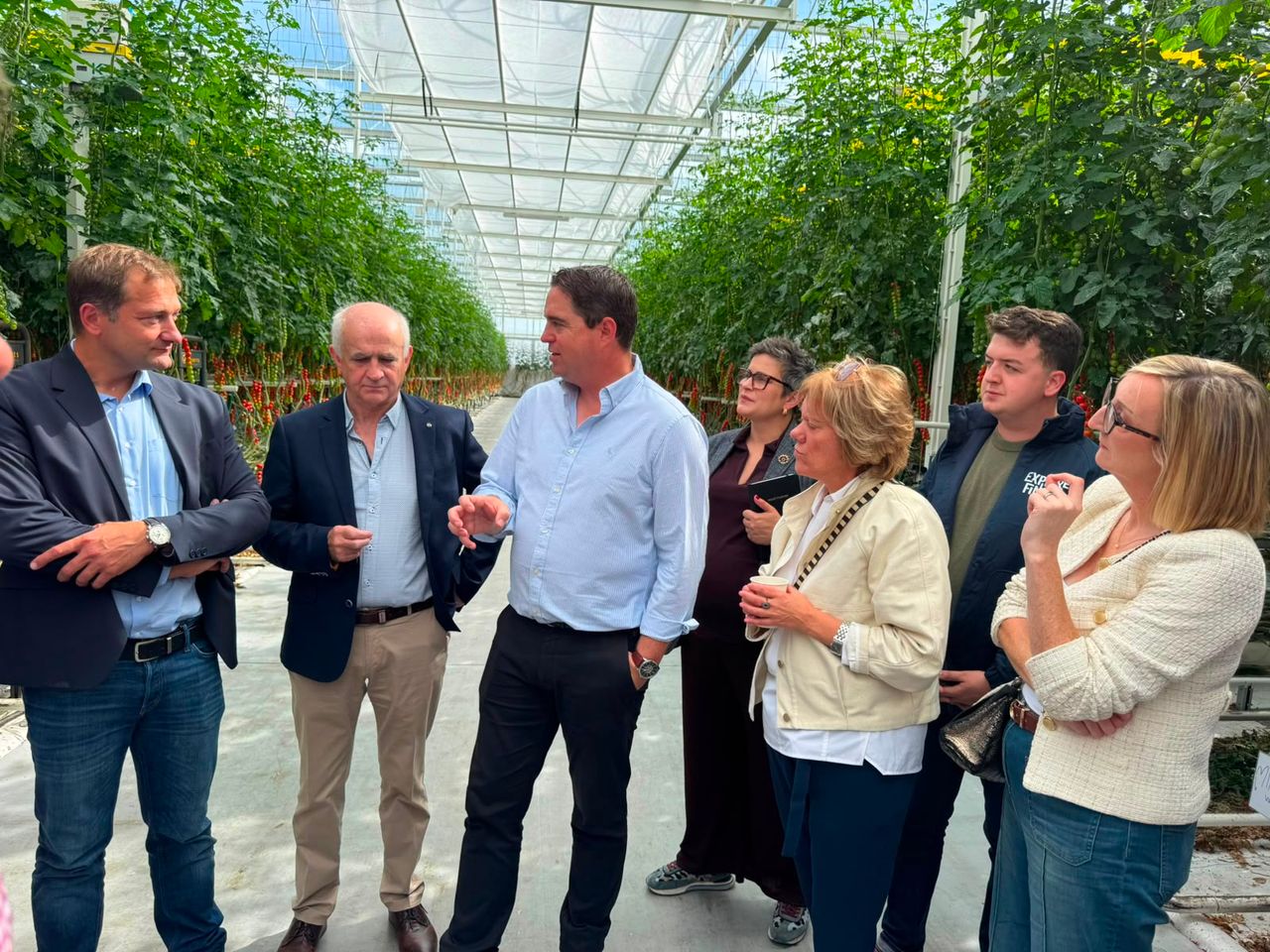
Ireland was active in that role during the weekend, with Flynn Tomato Farm in Swords, Co. Dublin, playing host to the European Commissioner for Agriculture Christophe Hansen, and Minister for Agriculture, Food and the Marine Martin Heydon.
That farm visit comes as Minister Heydon hosts an informal meeting of EU agriculture ministers and Commissioner Hansen this week, where CAP is set to be top of the agenda.
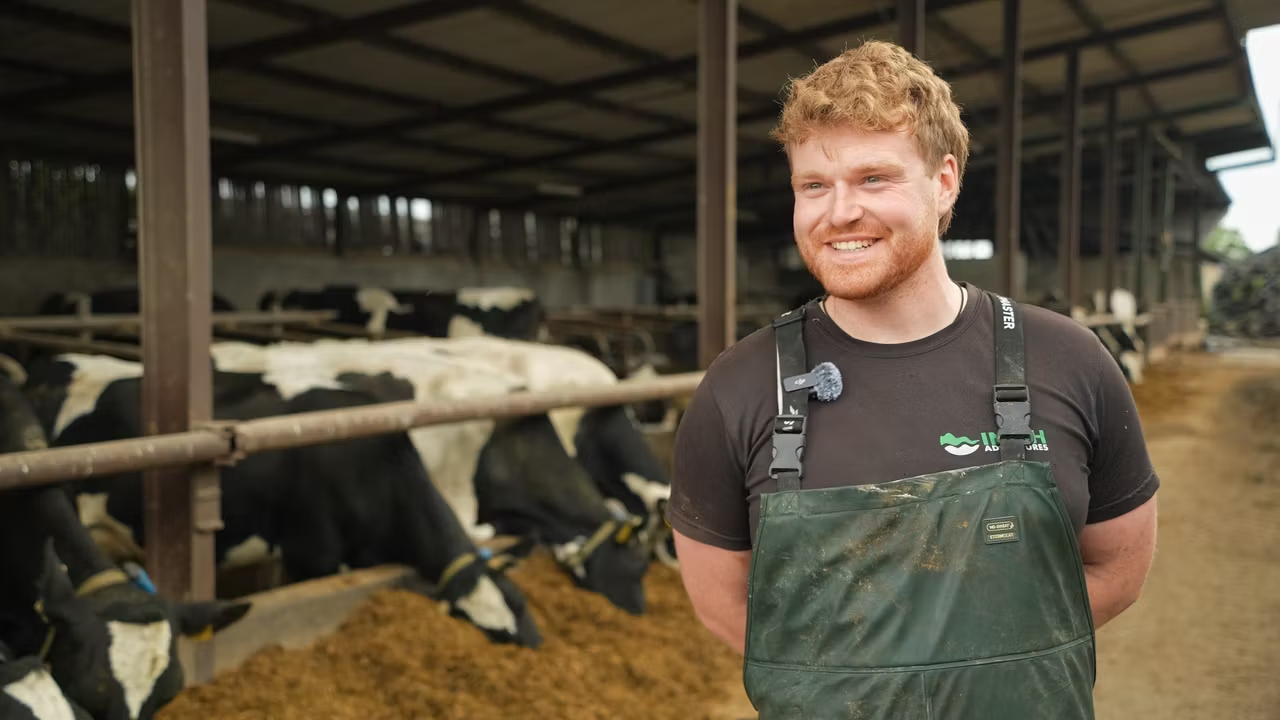
With the CAP debate ramping up in the coming months, Agriland is embarking on a podcast series where we speak to farmers who are benefitting from the CAP day-to-day, to see how important it is to their incomes, livelihoods, farm viability and families.
This series, called Farm Conversations: Why CAP Matters, will kick-off on Agriland at 5:00p.m this evening (Monday, September 7).
This series will hear from farmers about the direct impact of CAP on their incomes, putting real farmers’ stories to what is usually expressed in numbers and economic data.
That data comes from different sources, but it tells a similar story; thousands of farmers across several sectors are reliant on CAP to keep farming, with this effect more pronounced in specific sectors and regions of the country.
The Teagasc National Farm Survey (NFS) is one of the key sources of that data, and we now have three full years of NFS data on the current CAP (2023, 2024, and 2025) to see how it has impacted farm incomes across those years.
2025
| Sector | Avg. support/ha (avg. farm size) | Support as % of farm income |
|---|---|---|
| Dairy | €361, of which €245 Pillar I (69ha) | 16% |
| Cattle rearing | €585, of which €246 Pillar I (30ha) | 72% |
| Cattle other | €489, of which €255 Pillar I (34ha) | 50% |
| Sheep | €526, of which €259 Pillar I (53ha) | 95% |
| Tillage | €515, of which €279 Pillar I (70ha) | 65% |
| National | €477, of which €255 Pillar I (45ha) | 40% |
In general across farm systems in 2025, support payments made an important contribution to farm income, with the value of support payments largely stable compared the previous year, at €21,447 per farm.
However, the actual figures across systems, and the overall contribution of support payments to family farm income in 2025 varied considerably, a common feature of CAP farm payments across several years.
For cattle rearing (sucklers), support payments, especially from Pillar II of CAP, were critical to incomes in 2025, with the average amount of support payments received on cattle rearing farms standing at €17,285.
On cattle other farms (mainly finishing and store cattle) the level of support payments stood at €16,427 in 2025, and continued to be important in supporting incomes on those farms.
For sheep farmers, support payments remained stable on average compared to 2024 €27,779.
Such payments are very important on sheep farms, with continued participation in the Sheep Improvement Scheme, the Agri-Climate Rural Environment Scheme (ACRES), and the Organic Farming Scheme (OFS) helping to protect sheep farm income.
While the average payment fell on cattle rearing (suckler) farms and the figure on sheep farms remaining fairly unchanged, payments increased on average across the other farm systems.
In 2025, average market income from farming was positive across all systems, which is far from being a common situation.
Due to the improvement in economic performance across all farm systems in 2025, support payments accounted for a smaller share of average family farm income compared to 2024.
The relatively larger average payment that tillage and dairy farmers generally receive reflects the typically larger size of their holdings compared to other sectors.
This is also somewhat the case for sheep farmers, whose larger average support payment also reflects their generally larger average land area compared to cattle farms.
CAP Pillar I payments (mainly the Basic Income Support for Sustainability, or BISS) generally make up a larger proportion of average support payments on dairy farms, at about 68% in 2025, whereas on drystock farms, Pillar I payments account for a smaller proportion of support payments, around 44% to 55% 2025.
This is another recurring feature of CAP, with a higher proportion of drystock farms participating in Pillar II interventions, such as Areas of Natural Constraint (ANC), ACRES, and the OFS.
Targeted sectoral payments have been shown to be critical in supporting farm incomes.
For example, two thirds of suckler farms participated in the Suckler Carbon Efficiency Programme (SCEP) in 2025 and received an average payment of over €3,200.
Meanwhile, close to 90% of sheep farms participated in CAP sheep support schemes in 2025, receiving an average payment of over €3,500.
About one quarter of tillage farmers participated in the Straw Incorporation Measure (SIM), receiving payments of close to €5,000, on average.
About 20% of tillage farmers also participated in the Protein Aid Scheme, with an average payment of over €7,000. Furthermore, the Tillage Incentive Scheme provided a payment of over €3,000 to 12% of tillage farms in 2025.
In terms of agri-environmental schemes, just over 50% of farmers participated in ACRES, the flagship environment scheme under the current CAP, and received payments in 2025 at about €5,600 on average.
In 2025, 8% of farmers participated in the Organic Farming Scheme, with an average payment to participants of close to €14,000, and highest participation among sheep and tillage farmers.
The importance of CAP support payment can also be seen on regional basis, with farmers in north-western regions more reliant on support payments for a meaningful income.
Those regions where dairying is more prevalent are generally more profitable and have a lower reliance on support payments.
In 2025, the relative importance of support payments as a share of family farm income was highest in the west, at 70% of average income, reflecting an average payment of just over €18,000 in 2025.
This was followed by the border region, where support payments comprised 49% of farm income, with an average payment of about €19,000; and the Dublin-Mid East region at 42% with an average payment of just over €26,000.
In 2025, the proportion of farm income accounted for by support payments in the midlands was 36%, with an average support payment of just over €20,000.
In the south-west, the south-east and the mid-west, support payments accounted for just over 30% of farm income in 2025, with an average payment of close to €20,500 in the mid-west, €23,700 in the south-east and just over €23,000 in the south-west.
2024
| Sector | Avg. support/ha (avg. farm size) | Support as % of farm income |
|---|---|---|
| Dairy | €350, of which €252 Pillar I (70ha) | 22% |
| Cattle rearing | €556, of which €242 Pillar I (32ha) | 129% |
| Cattle other | €483, of which €265 Pillar I (33ha) | 87% |
| Sheep | €567, of which €273 Pillar I (49ha) | 102% |
| Tillage | €480, of which €296 Pillar I (72ha) | 84% |
| National | €475, of which €263 Pillar I (45ha) | 59% |
The value of direct payments in 2024 increased in aggregate terms compared to 2023.
The average payment received remained fairly stable on cattle other and tillage farms in 2024 compared to 2023, but payments increased across the other farm systems, to varying degrees, compared to the previous year.
On average, the total direct payment received per farm in 2024 was €21,388.
Average market income (before direct payments are included) were negative for cattle rearing and sheep farms, underlining the dependence of those systems on financial support, albeit to a lesser degree in 2024 compared to 2023.
The average direct payment on cattle rearing farms in 2024 was €17,743.
With a family farm income of €13,788, the typical suckler farm used just under €4,000 of those payments during 2024 to cover the farm’s operating loss.
The deficit between the level of farm income and support payments on the average sheep farm was smaller in 2024; however, the exact timing of when payments are paid out is a factor in this smaller deficit.
The average direct payment received on dairy farms in 2024 was €34,720. Payments on tillage farms remained largely stable, at €32,720.
The data from 2024 also reflected the larger average land area for sheep farms compared to cattle farms in 2024, which also partly explains for the larger average direct payment for sheep farmers.
As usual, Pillar I payments generally make up a larger proportion of the total payments received on dairy and tillage farms (72% and 62% respectively), compared to drystock farms, where there is higher participation in Pillar II schemes.
Scheme participation, and payments made under Pillar II through targeted sectoral schemes, made a significant contribution to farm incomes in 2024, as was the case in most years.
One in four farms (including more than half of cattle rearing farms) participated in SCEP in 2024 and received an average payment of close to €3,700.
Almost 90% of sheep farms participated in the Sheep Improvement Scheme in 2024, receiving an average payment of over €3,000.
Almost half of farmers were signed up to ACRES in 2024 and received an average payment of close to €6,000 under the scheme.
The level of participation in the OFS increased in 2024, with an average payment to participants of close to €15,000 made to mostly sheep and tillage farmers.
Other significant payments made to tillage farmers in 2o24 included the Straw Incorporation Measure and Protein Schemes, with average farm payments of about €5,000 from those schemes in 2024.

Regionally, the relative importance of direct payments as a share of family farm income was highest in the west, at 107% of average family farm income, reflecting an average payment of over €18,500 in 2024.
This was followed by the border region, where direct payments accounted for 73% of farm income, with an average payment of about €18,300; and the midlands region at 64% and an average payment of just under €22,000.
In the Dublin-Mid East region in 2024, the proportion of family farm income accounted for by direct payments was 57%, with an average payment about €24,300.
In the mid-west, south-east, and south-west, direct payments accounted for between 39% and 53% of farm income in 2024, with an average payment of close to €20,500 in the mid-west, €23,000 in the south-east and just under €24,000 in the south-west.
2023
| Sector | Avg. support/ha (avg. farm size) | Support as % of farm income |
|---|---|---|
| Dairy | €355, of which €246 Pillar I (65ha) | 44% |
| Cattle rearing | €507, of which €244 Pillar I (34ha) | 231% |
| Cattle other | €465, of which €275 Pillar I (36ha) | 112% |
| Sheep | €469, of which €266 Pillar I (44ha) | 161% |
| Tillage | €451, of which €293 Pillar I (46ha) | 154% |
| National | €432, of which €264 Pillar I (46ha) | 99% |
In 2023, the value of direct payments increased compared to 2022.
Across individual sectors, the average payment received remained largely stable on dairy and cattle other farms compared to 2022, and increased on cattle rearing, sheep and tillage farms.
On average, the total direct payment received per farm in 2023 was €19,628.
Due to the significant deterioration in the economic performance across all sectors in 2023, direct payments accounted for a larger share of average family farm income.
Market-derived income (before direct payments are included) was negative across all systems apart from dairy.
The significantly larger contribution of direct payments to farm income on cattle rearing farms in 2023 underlines the dependence of that sector on financial support.
The average direct payment on cattle rearing farms in 2023 was €17,137.
With an farm income of €7,425, the typical suckler farm used over €9,700 of those support payments to cover the farm’s operating loss.
The comparative figure on the average sheep farm was €7,600 in 2023.
Direct payments also accounted for a relatively large contribution of farm income in the tillage sector in 2023, also reflecting the low level of farm income in that sector for 2023.
Direct payments on tillage farms increased by 9% in 2023 compared to 2022 to €33,052. This was due to the introduction of new targeted sectoral payments to help support tillage farmers that year.
The average direct payment received on dairy farms in 2023 was roughly stable compared to 2022, at €21,667.
Sector specific payments were again important for cattle rearing and sheep farms., with scheme participation and payments under Pillar II major contributors to farm incomes.
One in five farms (including more than half of cattle rearing farms) participated in SCEP in 2023 and received an average payment of €3,700.
About 80% of sheep farms participated in the Sheep Welfare Scheme in 2023, and received an average payment of around €1,500.
25% of farmers were signed up to ACRES in 2023, and received an average payment of almost €5,000 under the scheme.
Participation in the OFS grew in 2023, with an average payment of €13,000, again mostly made to sheep and tillage farmers.
On a regional basis, regions where dairy farming is more prevalent as usual showed a lower reliance on direct payments.
However, the decline in farm income for 2023 impacted those regions proportionately more, due to the sharp decline family farm income generally.
The differences in the relative importance of direct payments across regions in 2023 reflected the general direction in farm incomes that year.

The relative importance of direct payments was highest in the west, at 161% of average farm income, reflecting an average direct payment of about €17,500 in 2023.
This was followed by the border region, where direct payments comprised 139% income, with an average payment of almost €17,000; and the Dublin Mid-East region at 126% and an average payment of about €22,500.
In the Midlands region in 2023, the proportion of farm income made up of direct payments was 97%, with an average payment of about €20,300.
In the mid-west, south-east and south-west, direct payments accounted for about three quarters of farm income in 2023, with an average payment of between €26,000 and €31,000.
The sharp decline in farm incomes in 2023 increased the relative contribution of direct payments to farm income across the regions, with the typical farm in several regions using a substantial portion of their support payments to cover their farms’ losses.
Podcast series
That's a overview of what the data shows for Irish farm incomes and their dependence of support payments through the CAP.
But as mentioned already, the impact can be more clearly communicated by hearing from and talking to real farmers who benefit from the CAP on a day-to-day basis, and will have to deal with the consequences of food production and farming fall victim to other priorities at a political level.
So for that reason, be sure to catch Agriland's podcast series Farm Conversations: Why CAP Matters, which begins this evening at 5:00p.m.