Ireland leads EU in sharpest beef production fall - down 14%

Ireland recorded the "sharpest decline" in beef production in the EU at the start of 2026, according to a new report today (Thursday, June 4).
RaboResearch’s latest Global beef quarterly report highlights that EU and UK beef markets entered 2026 with "tighter supplies" with production falling by 4% year-on-year by February.
Although the decline in production was felt across many of the major beef producing members of the EU, in Ireland it was significantly more acute.
Ireland recorded a 14% year on year fall off in production, compared to a 2% drop in France, a 4% fall in Germany and an 8% decline in Poland.
According to the RaboResearch report beef prices were high at the start of this year but by quarter two had begun to "level off" despite the ongoing tightness in supply.
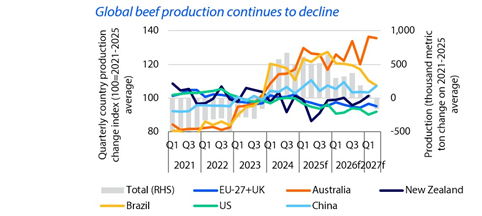
Generally beef production declined across the globe by 2.5% year-on-year in the first quarter of 2026 and is forecast to fall by 2.2% over the full year.
According to analysts this reflect contractions across major producing regions, including Brazil, the United States and China.
Beef imports
One key trend identified in the latest Global beef quarterly is that beef imports into the EU surged at the start of 2026 - up by 33% year on year in January while at the same time exports fell back by 13%.
The majority of these beef imports came from Brazil - up 57%, Uruguay which rose by 55%, while New Zealand saw its imports to the EU jump by 195% and Australia imports were up 61%.
The EU-Mercosur agreement provisionally took effect on May 1.
This gives Mercosur countries the green light to export beef into the EU under the Hilton Quota of approximately 47,000 metric tons at zero tariff, and introduces a new quota that will gradually rise to 99,000 metric tons at a 7.5% tariff.
According to says Angus Gidley Baird, senior animal protein analyst at RaboResearch, trade agreements like Mercosur and the deal between the EU and Australia are set to reshape beef trade flows in 2026.
But he does not believe they will have "a big impact in the short term", particularly in relation to the Mercosur agreement.
"This will improve the competitiveness of Mercosur beef in the EU market, but it doesn’t automatically translate into higher volumes.
"Exports to the EU are already at relatively high levels, which limits how much further volumes can grow in the short term," Gidley-Baird explained.
He said similarly while the Australia-EU agreement removes the 20% tariff applied to 3,389 metric tons of beef under the Hilton Quota and introduces a new quota of 30,600 metric tons this is over a 10-year phase-in period, "the benefits for exporters will, however, take time to materialise," he added.