How does pen space influence cattle performance?
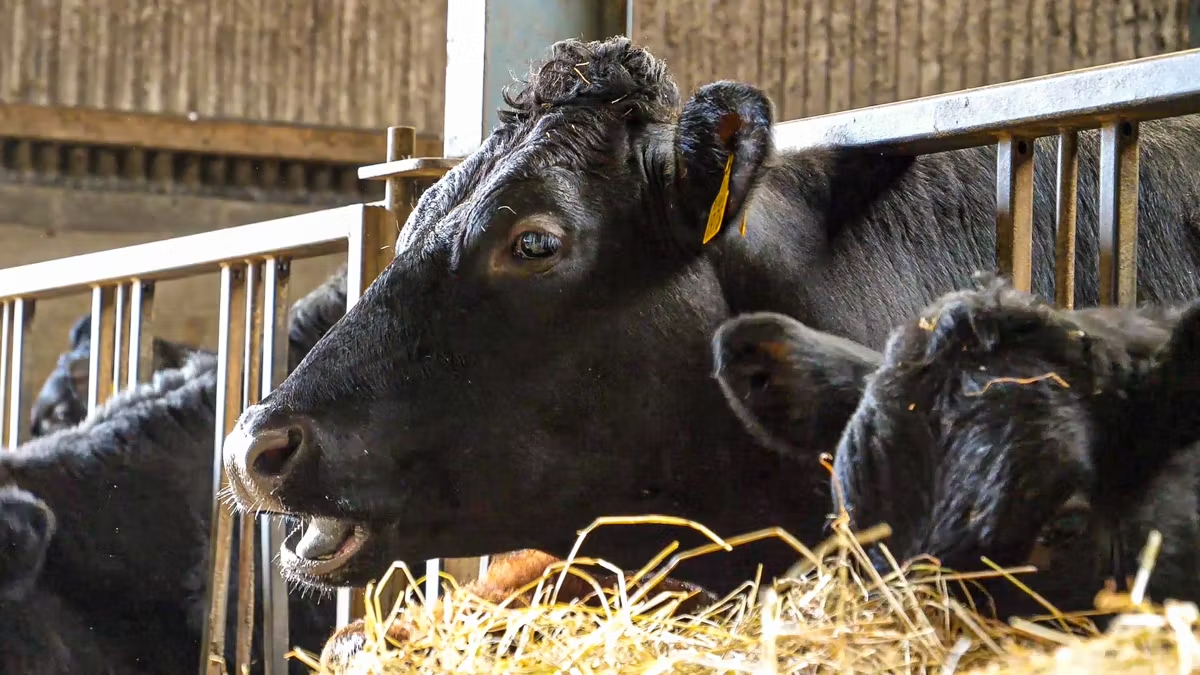
Overcrowding sheds can cost you carcass weight, even when feeding and animal health are right.
Teagasc beef specialist, Martina Harrington is advising farmers to measure pens before housing and match cattle numbers to the space available.
She provided the following tips on ensuring cattle have enough space when housed:
- Lying space: Teagasc research found that finishing cattle given 3m² each produced carcasses 20kg heavier than cattle given only 2m² over 105 days. No further performance benefit was found above 3m² in this trial.
- Know your pen capacity: A pen with a usable lying area of 5.6m x 4.8m provides 26.88m². This gives nine cattle approximately 3m² each. Putting 13 cattle into the same pen reduces this to just over 2m² each.
- Check feeding space too: Floor area alone does not decide how many cattle a pen can hold. Plan for their size at the end of winter, not just at housing.
- Put a value on space: Using an example beef price of €7.20/kg, an extra 20kg of carcass is worth €144/head, or €1,296 across nine cattle. This is extra carcass value before costs, not a guaranteed increase in pen profit. The overall return also depends on how many cattle are finished.
In a separate Teagasc trial, finishing steers on Durapak rubber mats over concrete slats produced carcasses 11kg heavier after 120 days than those on bare concrete slats.
They also spent longer lying down and converted feed into weight gain more efficiently.
Using the same example price of €7.20/kg, that extra carcass weight is worth €79.20/head, before allowing for the cost of the mats.
The same performance benefit was not found in weanlings.
Agriland spoke to Teagasc about this study earlier this year at the BEEF2026 open day in Grange on July 1.
Teagasc business and technology adviser David Hallissey told Agriland: "Straw bedding didn't show any performance gain over your concrete slats."
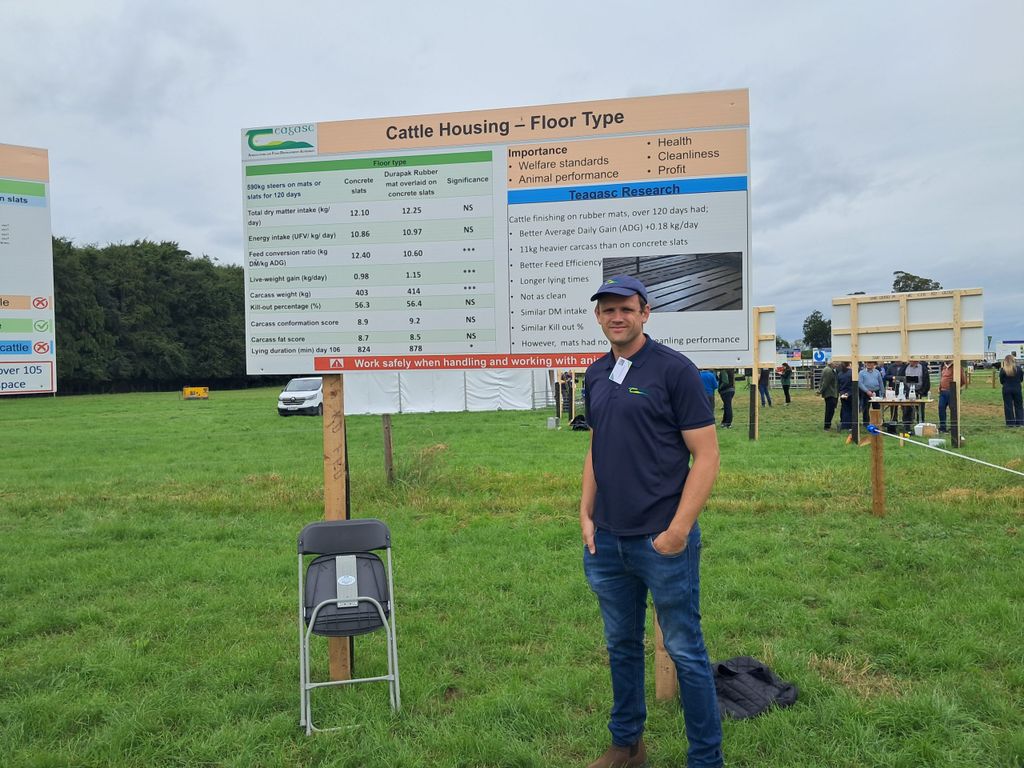
The trial found that cattle finished on mats over 120 days had a higher average daily gain (ADG) of 0.18kg/DM compared to concrete.
Cattle on rubber mats spent nearly one extra hour lying down, and had an 11kg heavier carcass-weight on average with no increase in feed intake.
Cleanliness was also measured and interestingly, concrete slats showed the highest cleanliness.
Straw bedding had the lowest cleanliness despite regular removal and replenishing of straw and a 5m² lying space allocation, compared to 3m² for concrete and rubber mats.