Bluetongue cases now confirmed across 15 counties

The Department of Agriculture, Food and the Marine (DAFM) has confirmed that a total of 62 cases of bluetongue have now been detected in Ireland.
The latest data published today (Tuesday, October 27) shows that the first case of bluetongue in Co. Leitrim has been detected in a cattle herd.
This means that cases have now been identified by the department across 15 counties.
The update also shows that bluetongue has been confirmed in sheep flock in Co. Meath.
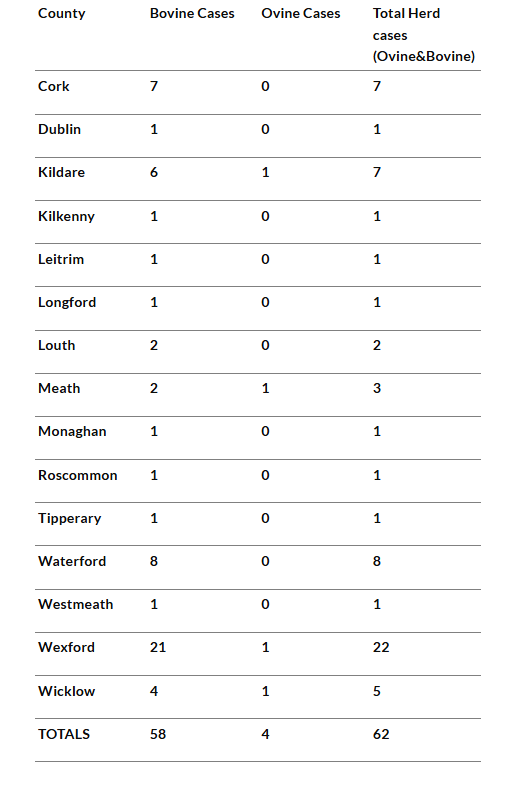
Wexford continues to be the county with the highest number of confirmed cases at 22.
In September, the department confirmed Ireland’s first case of bluetongue virus serotype 3 (BTV-3) of 2026 in a 16-month-old unvaccinated heifer in Wexford.
As the table below shows, there has been 58 cases in bovines and 4 cases in sheep detected in Ireland to date:
Bluetongue is a viral disease caused by bluetongue virus (BTV) which can cause severe clinical signs in ruminant species, particularly sheep, cattle, goats and camelids (llamas and alpaca).
There are different serotypes (strains) of bluetongue virus (BTV) with several serotypes currently circulating in Europe including BTV-8, BTV-4 and BTV-3.
DAFM said it is the BTV-3 serotype that is currently in Ireland.
Bluetongue
Bluetongue virus is mainly spread by infected biting midges (Culicoides species) many of which are found throughout the island of Ireland.
While the virus generally not spread directly from animal to animal, there are some animal-animal transmission routes.
Infected pregnant animals can also pass the virus to their unborn offspring in the womb, who can be a source of infection when they are born.
There is evidence to show that the virus can be spread through biological products such as blood and germinal products such as semen and embryos.
According to DAFM, sheep are more likely to show obvious clinical signs of bluetongue than cattle if they become infected, and mortality (death) rates can be as high as 70%.
Some animals may not show any clinical signs, and these animals can pose a risk for spreading the disease to new areas
The department has reiterated that bluetongue does not affect human health or food safety. It added that bluetongue is not a zoonotic disease and cannot cause infection in humans.
UK cases
The number of confirmed bluetongue cases also continues to rise in the UK this week.
There have been 3,445 cases of BTV-3 or unspecified serotype in the UK in the 2026 to 2027 bluetongue season.
This includes:
- 2,898 cases in England;
- 493 cases in Wales;
- 54 cases in Scotland;
- 0 cases in Northern Ireland.
A case is defined as a premises on which bluetongue has been confirmed, based on risk and following laboratory or clinical diagnosis.