Beef kill: Young bull supply steady as all other cattle types down

Latest beef kill figures show that young bull supplies are on par with this time last year despite the supply of all other cattle types down.
Young bulls make up a small percentage of the total beef kill. Of the 675,000 cattle slaughtered to date this year, just under 51,000 or 7.5% were young bulls.
The numbers of young bulls being slaughtered had been in decline over the past decade but has shown some signs of stabilising more recently.
Market preference for steer (bullock) beef as well as the specialised nature of bull finishing operations versus steer beef are just some of the reasons bull beef kill figures have declined over the past decade.
The table below details weekly beef kill numbers in the week ending Sunday, May 31, versus the same week of last year, the cumulative beef kill-to-date this year versus the same week of last year, as well as the change in numbers and percentage changes:
| Animal Type | Week ending May 31, 2026 | Same week of 2025 | Change | Cumulative 2026 | Cumulative 2025 | Cumulative Change |
|---|---|---|---|---|---|---|
| Young Bulls | 2,530 | 2,395 | +135 (+5.6%) | 50,950 | 50,773 | +177 (+0.3%) |
| Bulls | 625 | 413 | +212 (+51.3%) | 10,184 | 10,481 | -297 (-2.8%) |
| Steers | 11,433 | 11,438 | -5 (-0.0%) | 255,171 | 277,905 | -22,734 (-8.2%) |
| Cows | 6,736 | 6,470 | +266 (+4.1%) | 142,188 | 169,287 | -27,099 (-16.0%) |
| Heifers | 8,917 | 8,429 | +488 (+5.8%) | 216,847 | 243,972 | -27,125 (-11.1%) |
| Total | 30,241 | 29,145 | +1,096 (+3.8%) | 675,340 | 752,418 | -77,078 (-10.2%) |
As the table above indicates, last week's beef kill was up by almost 1,100 head or 3.8% on last year.
This marks the fourth consecutive week supplies were above the corresponding week of last year.
The graph below shows how weekly beef kill numbers have been trending compared to last year:
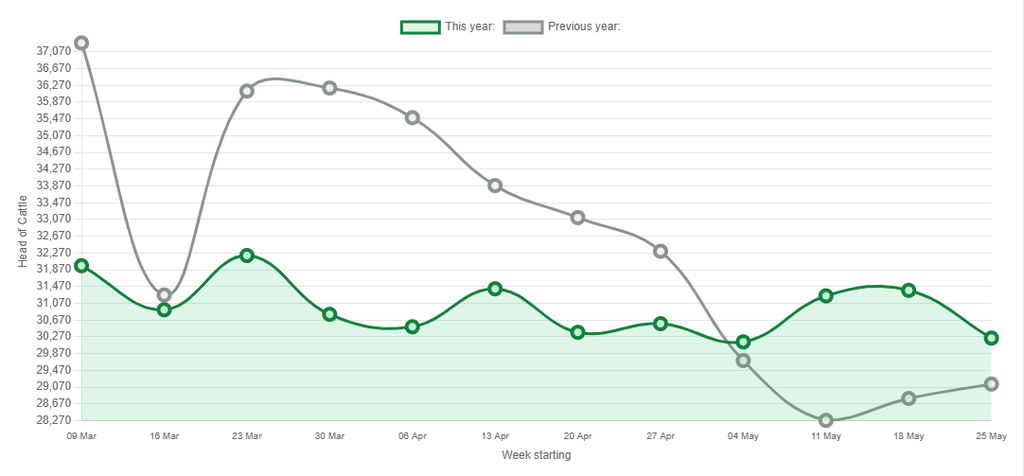
While week-on-week supplies have been up in the past four weeks when compared to 2025, the cumulative kill-to-date this year remains over 77,000 head or 10.2% below this time last year.
This gap is expected to narrow as the year progresses with weekly supplies expected to remain steady this year as opposed to last year when weekly kill numbers dipped off as the year progressed.