Avoiding water quality issues on your farm


Water quality issues on your farm can lead to fines or even prosecution, but many problems can be avoided ahead of that stage with good management.
According to Sinéad Devaney, Teagasc adviser with the Agricultural Sustainability and Advisory Support Programme (ASSAP), water quality is everyone's concern and responsibility.
“From farmers and foresters to fishers, landowners and rural and urban communities, everyone has a role in protecting and restoring Ireland's waters,” she said.
The Environmental Protection Agency published its National Agricultural Inspection Programme (NAIP) report last month (June 9).
Farm inspections
It showed that of the 4,315 farms inspected by local authorities under the Good Agricultural Practice (GAP) for Protection of Waters Regulations in 2025, 43% were found to be non-compliant.
According to Teagasc, GAP inspections have been increased with the aim of reaching the target of 4,500 farm inspections per annum as set out in the Water Action Plan 2024.
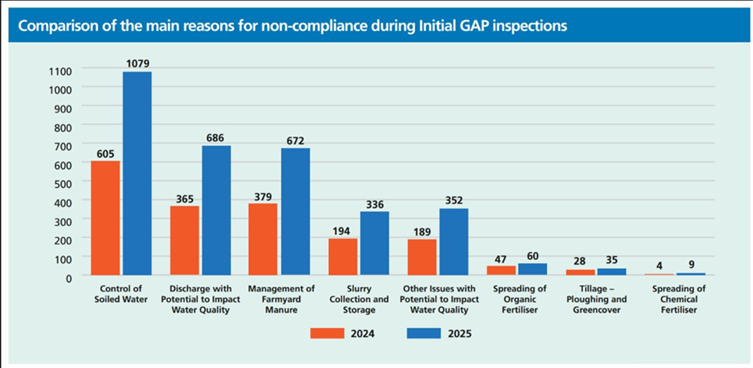
Devaney said that non-compliances are mainly issues that can be resolved “with good management on the farm”, either in the yard or in the field.
“Good management by and large is not costly and doesn’t require elaborate outlay.
"It is achieved by following best-practice advice when carrying out daily tasks on the farm," she said.
Actions to take
Devaney outlined several actions that farmers can take to prevent water quality issues developing on their holdings..
In relation to slurry, the Teagasc adviser made the following recommendations:
- Ensure there is sufficient slurry and soiled water storage capacity on farm. Having fully emptied tanks in advance of winter housing will help address this, as does ensuring that clean water is not getting into slurry tanks. Leaking troughs can be a culprit here;
- Follow best practice for slurry and farmyard manure spreading - 5m buffer zones from watercourses and drains (10m in first two weeks and last two weeks of open period).
As manure can pose water-related issues, Devaney recommended that farmers ensure runoff from manure storage areas is collected.
She also advised no field storage of farmyard manure during the closed period or within 20m of water bodies.
From a silage perspective, a farmer should ensure that all effluent run-off from silage pits is collected and store silage bales at least 20m from watercourses, including drains.

Property best practices also play a part, the Teagasc adviser said.
Farmyards and roadways should be effectively managed to minimise nutrient losses.
Gutters and downpipes should be in good working order, with good separation of clean and soiled water.
Clean water can be diverted away from the yard and out to drains while soiled water is not allowed to enter drains or ditches.
No supplementary feeding points should be located within 20m of surface water or on bare rock.
Other general tips include:
- Analyse soil samples for the farm and get a nutrient management plan (fertiliser plan) in place;
- Follow best practice for chemical fertiliser spreading – 3m buffer zones from watercourses and drains;
- For plant protection products (PPPs), a minimum 3m no-spray buffer zone applies to all watercourses. Use drift-reducing nozzles.
Farmers are also advised to observe best practice when using sheep dip chemicals.
Sheep should be held in a drip pen for 10 minutes post-dipping, followed by 24-48 hours in field with no access to drains or watercourses.
Spent sheep dip should be properly diluted and disposed of afterwards.
Your local ASSAP adviser, Teagasc adviser or private consultant can assist you with nutrient storage calculations and fertiliser planning for your farm.
They will also be able to give you more detailed information on complying with the above advice.