Table: Dairy-beef carcass-weights on the rise on Tipp calf-to-beef farm

Average dairy-beef heifer and steer carcass-weights on the Tipperary dairy calf-to-beef demonstration farm (Ballyvadin Beef Farm Ltd) have been on an increasing trend over the past four years.
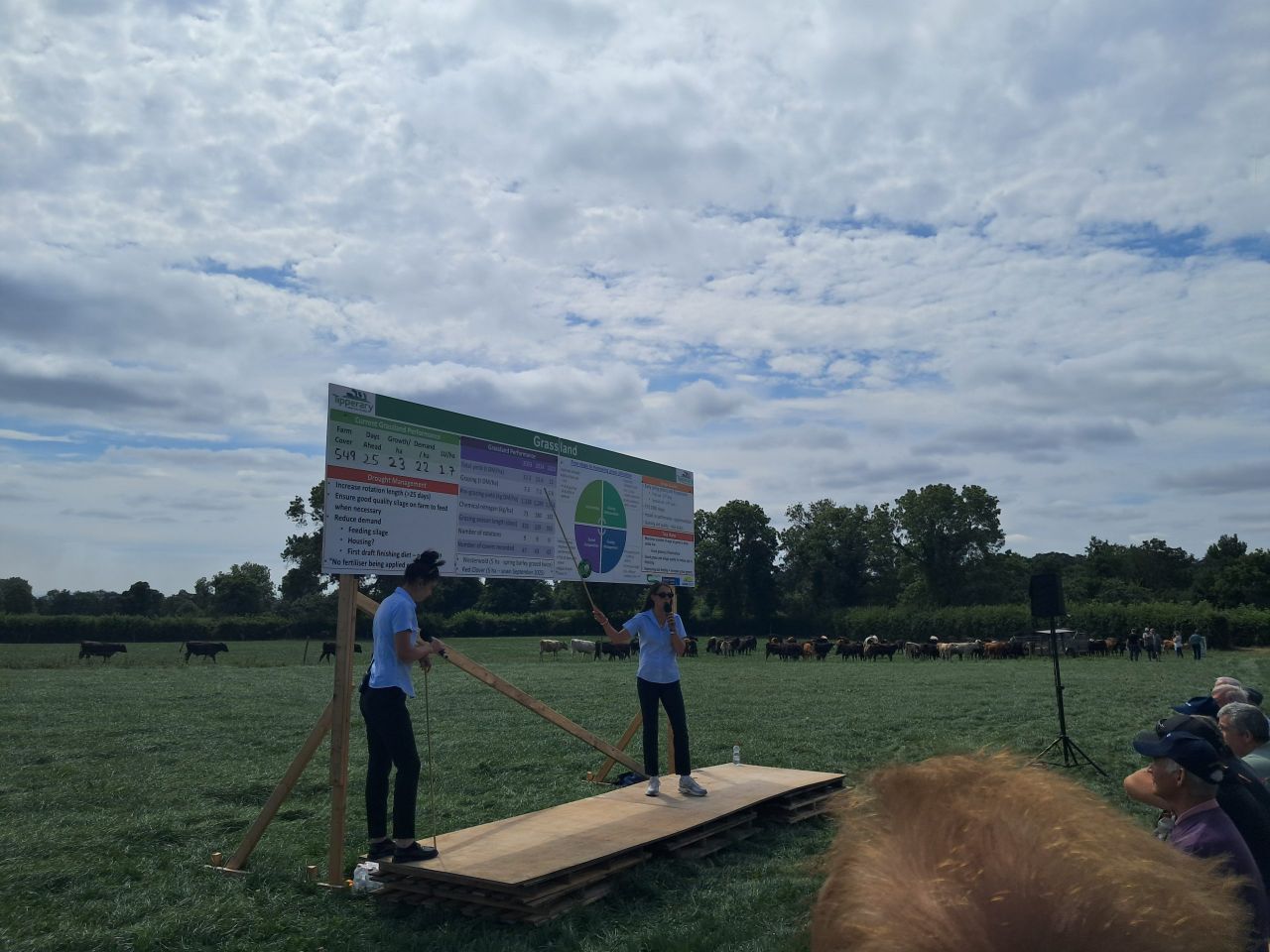
The farm opened its gates to the public on Wednesday, July 22, and openly shared all aspects of its physical and financial performance.
The profitability figures of the farm are available to view on the Agriland Knowledge Hub by clicking here.
Dawn Meats' agricultural manager Matthew Murphy and Teagasc's Alan Dillon discussed the slaughter performance of the cattle on the farm.
The table below details the carcass performance of the heifers and steers on the farm over the past four years:
| Animal | Year | Slaughter Age (months) | Carcass Weight (kg) | Conformation | Fat | Sale Price (€) |
|---|---|---|---|---|---|---|
| Heifers | 2022 | 21.0 | 250 | O= | 3= | 1,195 |
| 2023 | 20.6 | 250 | O= | 3= | 1,272 | |
| 2024 | 20.6 | 254 | O= | 3=/3+ | 1,431 | |
| 2025 | 20.5 | 271 | O=/O+ | 3+ | 2,108 | |
| Steers | 2022 | 21.5 | 262 | O= | 3- | 1,310 |
| 2023 | 21.4 | 288 | O= | 3- | 1,486 | |
| 2024 | 22.1 | 305 | O= | 3-/3= | 1,826 | |
| 2025 | 21.6 | 315 | O= | 3= | 2,353 |
The farm has slatted accommodation on-farm for 300 finishing cattle cattle and straw-bedded accommodation for 250 weanlings.
The aim is to get cattle slaughtered before weanlings are housed to minimise the numbers on straw.
In 2025, there were 191 steers and 153 heifers slaughtered off the farm. All of these were born in spring 2024.
The average steer carcass-weight in 2025 was 315kg at 21 months-of-age. This was 10kg carcass-weight heavier and almost 1 month younger on average than the previous year.
The average heifer carcass-weight in 2025 was 270kg at 20 months-of-age. This was 16kg heavier on average than the previous year.
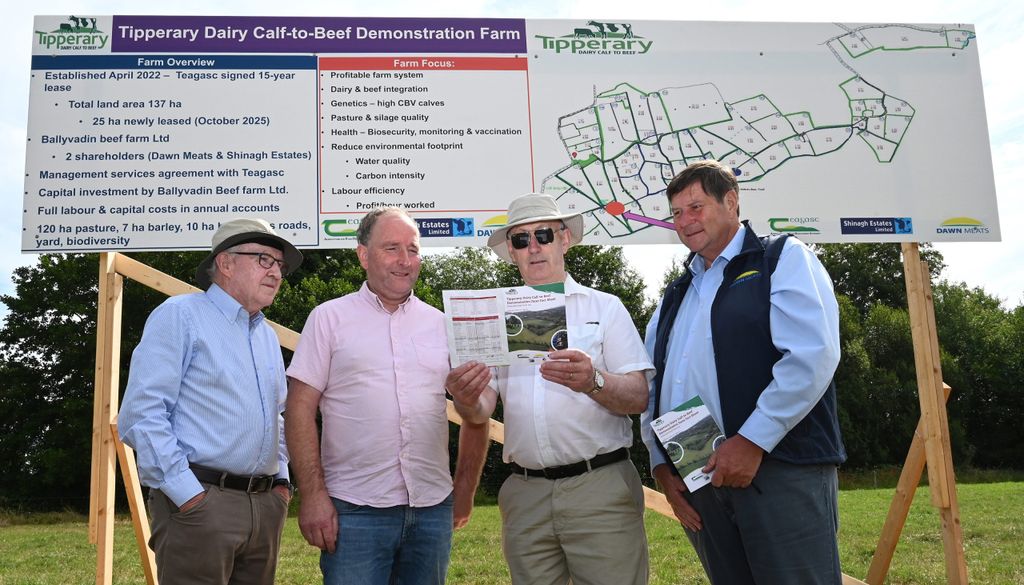
The Tipperary Dairy Beef Demonstration Farm
The farm delivered €1,620/ha net profit in 2025 and a €74/hour return on labour.
Projected figures for 2026 were also displayed on the day which reflected the changes in input and output prices in 2026 compared to 2025.
It was highlighted that the performance of the calves and the cattle is driven by good animal health practices, including a well-planned vaccination protocol for the animals on the farm.
Strong weight gain is achieved through good grassland management, including a planned reseeding programme incorporating clover and a soil fertility programme driven by soil testing results.
Speaking at the open day, Chloe Millar, Teagasc technologist with the Tipperary Dairy Beef Demonstration Farm emphasised the importance of maximising the number of days cattle are at grass to keep costs low.
Keeping good grass and silage quality in front of stock has helped to reduce the age at finishing also.
Farm manager, Jack Spillane spoke about labour efficiency on the farm.
A total of 443 calves were purchased over a six-week period this spring, with a single intake day/week.
Calves arrive at a minimum weight of 42kg at 21 days-of-age and have received an initial pneumonia vaccination on the birth farm.
A simple teat feeder system is used and calves are weaned when they reach 85-90kg.
Cattle are kept in large groups to minimise the number of grazing groups.
There was a lot of interest on the day in the farm’s contract calf supply model.
Nine spring-calving dairy farms provide a consistent supply of healthy, genotyped calves with high Commercial Beef Value (CBV) genetics.
The price paid for the calves is based on weight, sex and CBV.
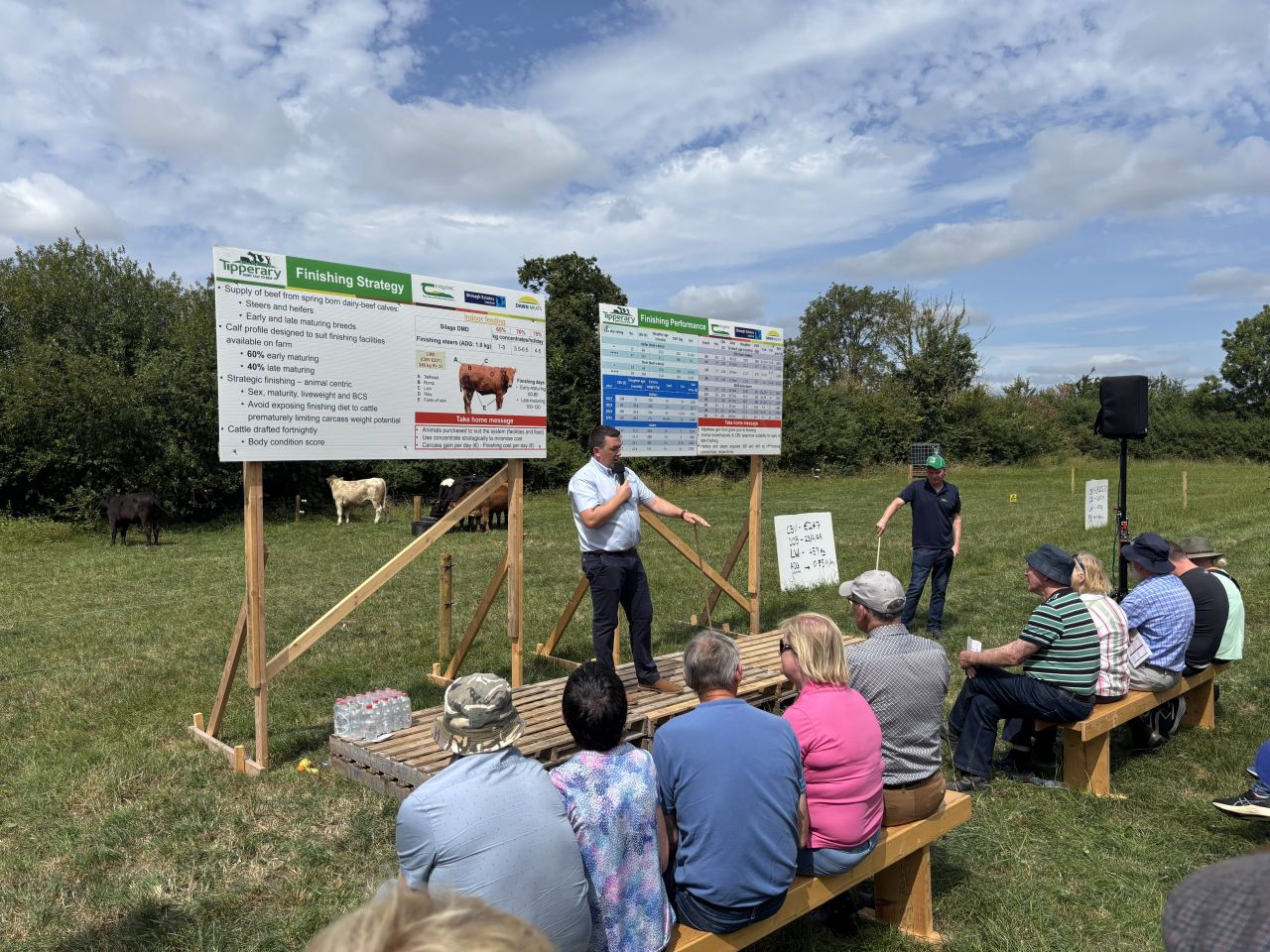
Mathew Murphy from Dawn Meats spoke about the finishing strategy on the calf-to-beef farm and how the profile of the calves is designed to suit the finishing facilities available on the farm.
This means there are 60% early-maturing breeds and 40% late maturing breeds on the calf-to-beef farm.
He also emphasised the strategic use of concentrates at the finishing stage to minimise cost with heifers and steers requiring approximately 300-440kg of finishing concentrate respectively.