Average calving interval down to 383 days in 2026
The average calving interval has reduced down from 388 days in 2022 to 383 days in 2026, according to the Irish Cattle Breeding Federation (ICBF).
It has also highlighted to farmers that the calving interval "remains one of the most important indicators of herd fertility".
ICBF has outlined that the 2026 dairy calving statistics are now available through the latest Dairy HerdPlus Calving Reports.
The 2026 dairy calving statistics are based on data from over 13,500 dairy herds with 30 or more dairy cows.
It said that the latest statistics show that the "national performance has continued to improve".
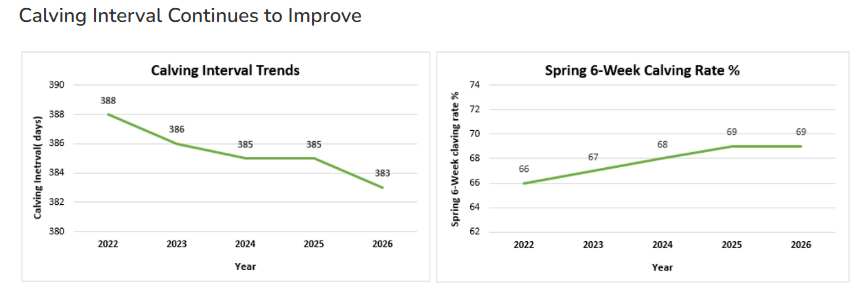
According to the ICBF, the five-day reduction "reflects improved reproductive efficiency and supports more compact calving patterns, greater milk production potential and improved farm profitability".
Six-week calving rate
The latest statistics also show that the spring six-week calving rate has increased steadily to 69% in 2026.
ICBF said this indicates that more cows are calving earlier in the season.
"Earlier calving can increase days in milk production, improve grass utilisation and contribute to greater overall herd efficiency," the federation added.
Heifers calving at optimum age
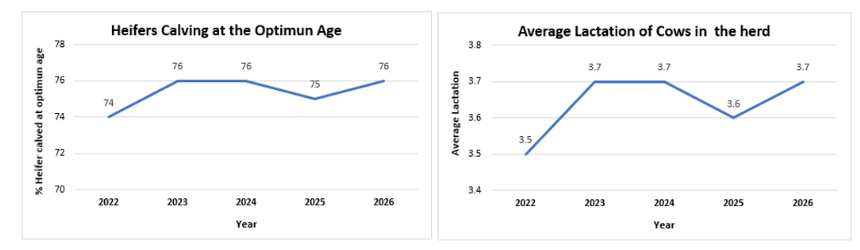
When it comes to the percentage of heifers calving between 22 and 26 months-of-age, there has also been an improvement, the latest statistics show.
ICBF said this performance improved from 74% in 2022 to 76% in 2026.
It added: "Achieving the optimum calving age helps maximise lifetime productivity, reduce rearing costs and improve overall herd profitability.
"While there remains room for improvement, the national trend continues to move in a positive direction".
Separately evidence suggests average lactation remains strong with the national average increasing from 3.4 lactations in 2022 to 3.7 in 2023.
It has remained stable through to 2026, which according to the ICBF "suggests that cows are remaining productive for longer, helping reduce replacement costs and supporting improved herd profitability".
AI
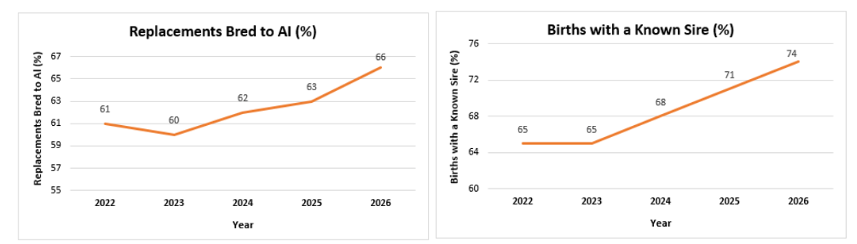
One trend identified in the Dairy HerdPlus Calving Reports is that the percentage of dairy artificial insemination (AI)-bred females has increased steadily and reached 66% in 2026.
"Greater use of AI provides farmers with access to higher genetic merit dairy sires, helping accelerate genetic gain and improve future herd performance.
"These sires are generally superior to the average stockbull and can contribute significantly to long-term breeding progress," ICBF has outlined.
The percentage of births from dairy dams with a known sire recorded has also increased to 74% in 2026.
It has pointed to the National Genotyping Programme, which genotypes calves at birth, as one of the reasons behind the increase in recorded sires
Best performing herds
According to the latest report, there remains a "significant variation between top-performing and bottom-performing herds".
The national average calving interval stands at 383 days, compared with 362 days for the top 10% of herds and 413 days for the bottom 10%.
Meanwhile the national six-week calving rate averages 69%, while the top 10% of herds achieve 89%.