Australian beef production hits record despite herd decline
Australian beef production will remain strong this year, driven by a productive herd, record high feedlot use, and robust global demand.
This was according to the Agriculture and Horticulture Development Board (AHDB), whose livestock analyst, Molly Corbett, said: "Diverse export markets are expected to drive exports to a second consecutive record in 2026.
"The Australian national beef herd is forecast to total 30.8 million head in 2026, a 0.9% year-on-year decline, with further contraction anticipated through 2027 and 2028."
The strong global demand for cattle, as well as increased cattle availability is reflected in the increase in slaughter numbers, "forecast to increase by 3.4% to 9.6 million head in 2026, the highest level in almost five decades", she said.
According to AHDB, beef production in Australia for 2026 is "expected to reach a record three million tonnes cwt, up 5% from the previous year".
Corbett said production was expected to ease slightly throughout 2027 and into 2028, however, but would still remain historically high due to elevated carcass weights.
"Average carcass weights are forecast to increase by 1% year-on-year in 2026 to reach 313kg/head."
These average weights are projected to continue rising in the coming years, and are expected to reach 319kg/head by 2028.
According to AHDB, "higher carcass weights and cattle availability reflect several changes in Australian beef production:
- Genetic gains, improving growth rates, fertility, herd survival rates and strong cow prices, are incentivising producers to replace older, less productive animals with younger breeding females.
- A younger breeding herd across Queensland and the Northern Territory is supporting long-term productivity. Good rainfall and pasture conditions have increased turn-off rates and feedlot entry weights.
- Increased feedlot capacity, shorter production cycles and improved finishing systems are enabling producers to market cattle more quickly, supporting throughput despite a gradually declining herd.
- Feedlot utilisation has exceeded 90%, with approximately 1.6 million cattle on feed".
Export growth
Corbett said that robust domestic supply and "resilient international demand continue to underpin export performance, but market access conditions are becoming more restrictive".
In 2025, Australia's beef exports reached a record 2.3 million tonnes carcasses weight equivalent (cwe), an increase of 15% year-on-year, she said.
"Export volumes are forecast to increase further to 2.4 million tonnes in 2026, representing growth of 5.8%."
ABHD added that safeguard measures introduced by China in January, "meant the allocated 205,000 tonnes of Australian beef was frontloaded into China, reaching the quota by June".
Thereafter, a tariff of 55% was imposed.
"Exporters are expected to start ramping up volumes in the last few months of 2026 to reach China in the first quarter 2027," Corbett said.
Australia’s second largest export market year-to-date, has been South Korea.
That country has quota arrangements in place, which have resulted in "tariffs of approximately 24% being applied after quota volumes were exhausted in July," she said.
Diversification
According to ABHD, the key message from Meat & Livestock Australia's outlook is that the country's diversified export portfolio "remains a major competitive strength".
"Australia supplies grain-fed and grass-fed beef to a wide range of premium markets."
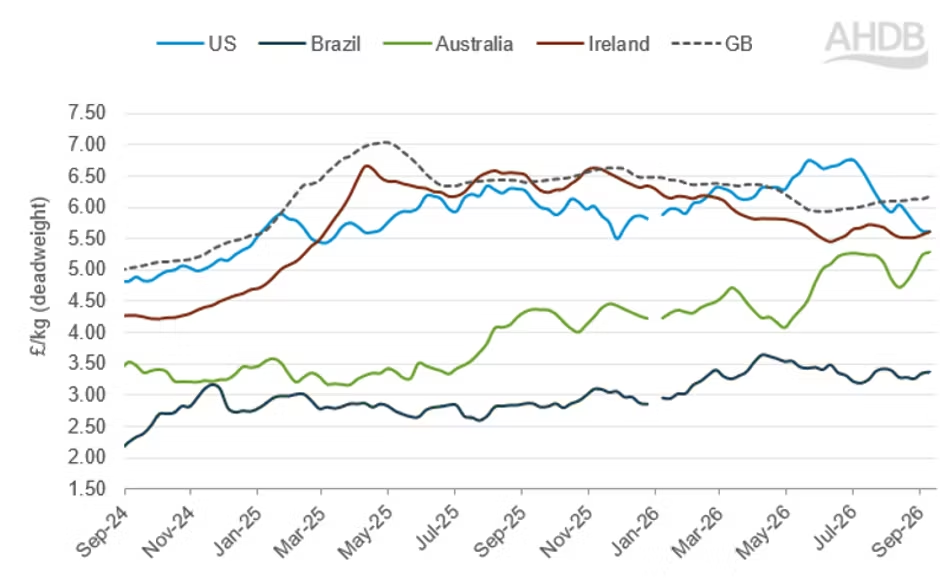
Despite producers continuing to face volatility in input markets, with fertiliser and fuel prices increasing significantly throughout the year following the outbreak of conflict in the Middle East, Australian cattle prices remain within the top 10% of historical levels, it added.
"The key watchpoints for Australian exporters are whether Brazil enters a herd rebuilding phase and how US herd rebuilding and trade policy changes affect future import demand."
It is expected that Australia's live cattle exports will reach 640,000 head in 2026, "with a modest recovery anticipated in the following year", according to AHDB .