Fertiliser prices stay 30% above 2025 levels

Fertiliser prices have eased but affordability remains a challenge, according to Rabobank's latest analysis.
Farmers face another squeeze on input costs, with fertiliser prices expected to remain about 30% above 2025 levels this year.
Geopolitical tensions, weather risks, and higher phosphate prices, cloud the global fertiliser outlook according to RaboResearch.
Analysts have also warned that supply remains at risk amid uncertainty surrounding flows through the Strait of Hormuz.
"Affordability remains a significant challenge for farmers, especially at a time when financial constraints are weighing heavily on them globally.
"Another important concern in the coming months is weather, with El Nino threatening crops," they said.
RaboResearch outlined in its report that the conflict in the Middle East continues to affect the nitrogen market amid uncertainty about flows from Middle Eastern producing countries.
"China’s return to the export market provides some relief to global supply, but not enough to resolve the situation," the report detailed.
"At the same time, China’s absence from the phosphate market, combined with higher sulfur prices and global supply constraints, is keeping phosphate prices elevated.
"Fertiliser prices have eased from their initial peaks after the start of the Middle East conflict, but crop prices and farm margins have not improved enough to restore purchasing power," analysts said.
RaboResearch’s fertiliser affordability index has improved from the lows reached after the conflict began, but fertilisers remain unaffordable for farmers.
The most challenging situation is in phosphates, with RaboResearch’s affordability index at -0.59.
"Commodity markets remain well supplied despite geopolitical tensions, trade disruptions, weather risks, and pressures on farm profitability.
"While global production and stocks of major row crops are expected to decline slightly in 2026, inventories remain historically high, keeping prices within established ranges.
"However, risks from El Nino, rising input costs, and Black Sea export challenges may increase uncertainty and support prices near the upper end of recent trading ranges over the next six to twelve months," analysts also detailed.
European fertiliser demand
RaboResearch said in its report that the European fertiliser markets enters the 2027 season with the strongest policy support for fertiliser affordability and supply security since the 2022 energy crisis.
It pointed to the European Commission's Fertiliser Action Plan and newly-introduced Common Agricultural Policy (CAP) support measures which "reflect greater recognition of fertilisers as a strategic input for EU food production and food security".
"Recent support schemes, including direct nitrogen fertiliser subsidies in France, Spain, Poland and Germany are expected to stimulate purchases and support fall demand," the report stated.
"Nevertheless, farmers remain highly cautious ahead of the 2027 season.
"Fertiliser costs for farmers are expected to remain elevated, averaging around 30% above 2025 levels in 2026 and declining only marginally in 2027," analysts warned.
Drought
At the same time, severe drought across large parts of western Europe is forcing farmers to reassess fall sowing plans and fertiliser requirements, the report said.
Although grain prices have strengthened since July, supported by weaker crop prospects and disruptions to Black Sea exports, higher crop revenues remain insufficient to offset elevated fertiliser and broader farm input costs.
"As a result, farm margins remain under pressure, likely leading to conservative fertiliser spending," according to RaboResearch.
"EU fertiliser import volumes remain well below historical averages as buyers delay purchases in anticipation of lower prices should geopolitical tensions in the Middle East ease.
"The largest declines have been recorded in urea and phosphate imports, particularly DAP and MAP, while potash and superphosphate imports have outperformed historical trends due to their lower exposure to conflict-related supply disruptions and price volatility," analysts highlighted.
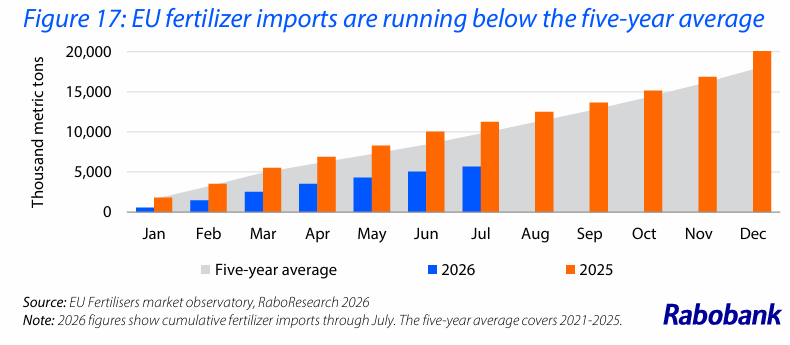
Although import activity is expected to strengthen in the second half of 2026, the weakness seen so far supports the view of a modest decline in European fertiliser demand during the 2027 application season.
"Meanwhile, the European nitrogen industry operated close to full capacity during the first half of 2026, supported by firm domestic prices and reduced import competition.
"Looking ahead, producer margins are expected to come under pressure from elevated gas prices, lower imported ammonia value and rising carbon costs under the EU Emissions Trading System," the report stated.
CBAM
RaboResearch said the Carbon Border Adjustment Mechanism (CBAM) has supported the competitiveness of domestic production.
Importers have had to calculate carbon costs using default emissions values that are punitively higher than actual plant-level emissions.
"While this helps level the playing field within the EU market, CBAM remains a challenge for European fertiliser exports and continues to weigh on export competitiveness," the report noted.
European fertiliser prices rose significantly in 2026 compared with 2025, with nitrogen prices up approximately 24%, phosphates up 10%, and potash up 6%.
While a moderate correction is expected in 2027, the scope for price declines "remains limited".
"As a result, fertiliser affordability is expected to remain a major challenge for European agriculture throughout the 2027 crop season," RaboResearch analysts said.