95% of Europeans see agriculture as vital for future of region


Agriculture and rural areas are considered important for Europe's future by 95% of Europeans, while 93% say securing a stable food supply for the bloc is crucial.
That's according to a new survey. the European Commission's Eurobarometer service.
It also showed that a large share of Europeans believe that the EU's Common Agricultural Policy (CAP) is delivering on its priorities.
Regarding consumption habits, the quality and origin of food are the most important considerations for Europeans.
Building on this, the commission will launch a new ‘European food’ campaign, as announced in President von der Leyen's State of the Union speech last year.
Commissioner for Agriculture and Food, Christophe Hansen said it was “encouraging" to see such strong public support for European agriculture and farmers.
"These results show that we are aligned with our citizens on the priorities that matter most: ensuring safe, high-quality food, supporting farmers and strengthening rural areas, while protecting our environment.
"The Common Agricultural Policy is central to delivering on these priorities and supporting farmers in meeting the expectations of European citizens," he said.
Public support
The growing public recognition of agriculture's strategic importance goes hand-in-hand with broad support for CAP.
70% of Europeans believe the policy benefits all Europeans, pointing overwhelmingly to its achievements in:
- Securing a stable supply of food in the EU at all times (93%);
- Ensuring reasonable food prices for consumers and sustainable management of natural resources (92%);
- Strengthening farmers' role in the food chain (91%).
In addition, around 85% consider that increasing agricultural competitiveness is an important CAP priority.
Most respondents believe food security has increased or remained stable over the past 10 years.
Nonetheless, more than nine in 10 recognise the impact that extreme weather events can have on food security and food supply.
EU origin
Respondents were also asked how important they consider EU origin when buying food products.
Almost eight in 10 Europeans consider it as an important or very important factor.
Almost nine in 10 point toward products being part of a short supply chain, and production being in line with higher environmental and animal welfare standards as equally determining in their purchasing decisions, together with quality labels.

When looking to the future, more than half of Europeans cite ensuring reasonable food prices for consumers (55%) and ensuring a fair standard of living for farmers (53%) as key priorities.
Other priorities include: securing a stable supply of food in the EU (50%); protecting the environment and tackling climate change (47%); ensuring a sustainable way to produce food (46%); and creating growth and jobs in rural areas (45%).
Over two in three respondents agree that CAP is delivering on protecting the environment and tackling climate change.
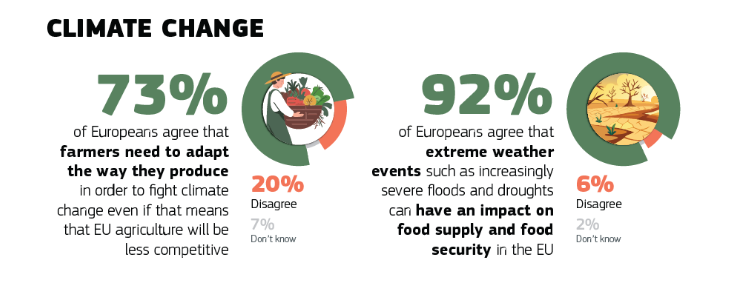
This is particularly relevant as 73% of Europeans agree that farmers need to adapt the way they produce in order to fight climate change.
The EU’s ‘Vision for Food and Agriculture’ framework seeks to address these priorities, including fair income for farmers, sustainable production and creating opportunities for young people in rural areas.
The European Commission's proposal for the next CAP also aims to address these issues.
Amongst others, it proposes a minimum amount for farmers' income support, which will be ring-fenced within the National and Regional Partnership Fund so that farmers will continue to have predictability and stability for their support under the Common Agricultural Policy from the EU budget.
Eurobarometer
Eurobarometer is the polling instrument used by the European Commission, the European Parliament and other EU institutions and agencies to monitor regularly the state of public opinion in Europe on issues related to the European Union as well as attitudes on subjects of political or social nature.
It provides data for experts in public opinion, researchers, media and the public.
For the survey, 26,456 respondents from different social and demographic groups were interviewed in their national language.