Will the next CAP give Ireland more control over farm payments?


The European Commission wants the next Common Agricultural Policy (CAP) to deliver "more targeted and fairer" support for farmers across Europe.
To do this it has proposed that the next CAP should be built around a single fund.
In essence the current two-pillar structure would be replaced with a single framework under a National and Regional Partnership Plan (NRPP).
High level discussions are now taking place over the next long term EU budget for the period 2028 to 2034, which is likely to be in the region of €2 trillion.
As part of this the commission has emphasised that it wants a "ring-fenced budget of at least €300 billion" set aside for farmers and a new National and Regional Partnership Fund (NRPP) - valued at €865 billion - that member states could also access "to finance the remaining CAP measures they need to put in place".
However in Ireland 75% of EU funding comes from CAP and as a result of this any changes to the current structure could have potentially far reaching implications for farmers.
The proposed changes would create a seisimic shift in how the CAP operates within the EU budget and on the ground.
But what might this mean for Ireland?
For a start potentially less money for CAP, although it is not strictly possible to compare like with like because of the proposed changes.
But based on current proposals Ireland would receive €11.4 billion under the general allocation for the new National and Regional Partnership Fund (NRPP).
Ireland’s proposed CAP allocation would then be €8.16 billion which technically equates to a 20% to 24% cut compared with the €10.7 billion Ireland received from 2021 to 2027.

In simple economic terms this would present a considerable challenge for Ireland.
The Minister for Agriculture, Food and the Marine, Martin Heydon, has made no secret of the fact that Ireland, which now holds the EU presidency and is in the driving seat in relation to budget discussions, wants to increase the funding for CAP.
Flexibility
But the European Commission has also argued that it wants to give member states more "flexibility" and claims that the integration of the CAP into the National and Regional Partnership Plans would deliver this.
Member states, including Ireland are currently working on their respective draft CAP Strategic Plans (CSPs) and next year will formally submit their draft national plans in line with the new legal provisions.
The European Commission will then assess and review each plan before they are officially approved and implemented at national level.
It will also make sure that each plan not only delivers on national needs, through country-specific CAP recommendations, but also aligns with overall commission objectives when it comes to the 2028-2034 proposal.
In the meantime "dialogue is ongoing" according to senior commission officials in relation to the Irish government and its CAP plan.
Ireland has previously set out its four key priorities for the next CAP these include:
- A CAP that is more straightforward for farmers and allows member states more freedom to better target measures to their own circumstances;
- A more flexible and responsive CAP with more flexibility to explore new funding streams;
- An appropriate balance between all elements of sustainability – economic, environmental and social;
- An adequate budget which retains the full toolbox of current measures under Pillar 1 and Pillar 2.
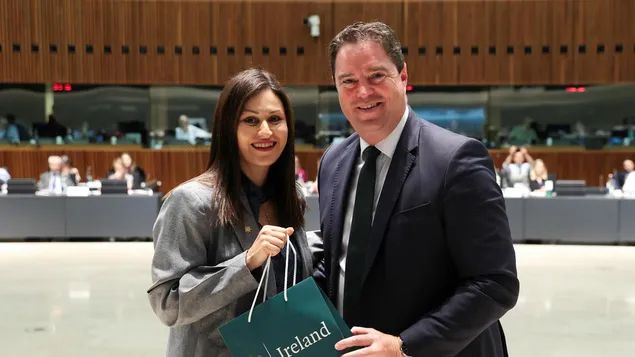
As Ireland takes the lead on CAP discussions, following on from the Cyprus EU presidency, it has also highlighted that the next CAP must be "workable in practice and simpler for farmers".
On this objective Ireland aligns with the European Commission's declared ambition to deliver "a simpler, more flexible budget" when it comes to supporting farmers.
The commission has proposed that a "simplified degressive area-based payment" will replace what it has described as the current complex payment scheme system.
It also claims that the next CAP will maintain direct payments but the new changes that it has proposed will also introduce measures "to prioritise support for young, small, and family-run farms" while reducing support for big farms by mandatory degressivity and capping.
In addition to this the commission has proposed an increase in coupled income support, with an increase in the maximum spending from 13% to 20%.
It has also suggested that an additional 5% could be possible for sectors and regions that "need it most, such as livestock farming and sensitive border areas".
The commission also wants to merge the current system of eco-schemes and agri-environmental measures into "a single category of agri-environmental actions" which in the future would be co-financed by member states.
Although the commission may preach the mantra of flexibility when it comes to the next CAP it has also acknowledged that there are certain elements that will be "mandatory" for each member state.
One of these is that every state will have to put in place a Generational Renewal Strategy which will ensure that structural, financial, and social barriers to entering farming are tackled.
But will the European Commission's CAP post-2027 proposal potentially impact on the payments that are so vital today to Irish farmers?
The commission has outlined that it wants "to prioritise income support for those who need it most" but what might this mean in practice?
It says this approach will acknowledge that farm incomes differ between sectors, farm sizes, age groups, and geographical areas and a one-size all approach does not deliver the best outcome for farmers in any part of the EU.
Commission officials believe the "proposed CAP makes it easierfor member states to redistribute support to the benefit of small- and medium-sized farms and specific groups of farms or farmers".
This could for example lead to the introduction of different levels of support for areas for example with natural or other specific challenges or for young farmers, mixed farms - growing crops and raising grazing livestock, female farmers, and family farms, "according to their specific needs".
In Ireland's case, according to officials, this would also give the Irish government more opportunity to design "targeted income support schemes".
By doing this the commission believes the next CAP could help "to promote a more resilient and sustainable agricultural sector" not just in Ireland but throughout the EU.
What it now means for Ireland as it gets ready to play a key role in the negotiations is that there is everything to play for.