Pig meat per sow up 6.8% since 2020 – report

The quantity of pig meat produced per sow per year has increased by 6.8% since 2020, due to a combination of "increased number of pigs produced per sow per year and increased carcass weights".
This is according to the National Pig Herd Performance Report (2025) from Teagasc, which examines performance of pig farms that participated in the Teagasc Profit Monitor (PM) recording system last year.
The data is from a total of 85 herds representing over 74,500 sows, or 55% of the total Irish sow herd.
Looking at growth rates, since 2020, growth rates from weaning to sale have increased by 7.4%.
The report also found that feed conversion has improved “a little” (1.7%) even though the live weight at sale increased by 3.6%.
Feed normally represents about 70% of production costs as reported in the Teagasc PM recorded herds.
Pigs born alive per litter
According to Teagasc, a “major” key performance indicator (KPI) to measure sow performance is the number of pigs produced per sow per year.
This is the number of pigs born alive minus all deaths in a year divided by the average number of sows in the herd.
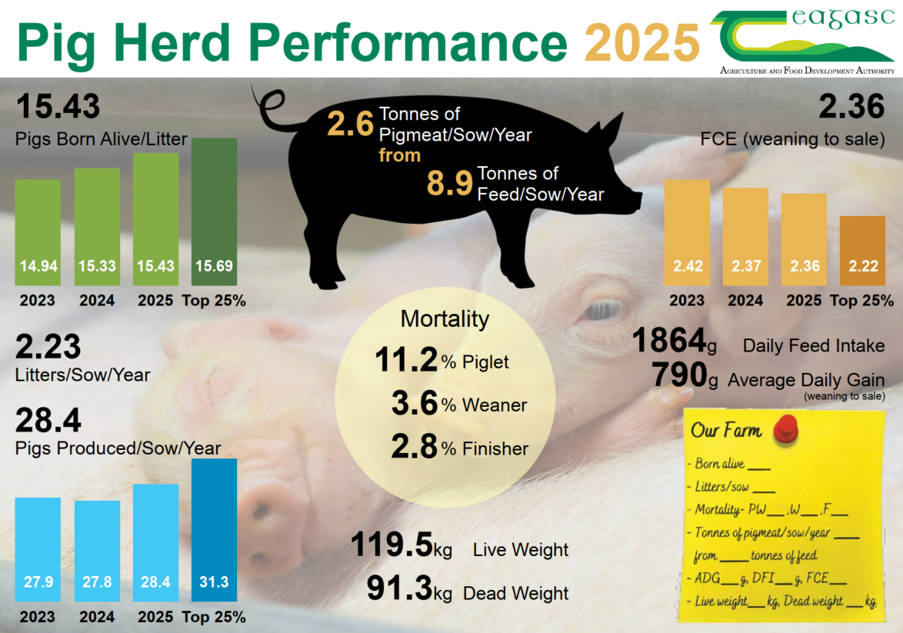
The rise to 15.43 pigs born alive per litter and an increase in litters per sow per year (2.23 in 2025 compared to 2.20 in 2024) combined with a slight drop in weaner plus finisher mortality caused the number of pigs produced per sow per year to increase from 27.8 in 2024 to 28.4 in 2025.
The output of pig meat per sow per year increased also, from 2,549kg in 2024 to 2,593kg in 2025.
Weight
Dead weight saw a "slight decline", according to the report.
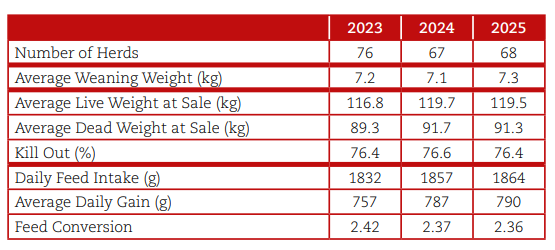
The average dead weight in recorded herds decreased from 91.7kg in 2024 to 91.3kg in 2025 per pig sold.
There was an increase in growth rate from weaning to sale (787 to 790g/day), and there was a decrease of 0.01 in the feed conversion from weaning to sale compared to 2024.
The average output of pig meat per sow per year was 2,593kg in 2025.
This amount of pig meat was produced using 8,980kg of feed, meaning it took 3.46kg of feed to produce 1kg of pig meat.
Teagasc said: “This figure was 3.47kg of feed to produce 1kg of pig meat in 2024.
"It is better than previous years’ figures when you consider that it ranged between 3.66 and 3.79 in the 10 years from 2001 to 2010.”
Weaners
On most farms, the weight of weaners transferred to finishing accommodation is an estimated weight rather than actual weights at transfer.
For this reason there may be a certain level of inaccuracy in the weaner and finisher performance figures.
The "true performance" is in the weaning to sale figures, according to Teagasc; however, it added that the breakdown in the weaner and finisher section is “useful information”.
There has been a decrease in the total weaner feed fed to weaners compared to 2024 (57.4 kg in 2024 versus 56.4kg per weaner in 2025).
The transfer weight was higher in 2024 at 39kg compared to 38.9kg in 2025.
The feed conversion decreased from 1.81 in 2024 to 1.79 in 2025. Weaner mortality dropped slightly from 3.58% in 2024 to 3.56% in 2025.
Finisher growth rates decreased from 988g/day in 2024 to 980g/day in 2025. There was a slight increase in feed conversion from 2.59 in 2024 to 2.60 in 2025.
Pig slaughter weights dropped slightly from 119.7kg live weight in 2024 to 119.5kg live weight in 2025.
Costs and prices
Teagasc said: “Most of the costs are quite similar to 2024.
“Healthcare cost increased by 0.9 cent in 2025 compared to 2024.”
The labour/management cost also increased by 1.7 cent (per kg dead weight) which may reflect more farms now recruiting more staff for their farms.
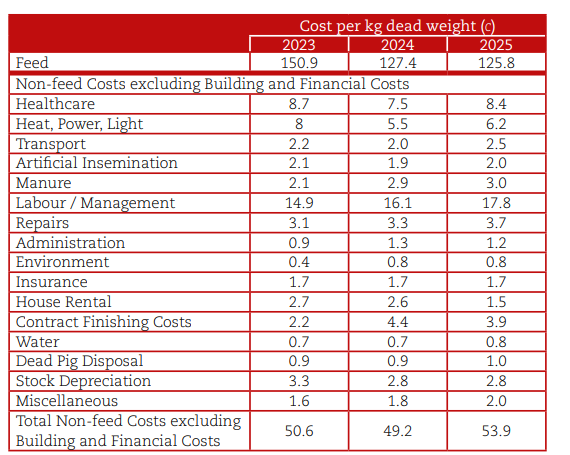
Heat, power and light and transport costs increased by 0.7 cent and 0.5 cent respectively in 2025 compared to 2024.
Costs such as house rental and contract finishing costs may not occur on all farms and are excluded from the “total” figure of 53.9c/kg deadweight shown above.
The average price paid was 210c/kg deadweight. Therefore in 2025 the study found that the price paid “did cover the production cost”.
Production
The herds in the top quartile of herds (selected on the number of pigs produced per sow per year) produced 2.9 more pigs per sow per year than the average herds, according to the report.
The extra pigs produced on these top 25% of herds is achieved by a higher born alive per litter and a lower mortality percentage at all stages of production.
Teagasc said: “This may suggest better management of pig health on these farms.”
The top 10% of recorded herds selected on the basis of 'number of pigs produced per sow per year' produced 4.0 more pigs per sow than the average for all recorded herds.
These top performing herds had:
- A higher number of litters per sow per year;
- Higher number of pigs born alive per litter: 0.46;
- Lower mortality levels in piglets, weaners and finishers: 4.84%.
The top 10% of farms used 18.3kg less feed per pig than the amount required on the average farms.
Teagasc said: "If we allow a feed cost of €320/t - this equates to a saving on feed of €5.86 per pig sold."