More bluetongue cases confirmed in Wexford

More cases of bluetongue have been confirmed in Co. Wexford.
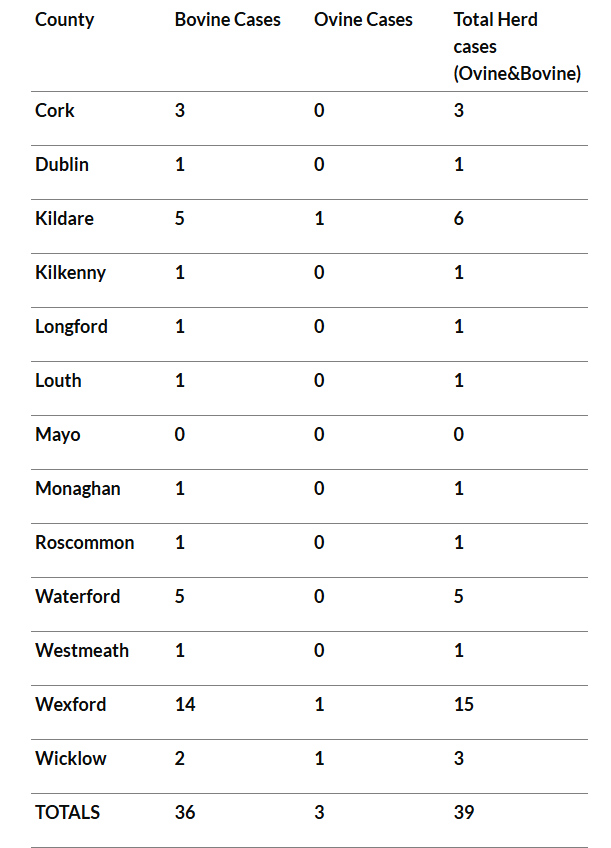
The Department of Agriculture, Food and the Marine has today (Tuesday, October 20) confirmed that the number of bluetongue cases in the country has risen to 39.
The majority of these have been bovine, while there have also been three bluetongue cases identified in sheep.
Latest figures show that Co. Wexford is currently the worst impacted county with 14 bovine cases and one sheep case.
Ireland is currently in the high-risk period for bluetongue spread - when midges are most active.
Bluetongue virus is spread by infected biting midges (Culicoides species), many of which are found throughout the island of Ireland.
Midge activity levels depend on average temperatures.
Traditionally the high-risk period would be between April and November, however rising global temperatures and mild weather conditions during winter may see midge activity persisting for longer, extending the periods of potential disease transmission.
Wind speed and direction can also affect how far midges can travel and could potentially facilitate the spread of disease.
Disease present across Europe
The disease is currently present in many parts of Europe.
Previously, bluetongue (serotypes 1, 4 and 8) was more commonly detected in southern Europe due to warmer climates.
However, the recent spread of a new bluetongue serotype, serotype 3 (BTV-3) across mainland Europe and Great Britain since Autumn of 2023, has increased the risk of spread to disease-free areas.
Currently, only some countries and territories, mainly towards the east of Europe, remain disease-free.