Land Use Review: Could a move away from livestock farming protect incomes?


A critical policy objective is to protect fair income for farmers, according to Phase 2 of the Land Use Review published by the government this week.
Phase two of the land use review was published after it was previously delivered to Minister for Climate, Energy and the Environment, Darragh O’Brien, Minister for Agriculture, Food and the Marine, Martin Heydon and Minister of State at Housing, Local Government and Heritage, Christopher O’Sullivan.
The first phase was completed in 2022 and the second phase - A Living Land - sets out current patterns and the various demands on land particularly in relation to climate and environmental commitments.
According to the review, the indicative pathways would imply a shift to those land uses which currently yield a higher family farm income than livestock systems - including tillage (plant protein), forestry, and bioenergy.
"Though the indicative pathways include a reduction in the area dedicated to dairy, this would be offset by significantly increased dairy productivity," the report states.
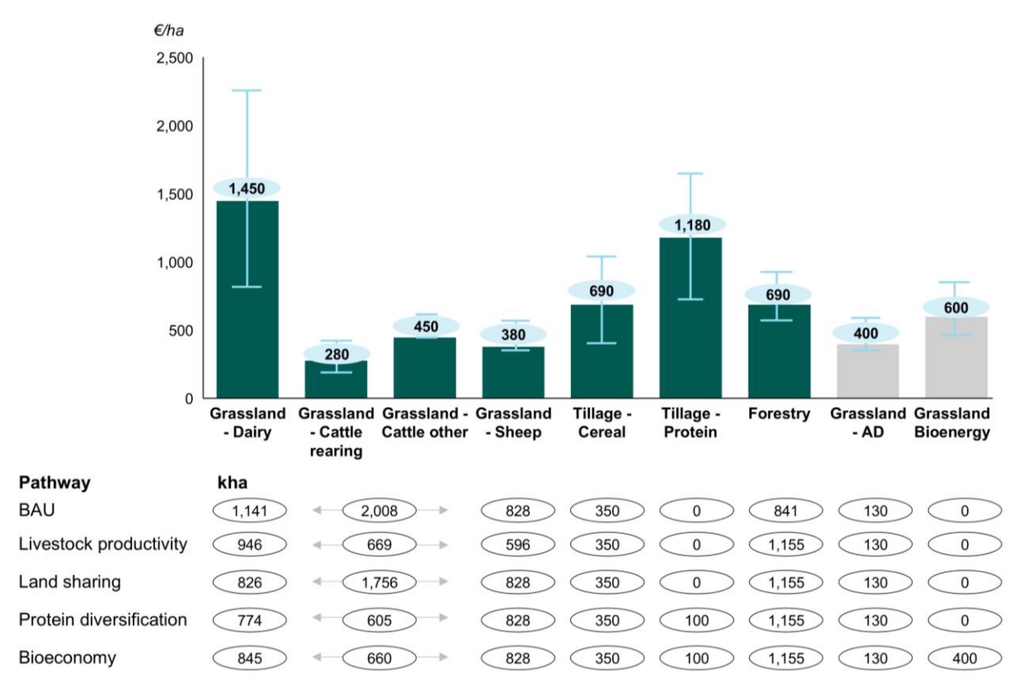
The graph above applies the current value of family farm income by land use type (assuming consistent direct payments) to the hectares of each land use type that would exist under each indicative pathway.
The authors have stated that it is important to note that these income estimates derive from the current economic performance of different land uses.
These estimates do not account for any potential improvements in productivity, or the incorporation of additional land management practices, which the report says may unlock additional income.
Production and exports
The report outlines that it will be important to consider how possible future output levels in key industries, such as beef and dairy, could impact employment and exports.
At present, up to 90% of Ireland’s dairy and beef produce is exported.
Therefore, the extent to which farm-level output varies in these sectors should be considered within the wider context of being high value-added export industries for Ireland, according to the report.
The indicative pathways would imply changes to the levels of total production.
In all indicative pathways output of bioenergy and wood from forests would increase compared to BAU.
Dairy and milk output would increase under two of the four alternative indicative pathways (sustainable intensification and bioeconomy).
Output and employment
The report also states that while understanding potential changes to family farm income and export value is important, land use systems also affect the broader economy.
To assess that impact, multiplier coefficients for output and employment could be considered.
Estimated multiplier coefficients are numerical values used to measure the wider economic impact of changes in one sector on the broader economy.
They indicate how change in an input variable, such as an increase in agricultural production, affects or “multiplies” output variables like GDP and employment across all industries.
An output multiplier shows the estimated change in total economic output for each additional unit of output from a specific sector.
The agriculture, forestry, and fishing sector has one of the highest estimated output multipliers of any sector in the Irish economy, at 1.97, according to the report.
Looking at individual subsectors, a disaggregated analysis suggests that the output multiplier for cattle is about 2.5, and 1.9 for dairy.
This places these industries among the highest within their category.
The food processing industry, particularly meat processing, shows a significant estimated multiplier of 2.4.
Prospective bio-based industries, especially incorporating cascading uses of biomass, could also leverage large multiplier effects, according to the review.
Estimated employment multipliers (both average and marginal) are said to also be substantial for agricultural subsectors.
E.g., milk, cattle, and sheep subsectors have average estimated employment multipliers of 15.7, 20.8, and 22.7, respectively.
Overview
The report states that land holders - working within the evolving economic, social, environmental and policy context - will be the "ultimate decision makers" on future land use patterns.
Land holders currently face economic challenges and uncertainties.
The report outlines that economic, social, and environmental considerations (around knowledge and behaviours) will shape the changes that occur on Ireland’s land, in response to policy incentives, regulation and market drivers.
When, in earlier decades, the EU guaranteed farmers product prices that were well above global levels, the outcome was ‘buttermountains and wine lakes’, the report outlines.
Similarly, the authors state that innovation can be supported by financial rewards, technical supports, and engagement.
E.g., the revolution in low-cost renewables started when feed-in tariffs were used to reward suppliers, and suppliers then delivered.
Recommendations
The report suggests developing a coherent policy framework that can:
- Drive extensive peat soil rehabilitation and restoration to achieve long-term climate and biodiversity objectives, through reducing GHG emissions and providing habitat for species;
- Rapidly scale up afforestation well beyond current rates;
- Develop new income opportunities for land holders;
- Continue to improve the GHG- and land- efficiency of bovine protein output within climate targets;
- Drive agricultural emissions abatement beyond the current marginal abatement cost curve (MACC), e.g.. adopting methane inhibitors and grass-clover or multi-species swards;
- Develop bio-based industries that drive downstream mitigation and negative emissions via afforestation, product carbon storage and bioenergy with carbon capture and storage;
- Consider appropriate incentives for land holders to leverage land use to deliver considerable downstream climate mitigation. There may be a case for a share of negative emissions to be assigned to AFOLU.
There is also a recommendation for a clear working definition for long-term climate neutrality to "underpin consistent land use policy".

'A Living Land' followed the split-gas definition, in an attempt to recognise the distinct warming impact of CH4 in a simple, transparent manner.
Socioeconomic impacts of land use change will be spatially specific and will be strongly influenced by policy engagement, design, and collaboration, according to the report.
Understanding such impacts will require spatially explicit mapping of local effects linked with specific policy and market drivers and should include Just Transition indicators.