Is your tractor road legal?

They may be built for the farm, but tractors also have to meet strict safety standards on Irish roads.
The Road Safety Authority (RSA) Revised Standards for Agricultural Vehicles guide, first introduced in 2016, outlines the key requirements.
According to the RSA, a simple walk-around a tractor can often help you assess whether it is road legal.
Any attachments, such as trailers, should adhere to the requirements for maintenance, and match the agricultural vehicle's size, weight, and systems.
Authorisation plates
According to the RSA, a manufacturer’s plate must be fitted to an agricultural tractor and an authorisation plate to an agricultural trailer.
A manufacturer's plate contains information such as:
- Manufacturer's name;
- Vehicle identification number (VIN);
- Total permissible mass;
- Permissible axle loads;
- Permissible towable masses.
An authorisation plate contains a slightly different list of information, including:
- Manufacturer's name;
- VIN;
- Maximum design speed;
- Permitted laden weight;
- Maximum drawbar loading;
- Vehicle length and width.
An authorisation plate may also include information on design weight if the implement weighs more than the national limits permitted in Ireland.
A retrofitted plate can also be required on machinery registered before January 1, 2016.
This includes cases such as tractors with a maximum speed over 40km/h, or those being used to draw tandem or triaxle rigid drawbar trailers with laden weights over 19t or 22.5t respectively.
Additionally, agricultural trailers capable of being drawn at speeds over 40km/h or operating at laden weights exceeding 19t for tandems and 22.5t for triaxles also require a retrofitted plate.
Manufacturer's plates and authorisation plates can only be fitted by the vehicle manufacturer or an authorised distributor.
Non-compliance could result in a court summons where a conviction could lead to a fine up to €2,500, a prison sentence, or both.
Maximum speed
All tractors, self-propelled agricultural machines, agricultural trailers, and interchangeable towed equipment (such as a baler or rake) manufactured on or after January 1, 2016 are required to display a speed disc showcasing its maximum design speed.
In addition, any agricultural vehicles capable of speeds over 40km/h are required to be fitted with a speed disc, which must be located in a prominent position on the rear of the vehicle.
A self-propelled agricultural machine must display speed discs in a prominent position on both sides and on the rear of the vehicle.
If a agricultural trailer or interchangeable towed equipment, due to design or use, cannot facilitate the disc on the rear, it should be displayed in a prominent position on the right.
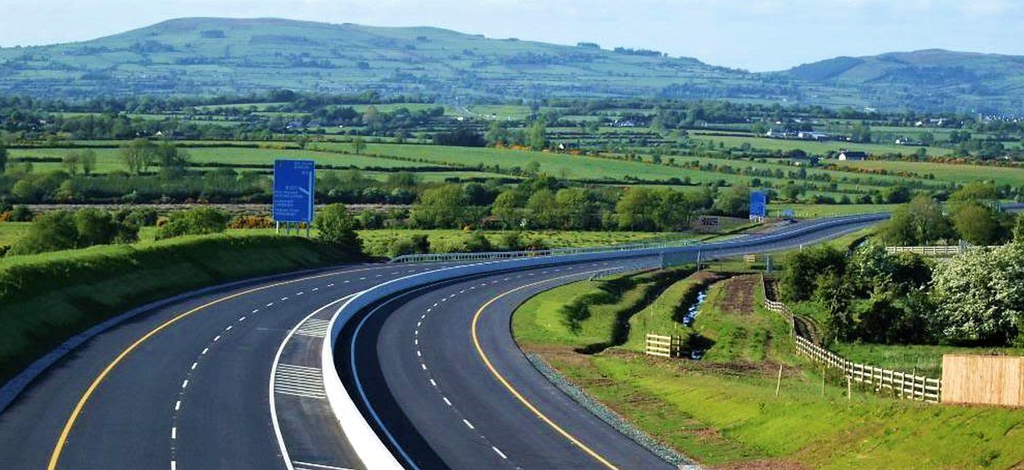
Tractors capable of maintaining speeds above 50km/h are permitted to travel on Irish motorways.
Commercial Vehicle Roadworthiness Testing (CVRT) was introduced for 'fast tractors' in 2018, and applies to machines with maximum design speeds exceeding 40km/h.
Lighting system
Tractors and self-propelled machinery that are used on roads are required to have flashing amber beacons to warn surrounding traffic that the machinery is a slow-moving vehicle (SMV), in addition to a SMV sign.
They must also be equipped with a full lighting system at all times, not just during lighting up hours (a half hour after sunset until a half hour before sunrise the following day).
A full lighting system must include: side lamps; head lamps; rear lamps; stop lamps; directional indicators; and number plate lighting.
A lighting board is required if a trailer or implement blocks a tractor's rear lights.
Marker lamps must be fitted to the right side of any trailer combination with a tractor where the combined length is over 10m.
The strength of marker lamps should not exceed a maximum of 7 watts and must show a diffused white light (i.e., light that does not dazzle).
Marker lamps must also not be higher than 1.5m off the ground.
Trailers with a design gross vehicle weight (DGVW) in excess of 3.5t must be fitted with rear reflective markings.
Agricultural trailers forming part of a vehicle combination over 13m long must display Irish specification or UN/ECE specification 'long vehicle' signs.
Braking
A category A anti-lock braking system (ABS) is required on trailers with a DGVW of more than 10t that were manufactured on or after January 1, 2016 and designed to be drawn at speeds over 60km/h.
Tractors capable of more than 40km/h are required to have an emergency braking system, which is generally activated the same way as the regular brake if this system fails.
There are also minimum braking efficiency requirements for agricultural machinery.
Minimum braking efficiency is calculated by dividing the braking force exerted by wheels by the vehicle weight. It is generally represented as a percentage.
Tractors with a speed rating up to 40km/h are required to have a service brake efficiency of 25% and parking brake efficiency of 16%.
Tractors with a speed rating over 40km/h are required to have a service brake efficiency of 45%, emergency brake efficiency of 22.5%, and parking brake efficiency of 16%.
Trailers/implements also have minimum braking efficiency requirements.
In addition, they are also required to have a breakaway brake, capable of automatically stopping the trailer if it becomes detached from the drawing vehicle while moving.
Trailers/implements with a speed rating up to 40km/h and DGVW of up to 5t require a service brake efficiency of 25%, breakaway brake efficiency of 13.5% and parking brake efficiency of 16%.
Trailers/implements with a speed rating of over 40km/h and DGVW more than 3.5t are required to have a service brake efficiency of 45%, breakaway brake efficiency of 13.5%, and parking brake efficiency of 16%.
Rules and advice
While much of these safety requirements are not in need of daily checks, they are legal requirements, so agricultural vehicles should be assessed regularly to ensure they are meeting their associated requirements.
Alongside these requirements, the RSA also issues safety recommendations in regard to operating agricultural machinery on the roads.
For instance, by law, agricultural operators are not required to wear a seatbelt while driving a vehicle; however, the RSA heavily advises it for safety reasons.
However, passengers in agricultural vehicles are required to wear a seatbelt.
Any passenger must also be seven years-of-age or above to sit into an agricultural machine.
Additionally, while we are all aware of the tractor licence requirement for road usage, agricultural vehicle operators must be a minimum of 14 years-of-age.
Drivers of agricultural vehicles are also reminded that they are subject to all road traffic legislation, and farm vehicles are required to be taxed and insured.