Hottest June-July on record for western Europe - report


Western Europe experienced its hottest June-July period on record this year, according to a report published today (Monday, August 10).
The average temperature in the region during the period was 21.62°C or 2.79° above average, surpassing the previous record from 2022.
The Copernicus Climate Change Service (C3S) said July saw the third and fourth heatwaves in the region since May, marking an "exceptional run of extreme heat" this summer.
"Although these were less intense than the heatwaves in June, the overall sequence of heatwaves since May remains exceptional for the region," the report said.
Europe
Much of western Europe also saw the widespread dryness of May and June persist and intensify during July.
Surface soil moisture levels in western Europe in July 2026 were significantly lower than those in July 2022, the last summer with severe drought across western Europe.
Exceptionally low rainfall and/or soil moisture was reported for France, Spain, parts of Germany and the UK.
The dry conditions caused river flows to be much lower than average, with the Seine, Rhine and Danube particularly affected.
This impacted water supply, irrigation and energy production in several countries.
The prolonged hot and dry conditions in western Europe in July also led to the spread and intensification of "extreme wildfires".
Around Europe, record high sea surface temperatures along the Atlantic and western Mediterranean were associated with widespread strong or severe marine heatwaves.
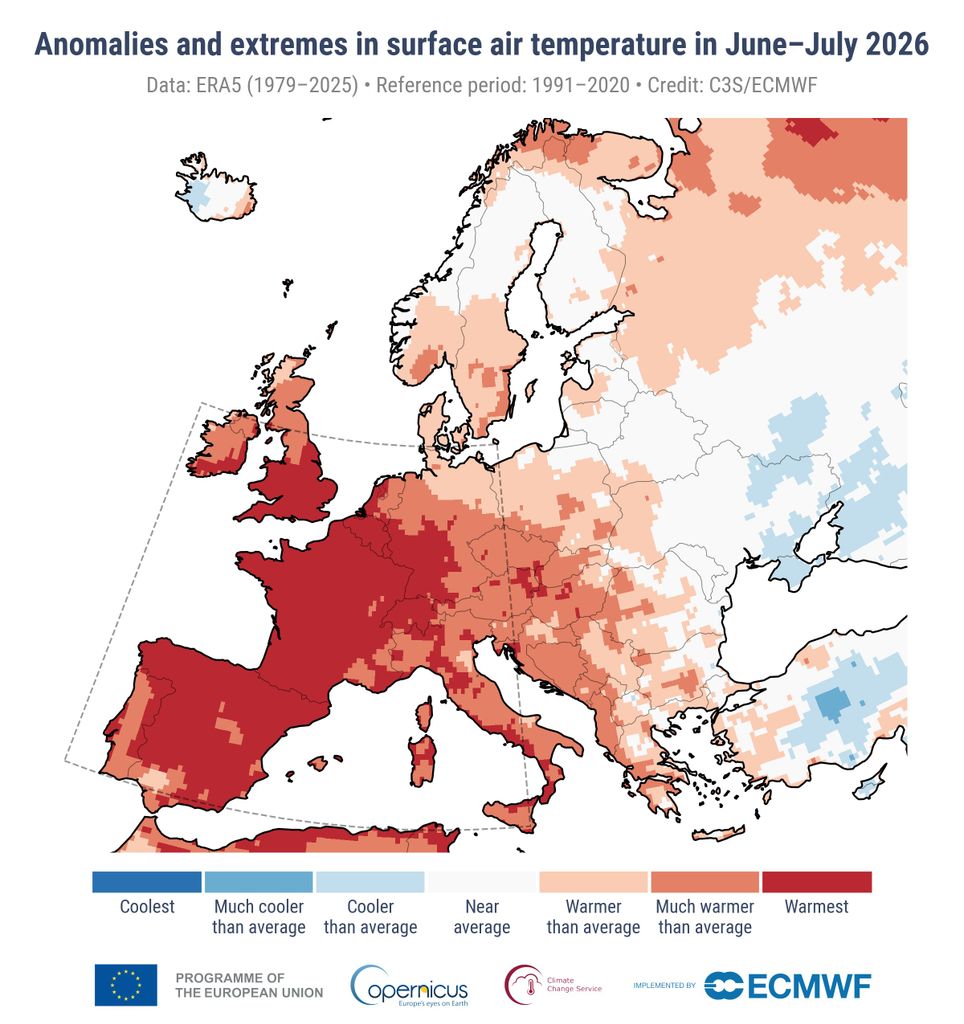
The average temperature over European land in July 2026 was the eleventh-highest on record for the month, at 20.49°, 0.66° above the 1991-2020 average for the month.
C3S said this relatively low ranking can be explained by a "sharp west–east contrast in temperature anomalies".
"Temperatures were much higher than average in western Europe (particularly in France, Spain, England and Ireland) but lower than average across much of eastern Europe and Scandinavia," the report said.
Wetter-than-average conditions were recorded in July 2026 in the Baltic States and Finland, Turkey, Greece, eastern Ukraine and large parts of western Russia, with some localised flooding and associated damage.
July
Globally, the month was the joint second warmest July on record, with an average surface air temperature of 16.90°, 1.47° hotter than the estimated pre-industrial baseline (1850-1900 average).
July 2026 was the joint-second warmest July globally, tied with July 2024 and behind the record set in July 2023.The month saw exceptionally high temperatures for the month across a large portion of the tropical Pacific.
El Nino conditions are present in this area and are forecast to further strengthen in the coming months.
Heat
Commenting on the report, Samantha Burgess, strategic lead for climate at the European Centre for Medium-Range Weather Forecasts (ECMWF), said:
"July 2026 was the third consecutive month of exceptional heat in western Europe, bringing the combined temperature for June and July to a new record for the region.
"Persistent high-pressure systems trapped heat over western Europe, the extreme temperatures also amplified widespread drought.
"As soils dry out, they lose their ability to provide natural cooling, allowing heat to build more readily.
"This is a clear example of how climate change is intensifying heat extremes, with heat and drought increasingly reinforcing one another."