Fertiliser prices: What are agri-stores quoting for products?


With the warm weather and silage underway, many farmers will be looking to get fertiliser into the yard ahead of a second cut or bringing paddocks back into rotation.
Farmers who have held off on buying in summer fertiliser supplies are now enquiring about current fertiliser prices.
Agri-stores can be reluctant to quote fertiliser prices openly, as there can be many variables in the price including delivery, time of payment, and when the fertiliser was purchased by the agri-store, as well as discounts for those with accounts with the seller.
Agriland contacted a number of agri-merchants located around the country to get an indication of what prices they are currently quoting for fertiliser.
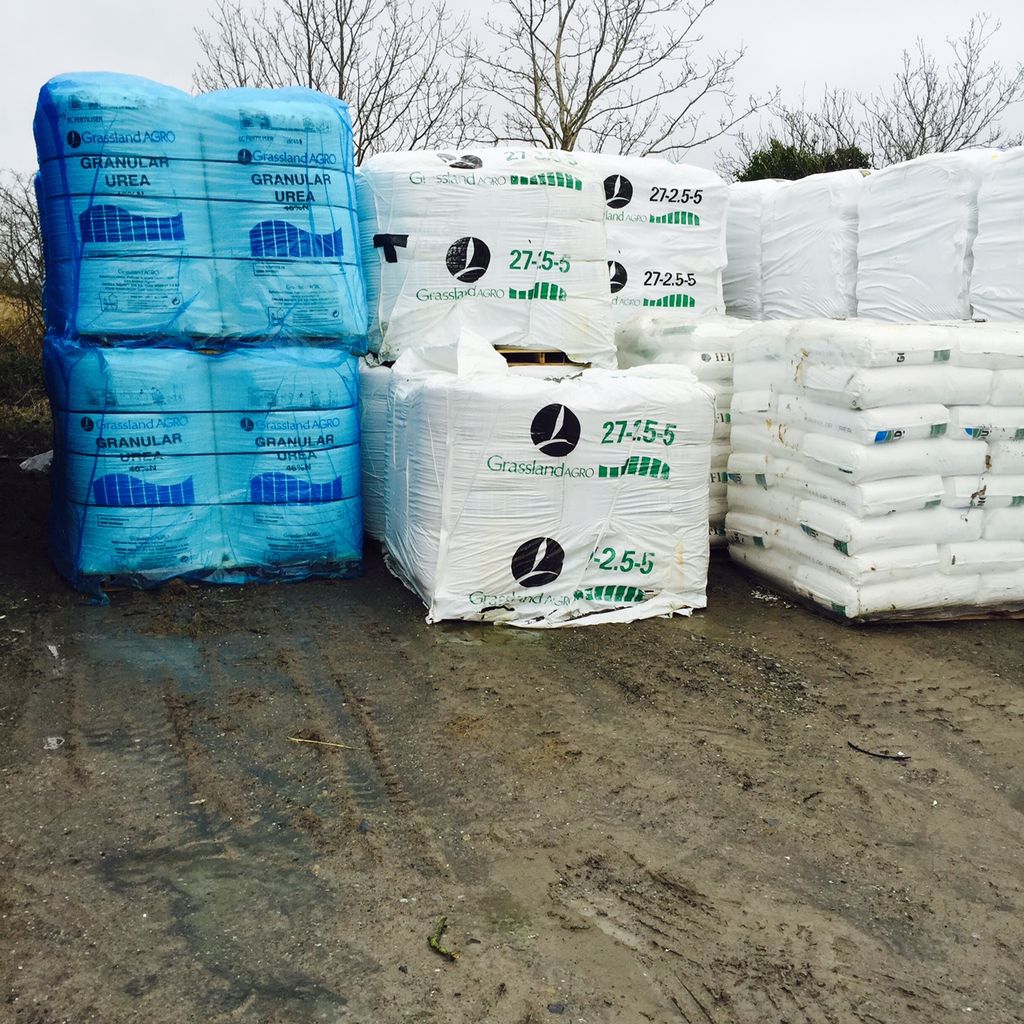
Most agri-stores who responded stated that prices have held or declined slightly over the last month, depending on the product purchased.
These prices have increased across the board since the beginning of the year, in large part due to the impact of the closure of the Strait of Hormuz in late February.
The table below gives a guide on the fertiliser prices quoted to Agriland for a range of commonly-used fertilisers:
| Fertiliser product: | Average | Range |
|---|---|---|
| CAN | €545 | €520-€570 |
| 46% Protected urea | €750 | €700-€800 |
| Pasture sward (27-2.5-5) | €649 | €620-€660 |
| Cut sward (24-2.5-10) | €652 | €615-€670 |
| 18-6-12 | €650 | €590-€680 |
| 10-10-20 | €729 | €715-€740 |
It is important to note that these are simply a range of prices quoted to Agriland by agri-stores across Ireland as of Monday, June 15. Prices are likely to vary in different locations.
Based on the fertiliser products that Agriland sought quotes for, 46% protected urea was noticeably harder to source, with many co-ops and agri-supply stores having limited or reduced supply and unwilling to give quotes over the phone.
In addition 38% protected urea with sulphur was marginally easier to source, but some outlets had difficulties with supplies.
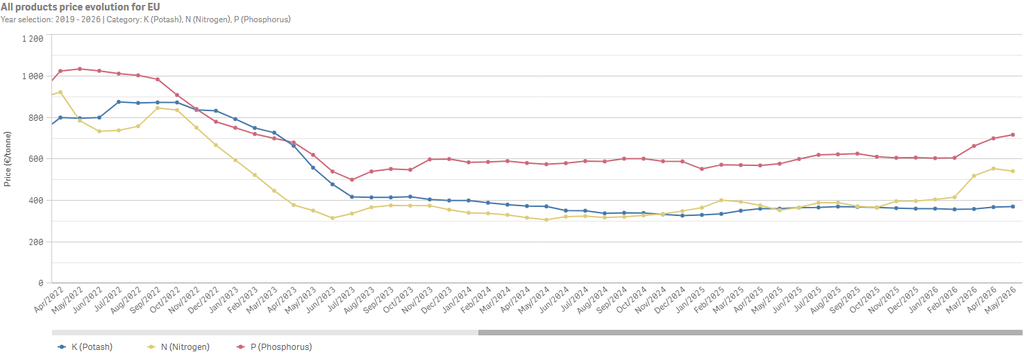
The prices have increased significantly since February, a trend seen across Europe as individual fertiliser compounds have seen dramatic price increases over the last five months.
The chart (below) from the European Commission Directorate-General for Agriculture and Rural Development (DG AGRI) shows the changes in prices for potash, nitrogen and phosphorus since April 2022.
When comparing Irish and European prices it is important to remember that Ireland imports the vast majority of its artificial nutrient requirements, chiefly from other countries in the EU and north Africa.
According to the International Food Policy Research Institute, the Strait of Hormuz was the chief transit route for 30% of the global fertiliser supply and 20% of the global Liquified Natural Gas (LNG), which is a key energy source used during fertiliser production.
Price forcasting
Discussions are underway on the reopening of the Strait of Hormuz following the announcement of a US-Iran peace deal.
The reopening of the strait may help to ease the pressure on individual fertiliser compounds, though prices may be slow to return to pre-conflict levels, as can be seen from the Russian invasion of Ukraine where EU prices have remained marginally above 2022 levels since.
Phosphorous in particular has seen a dramatic increase on pre 2022 levels.
According to latest data from the European Commission, while the 2019-2022 EU average for phosphorous ranged between €300-€400/t, the current average from 2024 to the beginning of 2026 is €600/t.
Another impact on EU fertiliser prices is the Carbon Border Adjustment Mechanism (CBAM), which is a tariff on fertiliser imported from non-EU countries, designed to increase the competitiveness of EU producers of fertiliser as well as acting as an environmental tax on high emission products into the EU.
According to the umbrella organisation representing EU farmers and agri-cooperatives Copa Cogeca, CBAM could cost farmers €39 billion over a seven-year period.
Managing the increases
With fertiliser prices putting strain on farm finances, farmers may aim to reduce the volume of fertiliser spread.
Soil tests are key to this as they enable a farmer to tackle the fields that require nutrients the most.
Understanding soil indexs for P and K is crucial to farmers.
Applying products with P and K on index 4 fields is a costly waste.
Index 1 and 2 fields as well as index 3 fields after silage should be targeted, as every 1t of dry matter taken off the field removes 4kg (8 units) of P and 25kg (50 units) of K, according to Teagasc.
- Lime spreading can unlock P supply within the soil, and boost grass growth;
- If spreading CAN, it is important to avoid very warm days as volatilisation (loss to the atmosphere) will result in losses;
- Heavy rain showers soon after CAN applications will result in losses to leaching within the soil and run off over the surface;
- Slurry can provide valuable potassium supply. Standard slurry contains 9-5-32 per 1,000 gallons, while farm yard manure, if it can be sourced, is even higher quality;
- Urea if applied in dry windy conditions is prone to volatilisation. Environmental Protection Agency data suggests 15.5% of urea can be lost if conditions are not favourable;
- GPS if available, can help reduce crossing over when spreading, reducing over-applications.
Fertiliser calculators are also available that can help farmers avoid over-applying.
If converting from kgs/ha to units/acre - kg/ha x 0.8= units/acre. 1kg=2 units / 1ha=2.47 acres