Call for action on how climate change impacts European agri-work


Protecting farmers and farm workers from a changing climate is not only a question of health and safety, “it is about whether farming remains a future people want to be part of, and ultimately about Europe's food security”.
This is according SafeHabitus project coordinator David Meredith, of Teagasc.
He added: “When employers and workers call for action with one voice, it tells us this can no longer wait.”
These statements were made at an EU seminar held this week.
SafeHabitus and the European Economic and Social Committee's (EESC) held the seminar on climate change and its impact on farmers’ health and safety.
SafeHabitus is a multi-actor project that aims to strengthen farm health and safety knowledge innovation systems and support the EU transition to social sustainability in farming.
The EESC is made up of representatives of employers, workers and civil society groups across the EU.
The policy workshop brought together EU institutions, social partners, researchers and civil society organisations to discuss how the EU can better protect those most exposed to climate‑related hazards.
The seminar was in response to a call from Europe's agricultural social partners, the European Federation of Food, Agriculture and Tourism Trade Unions (EFFAT) and the Employers' Group of Professional Agricultural Organisations in the European Union (GEOPA-COPA).
In a joint declaration, the groups urged the EU and national governments to “act on safe working in extreme temperatures and weather events”, and committed to take this work forward within the Sectoral Social Dialogue and, in particular, through the EU-funded SafeHabitus project.
Sectoral Social Dialogue in the agricultural sector refers to the formal discussions, consultations, and negotiations between European trade unions and employer organisations.
SafeHabitus is a multi-actor project that aims to strengthen farm health and safety knowledge innovation systems and support the EU transition to social sustainability in farming.
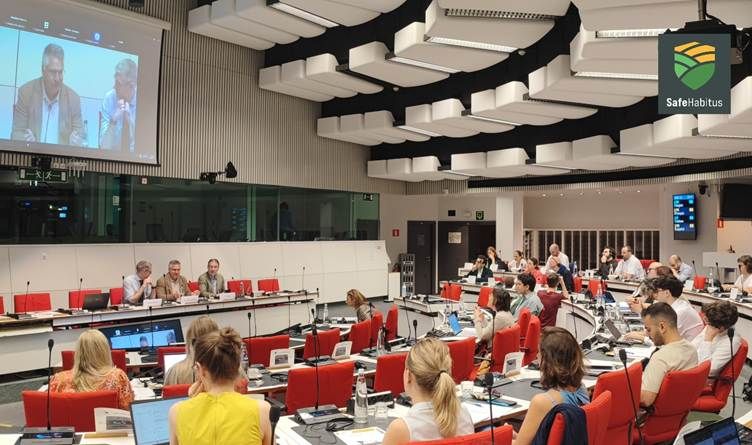
Stoyan Tchoukanov, president of the EESC’s Agriculture, Rural Development and the Environment (NAT) section said: “Addressing these risks requires an integrated approach that recognises the close links between healthy ecosystems, healthy food systems and healthy working conditions.”
The event examined how rising temperatures, extreme weather events and shifting seasonal patterns are affecting occupational health and safety (OSH) in agriculture.
Participants reviewed emerging evidence, shared examples of good practice, and explored policy options to strengthen resilience across the sector.
The programme included expert contributions from the International Labour Organisation (ILO), the European Agency for Safety and Health at Work (EU-OSHA), European Commission's Directorate-General for Employment, Social Affairs and Inclusion (DG EMPL) and leading academic researchers.
Roundtable
A policy roundtable featuring representatives from the European Parliament, EFFAT, GEOPA and the EESC discussed potential EU‑level mechanisms to address climate‑related OSH risks.
Panellists emphasised the need for improved data collection, stronger integration of OSH into climate adaptation strategies, and enhanced support for farmers and workers facing income loss due to extreme weather.
Tchoukanov said: “Climate change is increasingly affecting the health, safety and wellbeing of farmers and agricultural workers across Europe.”
The workshop forms part of SafeHabitus’ stated wider mission to “strengthen evidence‑based policymaking and promote safer, more sustainable working conditions in European agriculture”.
The project will publish a summary of key policy recommendations as part of its ongoing engagement with EU institutions and stakeholders.
The project’s policy lead Alun Jones said: “The EU Framework Directive on safety and health at work (OSH) was written during different times.
“Now with the impacts of climate change on the EU agri-workforce (including self-employed farmers and family members) being fully felt, we need to evaluate and manage these risks with an effective climate change risk management plan.
"After this seminar, we are now one step nearer to defining the next steps to manage this risk successfully.”