AI, X-Rays and heated knifes - how tech could change the carcass game


As researchers look to improve the reliability and efficiency of carcass processing, technology is at the forefront of their efforts.
This was evident at the Beef2026 open day in Teagasc Grange this week, where Agriland heard how new technological advancements are being tested to improve the process of carcass grading.
According to researchers, the beef processing sector has lagged behind poultry and pork in innovation due to carcass challenges, such as the larger size and significant variability between carcasses of different breeds.
Meat Technology Ireland (MTI), a major industry-led technology centre hosted by Teagasc, has placed a major emphasis on meat digitalisation research in computer vision systems and artificial intelligence techniques.
Speaking to Agriland at the event, Teagasc research officer Jingjing Liu discussed how these technologies are often being adapted from medical fields and trialled to determine their feasibility for use in the beef sector.
Old vs new
Current vision techniques rely primarily on colour and depth information but often cannot provide detailed tissue-level carcass characterisation.
X-ray sytems can provide internal composition information, but require specialised infrastructure that most small to medium processors do not have.
Visable-near infrared spectroscopy (V-NIS) is a technique that in lay-man terms means measuring how something reacts to light and measuring the wavelengths produced when light hits it. It does not damage the carcass and is relatively cost-efficient.
In a study, MTI combined V-NIS with several machine learning techniques and used it to discriminate between over 300 tissue types (such as muscle, fat, marrow, bone, cartilage, and tendon).
The results showed clear ability to differentiate between muscle, fat and marrow tissue, whereas overlap occurred where ligament and tendon and other similiar tissues were analysed due to their similar chemical composition.
The study showed that certain machine learning models worked best.
When V-NIS was replaced with the more accurate near-infrared-spectroscopy, this lead to 100% overall classification accuracy.
This showcases the enormous potential that combining these technologies has to improve carcass characterisation.
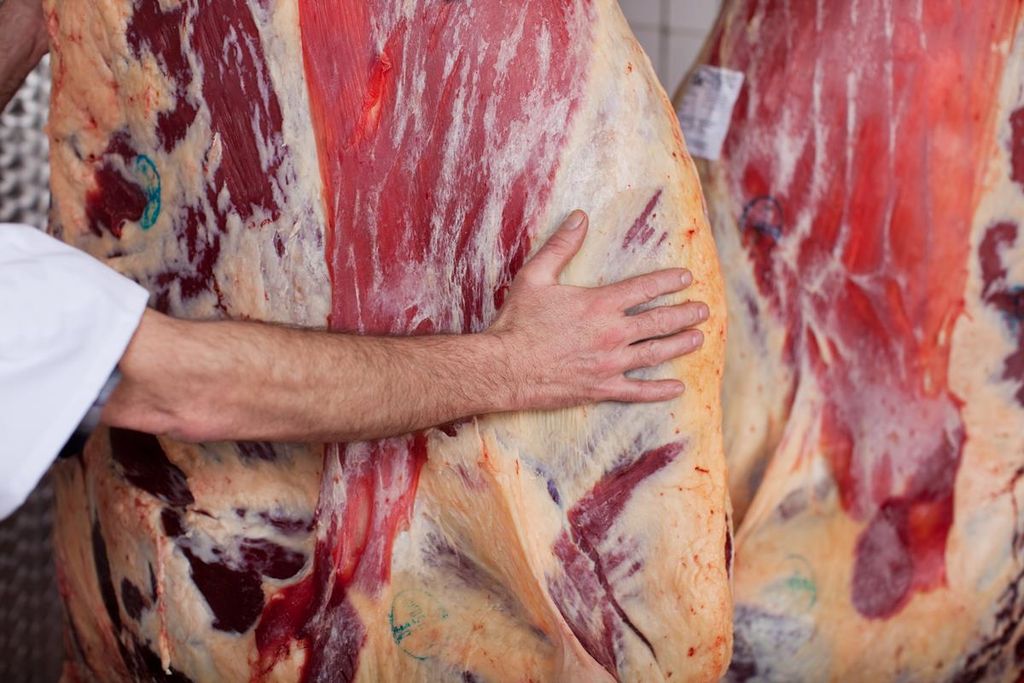
Artificial intelligence (AI) will play a role in future classification systems.
Trials using two deep learning frameworks analysed 118 carcasses. The models were trained to identify large features (spin, rib cage, and aitch bone) and smaller more complex features like individual ribs.
The average precision for large structures ranged from 94-97% but fell to between 78-92.4% for small features.
Computed Tomography (CT) is the gold standard for determining carcass lean meat content. It utilises a rotating X-ray and uses computer algorithms enabling the differentiation and quantification of tissues.
While time-consuming, CT and 3D scanning techniques are valuable in identifying variation in carcasses, and when used in conjunction with training new technologies.
The EUROP grid challenge
Teagasc also pointed to a 2018 study involving consumer trials across four European countries which found that 19% of sirloin, 25% of rump, and 53% of topside cuts were rated unsatisfactory.
According to the researchers, this inconsistency undermines consumer confidence, who cannot predict eating quality at the point of purchase and may experience different levels of satisfaction despite paying similar prices.
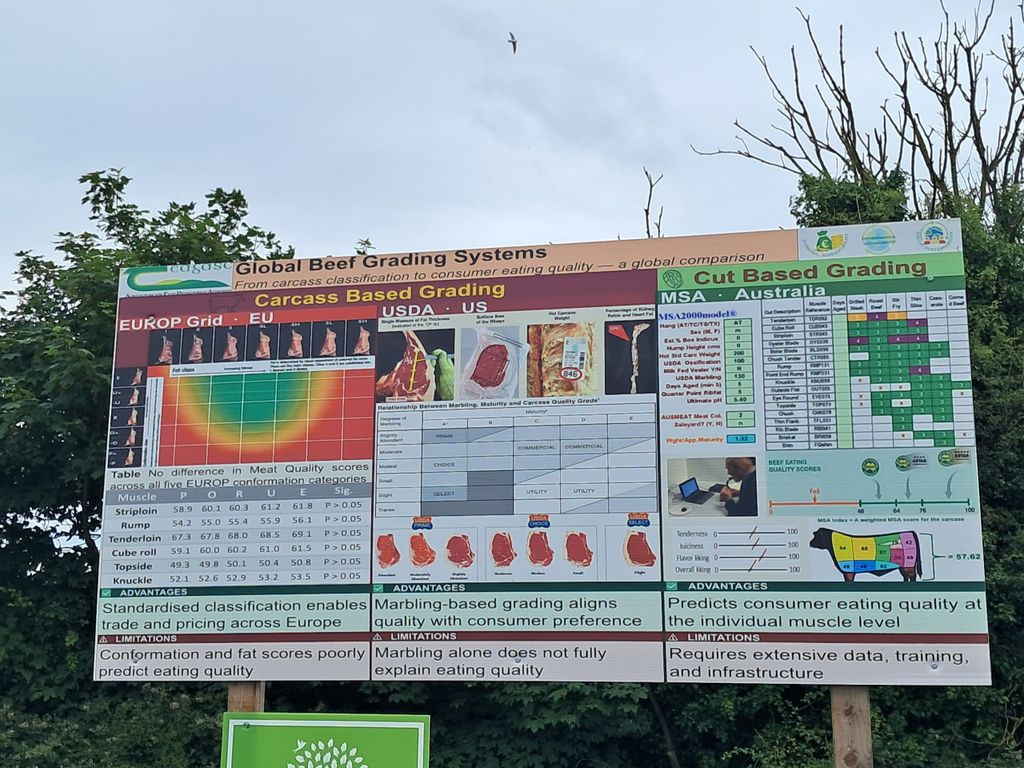
The European beef carcass grading system, the EUROP grid, was introduced in 1981 and remains dominant for carcass classification and pricing across EU countries.
However, its relevance has diminished as the beef industry increasingly depends not only on overall carcass characteristics but also on eating quality of individual primal cuts, researchers said.
In response to similar challenges, several international beef grading systems have incorporated quality-related traits alongside saleable meat yield.
The US, Japan, Korea, and Australia systems all include marbling in carcass grading.
According to the researchers, the "most scientifically validated consumer-orientated approach" is Meat Standards Australia (MSA), developed from the 1990s, which includes factors such as hanging time, muscle pH, and hump height, in giving each carcass an eating quality grade.
Meanwhile, Rapid Evaporative Ionisation Mass Spectrometry (REIMS) has shown huge potential for on-line beef quality prediction.
It works by directing a heated surgical knife towards the meat surface, creating an aerosol that is then analysed by a mass spectrometer creating a fat (lipid) fingerprint that acts as a quality guide.
REIMS achieved a 99% accuracy for rating wheather a consumer would like the meat flavour or not.
As tenderness is shown to be a trait that that consumers value highly, being able to predict quality is essential in reducing negative experiences with beef products.
Commenting on the challenges of REIMS, researchers noted how infrastructure is the primary concern, as the mass spectrometer is not feasible in the majority of small to medium processors.
They pointed to the need for continued research to identify the best technologies, being both streamlined and effective enabling potential wide-spread roll-out.
These technologies, when introduced on a large scale, will help address labour shortages, improve the accuracy of carcass grading, and reduce wastage and consumer dissatisfaction.
More details on the research presented at BEEF2026 on this and a wide range of other topics relating to beef production are available on Agriland's BEEF2026 Knowledge Hub.