Why were 43% of farms inspected in 2025 deemed non-compliant?

Local authorities carried out 4,315 initial farm inspections under the National Agricultural Inspection Programme (NAIP) in 2025.
This was up from the 2,598 inspections carried out in 2024, but just shy of the 4,500 inspection target set out by the Water Action Plan 2024.
However, the worrying figure is that 43% of these inspections were non-compliant under the Good Agricultural Practice (GAP).
But why are this many farms failing inspections?
Non-compliance
Senior executive scientist with Cork County Council, Frank O'Flynn spoke at the 2026 Teagasc Water Quality Conference yesterday (November 24), highlighting the issues they are seeing on the ground.
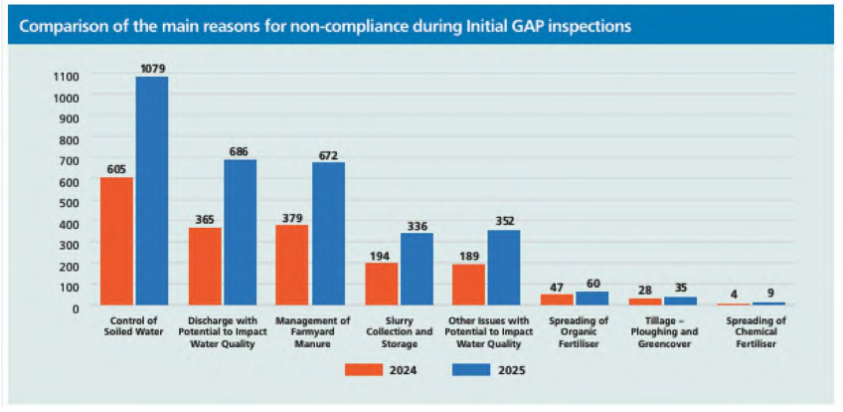
O'Flynn noted how the majority of non-compliance cases related to to the control of soiled water, with 1,079 farms non-compliant in 2025 for this reason.
This included issues such as inadequate gutters or downpipes to redirect clean water; insufficient storage for soiled water; and improper segregation of clean water.
A further 686 instances of non-compliance were due to discharge with potential to impact water quality.
Issues highlighted here included: improper management of the silage pit; silage effluent discharging to groundwater; and overground runoff to surface water, whether that be in the farmyard or on roadways.
Following on from here, 672 farm were found non-compliant when it came to the management of farmyard manure (FYM).
O'Flynn noted how issues here included runoff from FYM not being controlled, field storage of FYM during the closed season, as well as FYM being stored too closely to a waterbody,
Meanwhile, a further 336 farms were flagged as non-compliant due to slurry collection and storage.
Overall, this resulted in 2,935 enforcement actions being taken in 2025, 2,519 of which were compliance letters, 199 of which were cross-reports, and 203 of which were section notices under GAP regulations.
How to prevent non-compliance
No farmer wants to be non-compliant, so how do we go about passing inspections?
When inspectors come out, they are looking to see where water, be it clean or dirty, is running or leaching.
If there is an issue, it may be a simple fix like having enough gutters and pipes to redirect clean water, as clean water entering your soiled water tank could be as good as doubling your volume.
Another fix may be resurfacing and cambering the road away from a waterbody, as roadways can be a major source of pollutants that we can forget about once tanks are in the yard.

Other fixes which every farmers should be doing is eliminating poaching where possible, especially near waterways, as well as strictly abiding to buffer zones.
Farms who think they are doing everything right should still be monitoring local waterways regularly in-case of an oversight.
Slurry storage
Dr. Pat Tuohy of Teagasc also spoke at the conference, highlighting how nutrient losses can be minimised through upgraded infrastructure.
Dr. Tuohy referred to a recent study in which 100 dairy farmers participated.
One said their farm was able to divert 110m³ of fresh water by roofing over the collecting yard, which came at a cost of €64,000.
The farm was able to divert a further 370m³ of rainfall by roofing over open cubicles, which came at a cost of €90,000.
This was a total cost of €154,000, which worked out at €367/cow to divert 480m³ of water on a 420-cow farm.
Meanwhile, a 100-cow farm which was part of the study constructed a new soiled water tank at a cost of €14,850, as well as a new slatted tank at a cost of €72,500, equating to a cost of €874/cow to overcome storage issues.
Across the 100 farms, the average cost/m³ of diverting rainfall was €345.
Meanwhile the average cost of new storage was €152/m³.
The costs may seem high but it is something farms must be on top of ahead of the updated regulations coming into force in October 2028.
The updated regulations will see slurry storage requirements increase from 0.33m³ to 0.4m³, while the storage of soiled water requirements will increase from 0.21m³ to 0.3m³.
The upside of investing in additional storage, other to being compliant, is farmers will be able to avail of the full value of their slurry, rather than being forced spreaders in the spring.
As it stands, 1,000gls of slurry spread in ideal conditions is valued at €34, compared to just €14 when slurry is spread in poor conditions.
That means the slurry produced by a 100-cow herd over 18 weeks is worth €3,165 more when spread in ideal conditions.
Dr. Tuohy also noted the importance of emptying tanks ahead of the closed period, stating that a foot of slurry in an 8ft tanks is 12% of storage gone straight away.