Research: 69% reduction in nitrates on tillage land from cover crops

Research has found that nitrate loads on tillage lands could be reduced significantly where cover crops are used.
While the level of reduction noted at progressively larger catchments was lower, reductions were still noted.
The research was presented today (Tuesday, November 24) at the Teagasc Water Quality Conference 2026.
In tillage systems, cash crops can take up nitrogen remaining in the soil during the fallow period, thereby helping to reduce nitrate leaching to groundwater.
In Ireland, cover crops are supported through agri-environmental schemes, including the Agri-Climate Rural Environment Scheme(ACRES), as well as the Farming for Water EIP that was introduced in 2024.
The Teagasc modelling exercise that was presented today examined the potential water quality effects of the introduction of cover crops in terms of estimating their ability to producenitrate loss reductions.
The research first involved a plot-scale simulation of the Castledockrell catchment in which tillage farming accounts for approximately 72% of the land area, which was then extended to simulate the entire 1,120ha catchment.
A third set of simulations presented upscaled work to the larger Slaney catchment.
These three sample sites varied in size from 1ha; to 1,120ha; to over 1,000km2 (100,000ha).
According to Teagasc, at the smaller of the three scales, reductions relative to an established baseline level of up to 69% were predicted.
Teagasc noted that climatic factors partially explained difference in nitrate losses and uptake across different years.
At the larger scale 1,120ha catchment, similar findings were noted, where cover crop use reduced nitrate concentrations by 26% on average over a three-year period.
At the largest-scale Slaney Catchment, smaller loss reductions of 5% were predicted.
Teagasc water quality conference
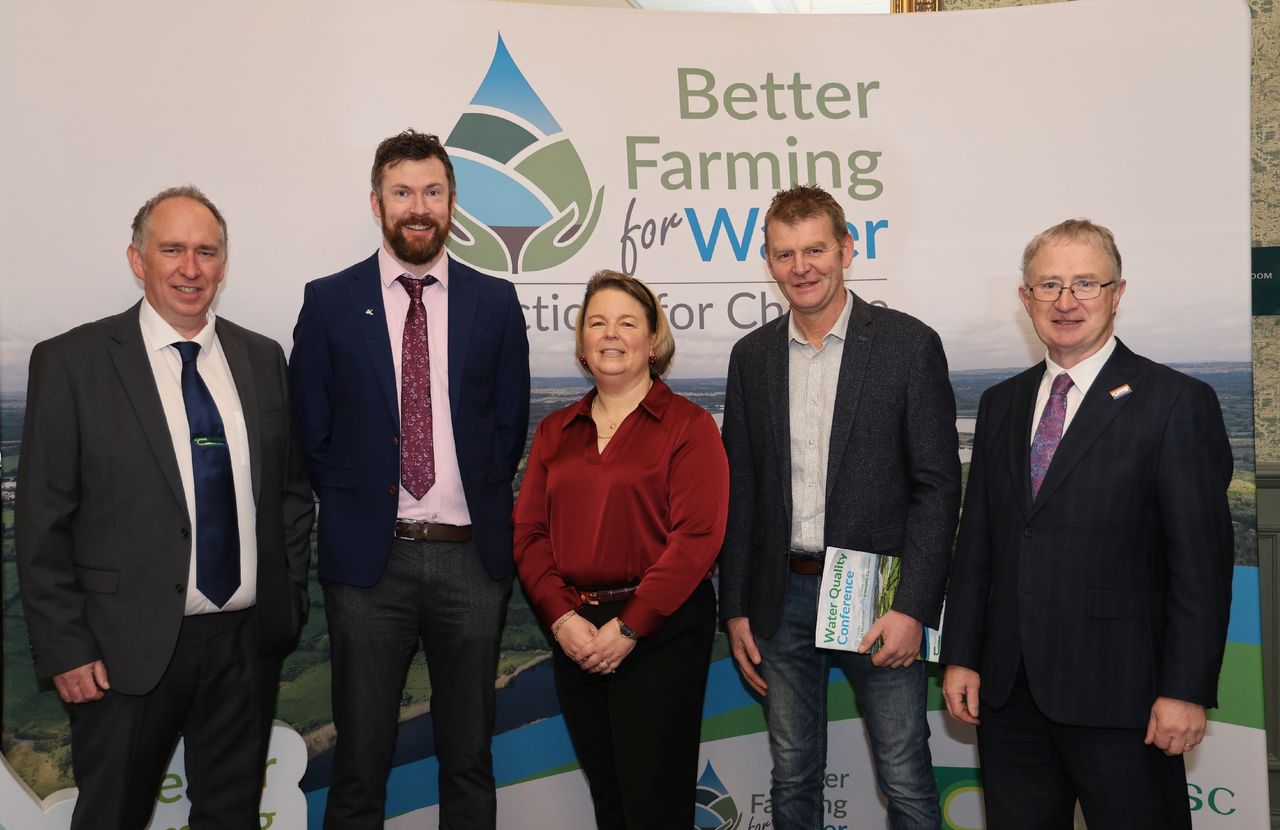
The Teagasc Water Quality Conference took place in Co. Laois today, with the event focussing on helping farmers to increase compliance with the National Agricultural Inspections Programme.
The conference also addressed how nitrogen losses to water can be reduced.
Commenting at today's event, Teagasc chairperson Liam Herlihy said there is "now a collaborative, joined up approach to improve water quality".
"We are unique in what we have, and we must strive to improve what we have. I see farmers are listening and taking on board the advice," Herlihy commented.
Director of Teagasc Prof. Frank O'Mara said: "Agriculture needs to play its part to improve water quality. Through the Better Farming for Water campaign, we are supporting farmers to adopt better nutrient, farmyard and land management practices."
Teagasc said that both itself and partner bodies have delivered 18 water quality events and collaborated with the Environmental Protection Agency's (EPA's) National Agricultural Inspection Programme (NAIP) to produce the information sheet and self-assessment farm checklist to help farmers prepare for inspections.
As well as that, more than 350 agricultural advisors recently completed water quality training required under the sixth and current Nitrates Action Programme (NAP).
Teagasc said its advisors are "now working directly with derogation farmers", while Teagasc dairy advisors are undertaking nitrogen assessments on farms in high-risk catchments, focussing on nutrient management, storage capacity and nitrogen redistribution.
Teagasc said "these collective efforts demonstrate the sector's commitment to improving water quality and securing the environmental and economic sustainability".
Jim Bergin, chair of the Better Farming Water Steering Committee, said: "Today's Irish farmers are the most educated, scientifically advanced and commercial in our history, having invested heavily in capacity and innovation.
"It would be regrettable if they were remembered for losing precious production capacity through delayed adoption of proven nutrient management practices. Let us resolve together to convert this compliance challenge into a science-driven profit opportunity," Bergin added.