Sponsored
Watch: Co. Meath farmer stresses the dangers of working at heights


Sponsored by

In 2021, Eddie Downey was working in a shed on his farm close to Slane in Co. Meath when he fell 12ft onto the concrete below.
The former president of the Irish Farmers' Association (IFA) shattered his pelvis, badly damaged his bladder and broke a bone in his wrist.
Downey was rushed by ambulance to hospital where he underwent several operations over a five-week period, before returning home in a wheelchair.
After two weeks, he transitioned to crutches and then began physiotherapy sessions.
"You're talking about six months or a year before I got back to where I was. It was a strange journey and one that I don't want to repeat," he said.
Downey is unsure if the fall, which happened during routine work on the farm, may have been caused by a blackout.
"It just was one of those things that happened in a split second," he said.
"I was 61 years-of-age, very fit at the time. You think at that stage you're invincible, it can't happen to you, but the reality here is that it did happen to me.
"I'm very thankful to be here alive today to talk about it and I just hope that other people will listen and not let it happen to them," he added.
Downey appealed to farmers not to use ladders for working at heights, if possible.
He also stressed the importance of using experienced people with proper equipment to carry out such work.
Working at heights
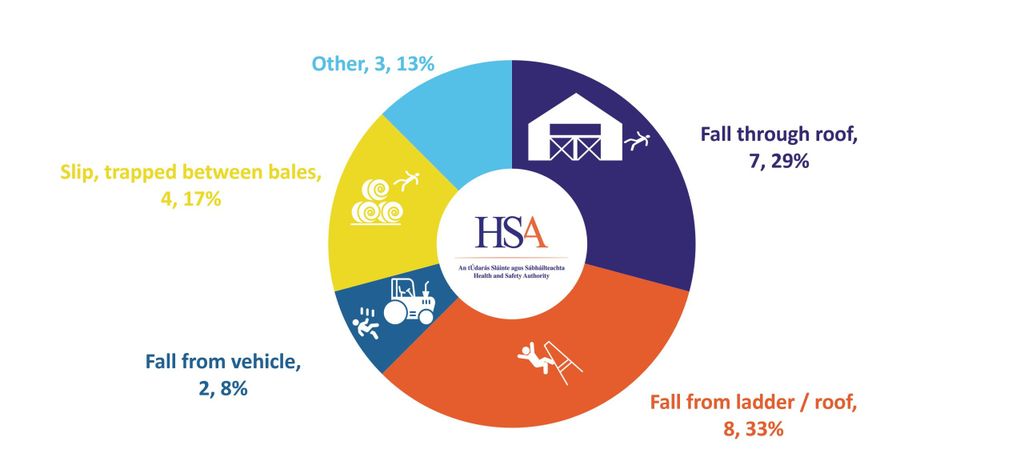
According to the Health and Safety Authority (HSA), in the 10-year period 2016-2025, approximately 14% of all deaths in the agricultural sector are associated with falls.
Falls from a height are also the major cause of accidents involving farm buildings.
A major issue on farms is people falling through fragile roofs, from ladders or from unprotected edges of roofs or other structures.
Before carrying out any work at height involving minor repairs on sheds, on buildings or on silos, farmers should ask themselves if they have the necessary skills and correct equipment to carry out the work safely.
The HSA advises farmers to consider using competent construction contractors for all work at height.
HSA
The authority said the right work equipment has to be selected and collective measures put in place to prevent falls, such as guard rails and working platforms.
Risk assessments should be undertaken by a competent person for all working at height activities.
This must identify all the hazards, including the presence of fragile roofing materials, and should set out the controls that will be put in place.
A roof is considered fragile if it cannot support the weight of a person or where part or all of the roof can easily be broken or shattered.
Skylights that become weathered or are painted over pose a significant danger as they are difficult to distinguish from other materials on the roof.

Farmers should minimise having to go onto a roof by working from underneath using a suitable work platform to replace sheets and lights.
Ensure all the work areas and access platforms are fitted with guard rails.
When this is not possible, safety nets or air bags should be installed underneath the roof or use a harness system.
If you need access to the top of the roof, use a mobile elevating work platform (MEWP), also known as a cherry picker, that allows people to work from within the basket without standing on the roof itself.
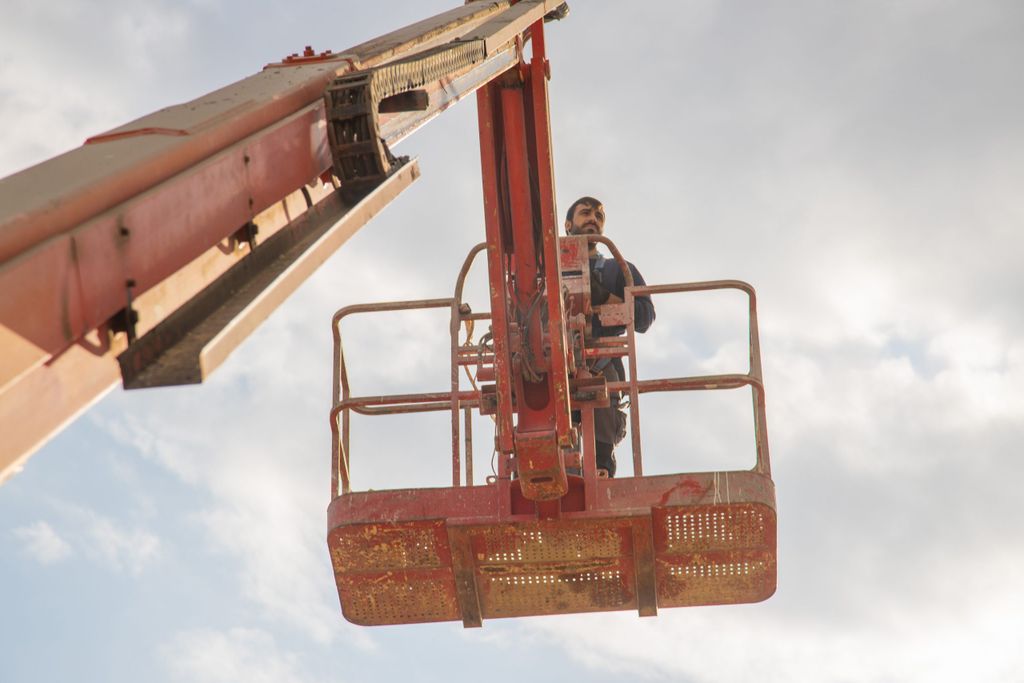
Anyone in the MEWP basket, which must have integrated controls for the machine, must wear a safety harness.
The HSA noted that extensive work at heights may require the use of scaffolds or properly designed work platforms.
It added that scaffolds should only be erected by people with appropriate training and experience.
Ladders
The HSA said that ladders should only be used as a means of access or for work of very short duration when there is no other safer way of doing a job.
Farmers are advised to place the base of the ladder on firm, level and secure ground, while always keeping three points of contact with the ladder.
The top of the ladder should be tied to a secure part of the building to stop it from slipping.
Ladders must be placed against the side of a building at a safe angle - about 75 degrees to the horizontal (1m out for every 4m in height).
When on a ladder, do not reach out sideways as this could cause it to destabilise and possibly turn over.
You can find more advice around working at heights on the Health and Safety Authority (HSA) website by clicking here.
TAMS
Through the Targeted Agriculture Modernisation Schemes (TAMS3) Farm Safety Capital Investment Scheme, the Department of Agriculture, Food and the Marine (DAFM) incentivises farmers to invest in improving safety on their farms.
The scheme provides grant aid for a range of farm safety-related investments at the higher rate of 60% to help farmers improve safety on their farms, including when working at height.
The main TAMS investments to help prevent falls from height are:
- Guide rails for silo wall;
- Retrofitting roof-light with safety cages;
- Manhole covers and protective fencing (including gates) for slurry store - while primarily to prevent drowning, they also protect against falls.
The TAMS specifications also provide information on health and safety before and during construction, including guidance explaining in practical terms what a farmer must do as a client commissioning construction work, in order to fulfil their legal duties.
Other than very minor repairs, such work is considered “construction work” and the legal requirements for construction work must be complied with, including the appointment of project supervisors in writing.
While working at height is not always a 'particular risk', if the work involves other dangers such as fragile roofing materials or nearby overhead power lines, it legally becomes a particular risk requiring you to appoint project supervisors in writing.
Topics
Sponsored by