VistaMilk exploring the future of dairy breeding

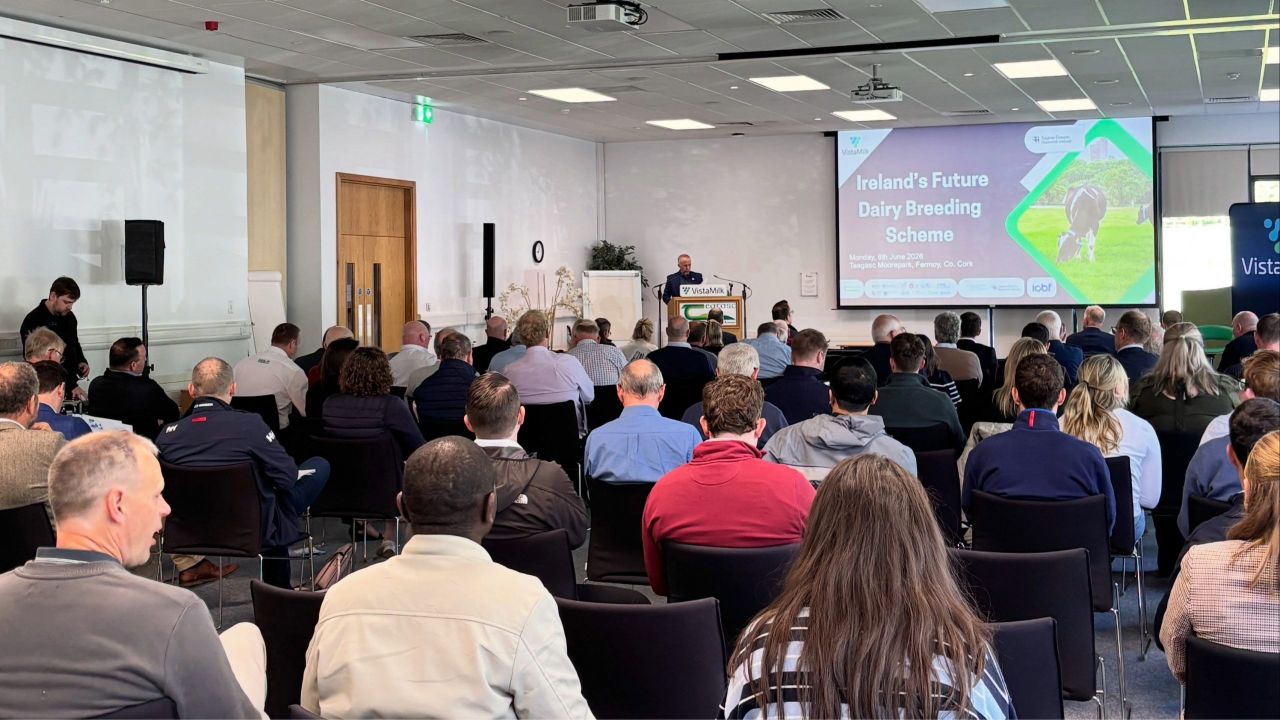
The VistaMilk Research Ireland Centre hosted more than 100 stakeholders in Teagasc Moorepark this week for a future breeding conference.
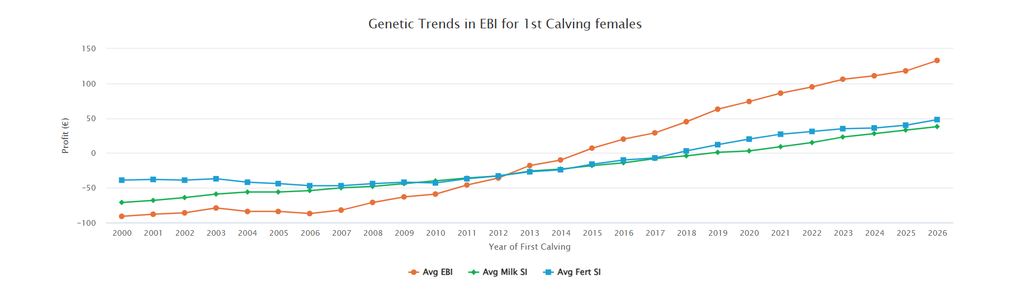
Breeding has already advanced significantly in the last 20 years, with the average Economic Breeding Index (EBI) climbing from €-87 in 2006 to €133 in 2026.
The average milk sub index has risen from €-54 to €38, while the average fertility sub index has also been elevated to €48 from €-47.
As research constantly improves, so does on-farm education leading to these rapid improvement in genetics.
However, technology has also improved significantly, from heat detection systems to genomic testing.
Many farmers have already adapted to these advancements, but we are yet to see the full impact at a nationwide level.
In 2025, the average cow had an EBI of €105 and was producing 5,412L of milk at 4.31% fat and 3.6% protein, equating to 441kg of milk solids (MS).
When it came to the breeding statistics, the average cow had a calving interval of 385 days, with farms maintaining a 70% six-week calving interval, where 60% of the replacement heifers born down in this time were bred via artificial insemination (AI)
Future dairy breeding
With dairy breeding already in a strong position, the VistaMilk conference explored how we can continue to improve dairy breeding through the future in terms of economically, environmentally, and social sustainability.
On the day of the VistaMilk led summit, there was an array of speakers from breeding and genetic organisations around the world.
The crowd heard from Havard Melbo Tajet from the Norwegian breeding organisation Geno; Andrew Cromie from global genetics company ST Genetics; Hendrik Albada of Genus ABS; and Lars Nielsen from Scandinavian breeding cooperative Viking Genetics.
The Irish Cattle Breeding Federation (ICBF) CEO, Seán Coughlan; reproductive technology expert with Teagasc, Dr. Stephen Butler; senior principal research officer and quantitative geneticist with Teagasc, Dr. Donagh Berry; and genetic operations officer at ICBF, Dr Margaret Kelleher, all spoke on the day too.
Dr. Berry said: “Having been involved in the development of many aspects of the Irish breeding programme over the past 25 years, I have seen first-hand the value of collaboration and knowledge exchange across the international breeding sector.
"One of the sector’s greatest strengths has been its willingness to rapidly adopt innovation once new technologies became practical and deliverable at farm level."
Dr. Berry noted that dairy breeding is once again evolving, but this time the changes are been driven by technological advancements, genomics, data analytics, and social expectations.
He added that global conferences are a great opportunity to learn from innovations already in place globally and identify emerging opportunities.
Dr. Berry noted that by doing this, Ireland can "develop a future-ready breeding programme that delivers long-term environmental, economic and social sustainability".
"By setting out a blueprint, I want to ensure the industry continues to thrive for the next 25 years".
Dr. Margaret Kelleher followed this by stating that the breeding strategies discussed at the event are "already shaping dairy industries internationally".
She added: “The Irish dairy industry has made significant progress through genetic improvement over recent decades, and continued collaboration between industry, researchers and international partners will be essential to maintain that momentum into the future.”