Tillage: Boosting photosynthesis rates in crops


For decades, boosting photosynthesis rates has been viewed as the holy grail within the world of crop science.
This represents the engine of growth and biomass production within all cropping systems.
Yet photosynthesis does not operate in isolation: it is tightly interwoven with environmental factors -light, carbon dioxide, soil nitrogen, and water - as well as the plant’s own internal regulatory networks.
These complex interactions mean that improving photosynthesis in real-world agricultural settings requires a holistic, systems-level approach rather than a single, linear solution.
Photosynthetic efficiency
Significantly, scientists at Rothamsted Research are highlighting the role of trehalose 6-phosphate (T6P), a key signalling molecule that coordinates how sugars produced during photosynthesis are used for growth and yield.
Significantly, work on T6P has revealed that aligning sugar production with sugar utilisation -particularly during critical stages such as wheat grain filling - may unlock significant gains in photosynthetic efficiency.
Field trials show that applying T6P as a foliar spray can increase photosynthesis by adjusting the balance between supply (photosynthetic sugar production) and demand (growth processes requiring sugars).
By stimulating sugar utilisation into starch during grain filling, T6P effectively creates additional metabolic demand.
In response, the plant’s flag leaves increase their photosynthetic activity, supplying more sugar to the developing grain.
Dr Matthew Paul, senior plant scientist at Rothamsted, said: “The challenge now is to unlock that potential and the endogenous regulatory mechanisms currently holding photosynthesis back.
“Creating more demand with T6P is one way to do this.”
T6P application
Looking ahead, technologies that help crops overcome these internal constraints - whether through T6P-based treatments or targeted genetic approaches - could play a crucial role in raising global agricultural yields.
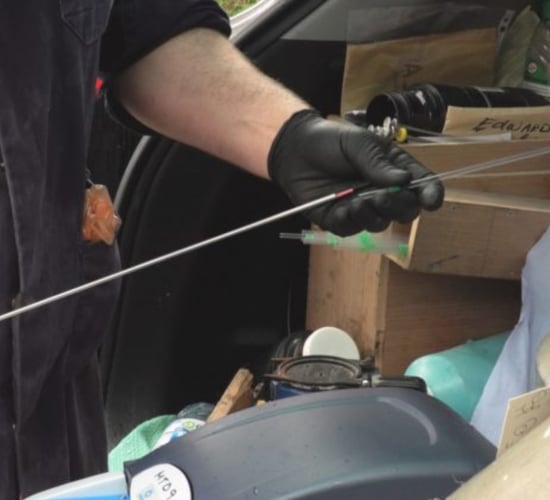
One way of securing the maximum impact generated by T6P is spraying a biochemical precursor of the agent on to commercial crops, which is then activated by light.
Up to now, T6P application has increased yield while maintaining grain protein levels.
Yield benefits were observed under both drought and well-watered conditions, offering a sustainable route to improvement.
T6P treatments have also triggered higher expression of the full sucrose-to-starch pathway in the grain: something never achieved through technological means before.
In addition, genes linked to nitrate reduction, amino acid production and protein synthesis were upregulated, explaining why protein content remained stable despite higher yields in T6P-treated crops.
And, finally, T6P increases in both grain number and grain size were achieved simultaneously, thereby overcoming a long-standing limitation in wheat yield potential.