Improving cow flow over the summer months

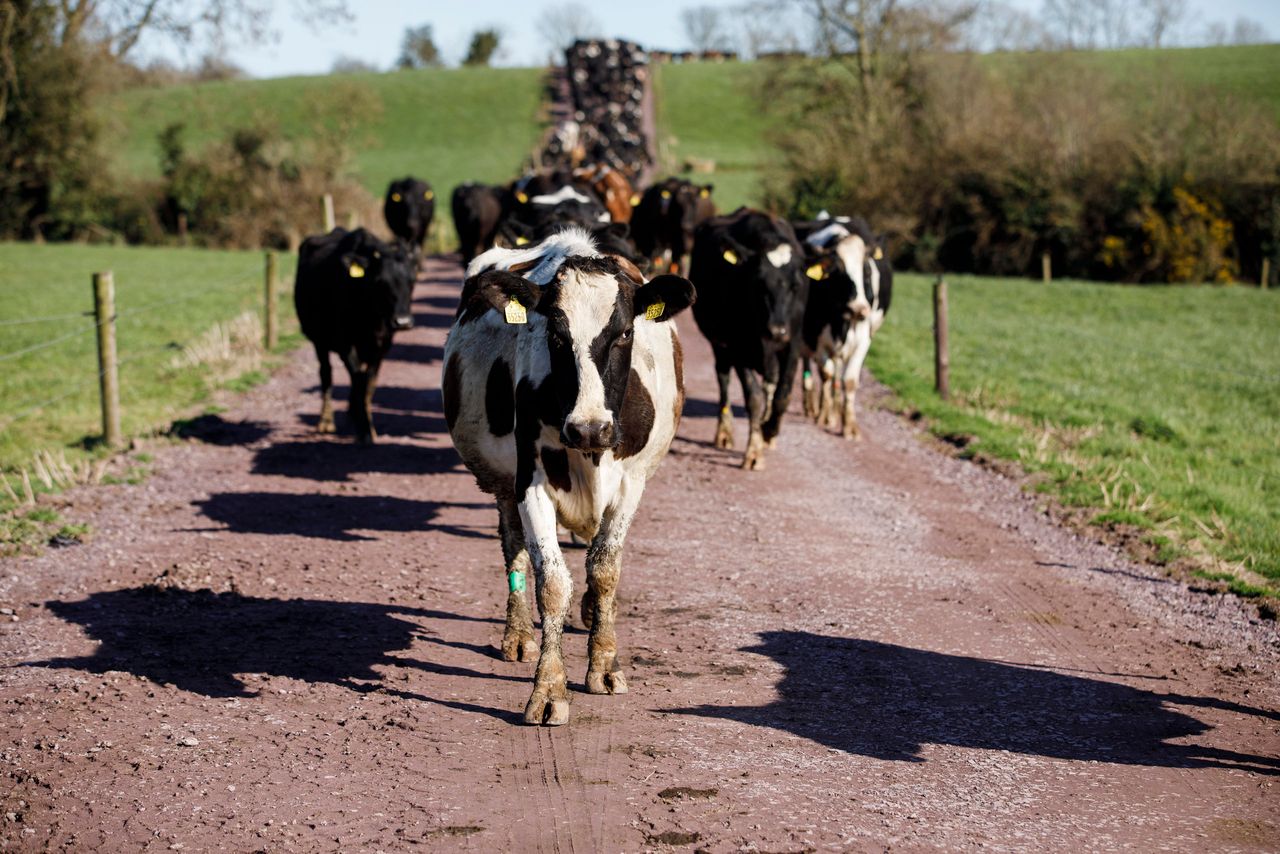
As oestrus activity begins to settle down, farmers should use the next couple of weeks to identify issues with cow flow and pinpoint areas of congestion.
A lot of farms across the country have not upgraded laneways since before the abolishment of quotas, and have expanded herd numbers travelling on inadequately sized laneways.
This may seem like a small issue, but in reality inadequate roads may be affecting the farms profitability.
Poor cow flow can lead to issues such as lameness and mastitis, while also affecting grass utilisation and cow performance.
Issues with cow flow can be the biggest problem at this time of year during breeding, as mounting activity on tight and poor condition roadways can lead to lameness or injury.
This can affect can affect milk production during peak, as well as impacting the cow's chances of going back in-calf.
Cow flow
Teagasc previously carried out a study on 55 farms with herd sizes ranging from 30 to 760 cows to see what condition road ways were in.
Information was compiled to use as an estimate of mean cow flow on each farm, defined as cows moved per minute (CPM).
The on-farm survey results were as follows:
| Herd size (cows) | <100 | 100-149 | 150-199 | 200-249 | >250 |
|---|---|---|---|---|---|
| Number of herds | 11 | 18 | 8 | 5 | 13 |
| Sample size of roadways (m) | 130 | 260 | 124 | 87 | 292 |
| Length of sections examined (m) | 87 | 129 | 114 | 157 | 185 |
| Mean roadway width (m) | 2.97 | 2.94 | 3.3 | 3.6 | 3.89 |
| Range roadway width (m) | 1.7-6 | 1.2-5 | 1.8-7.7 | 2.5-5.3 | 1.9-10 |
| Roadway width relative to herd size | 0.76 | 0.7 | 0.69 | 0.74 | 0.62 |
| Mean surface condition score | 2.46 | 2.75 | 2.81 | 2.64 | 3.06 |
| Public crossings | 10 | 20 | 20 | 4 | 41 |
| Mean total farm CPM | 35.6 | 36.6 | 41 | 43.7 | 55.4 |
The study shows that the majority of roads are in a suboptimal state when it comes to width, not reaching the desired standard of 3.5m for a 50-cow herd, with another 0.5m allowed for every additional 50 cows thereafter.
On average, roadways were 70% of the recommended width relative to the herd, with only 4% of the roadways being an optimal width for the herd size.
The study also highlighted that surface conditions significantly affected the CPM rate.
Measured CPM with varying roadway width and surface, with a surface condition index (SCI) ranging from one to five, were as follows:
| Width (m) | SCI 1 | SCI 2 | SCI 3 | SCI 4 | SCI 5 |
|---|---|---|---|---|---|
| 1 | 12.4 | 13.8 | 15.2 | 16.6 | 21.3 |
| 1.5 | 13.4 | 15.6 | 21.5 | 25.1 | 32.1 |
| 2 | 14.4 | 17.4 | 27.8 | 33.6 | 42.9 |
| 2.5 | 15.5 | 21.2 | 34 | 42.2 | 53.6 |
| 3 | 16.5 | 25 | 40.3 | 50.7 | 64.4 |
| 3.5 | 17.5 | 28.8 | 46.6 | 59.3 | 75.2 |
| 4 | 18.5 | 32.6 | 52.8 | 67.8 | 86 |
| 4.5 | 19.6 | 36.4 | 59.1 | 76.3 | 96.8 |
| 5 | 20.6 | 40.2 | 65.4 | 84.9 | 107.6 |
Public road crossings had a significant negative impact on cow flow, as it was found to reduce CPM by 32.7% on average, whereas congestion points did not have a major impact.
The study found that only 14.2% of farm roadways were in an optimal surface condition to allow for sufficient cow movement, with 24.4% being completely inadequate.
The ideal roadway
As mentioned above, the ideal roadway should be at least 3.5m wide for a 50-cow herd, with another 0.5m allowed for every additional 50 cows.
Roadways should be laid out efficiently to ensure cows are not walking unnecessarily long distances, while avoiding any sharp turn or bends if possible.
There should be no distractions on the route to the parlour from the paddock, as distractions on the track will lead to cows stopping to take a look, which can lead to the middle of the herd getting bunched up.
Install good fencing to keep cows out of any drains ditches, aim to install at least two gaps to each pasture, using the furthest gap for entrance and the nearest for exit.
The gaps should be the same width if not wider than the track itself to avoid bottlenecks, it may also be worth angling the gaps onto the track to prevent cows from having to do a 90º turn (increases speed and reduces mucking up of entrance).
The roadway itself needs to have a good binded surface that is comfortable on the herd's hooves.
Getting the camber right will ensure longer lasting quality and comfort, as water runs off freely without affecting the cows movement.
The roadways should be graded annually from there on after to ensure cows are not getting mechanical damage, drains and grass verges should also be regularly cleaned to ensure water can run off freely.
After all of the rain this year, ensure any new potholes are filled so they do not trap water and ruin the base layer.