Brazil meat exports to EU up 170% under Mercosur deal


Brazil has reported a 170% increase in the volume of meat exports to the European Union since the provisional application of the EU-Mercosur trade deal, the country's Agriculture Ministry said.
The EU-Mercosur Interim Trade Agreement marked six months since it came into force yesterday (Sunday, November 1).
The deal allows an additional 99,000t of beef from Mercosur countries to enter the EU at a reduced tariff rate of 7.5%, which will be phased in over six years.
An additional 180,000t of poultry will also be allowed into the EU at a lower tariff.
Brazil
Between May and September 2026, Brazilian agribusiness exports to the EU grew by 14.8% in value compared to the same period last year to hit $12.2 billion, according to data from Brazil's Ministry of Agriculture and Livestock (Mapa).
Brazil exported 17.74 million tonnes of agricultural and agro-industrial products to the 27 EU countries between May and September this year.
This volume is 8.1% higher than the same period in 2025, when 16.42 million tonnes were shipped.
The ministry pointed to strong export performances across soybean, meats, honey and fruits.
The period also saw the beginning of tariff preferences for certain Brazilian products under the EU-Mercosur trade deal.
Exports
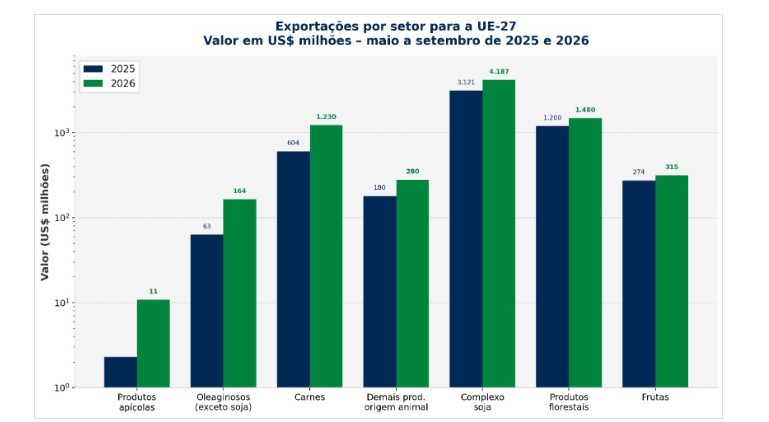
The ministry said that Brazilian meat exports to the EU in the five-month period grew 103.5% in value terms and 170% in volume, going from 101,000 to 272,000 tonnes.
Exports of honey from the south American country increased by 367%, and oilseed products, except soybeans, were up 161%.
The 'soybean complex', which includes grains, meal, and oil, remained the main segment of Brazilian agri exports to the EU.
Sales increased from $3.12 billion between May and September 2025 to $4.19 billion in the same period of 2026, representing growth of 34.2% in value and 20.5% in volume, the ministry said.
Soybean exports saw a 49% increase in value and a 35.1% increase in volume.
While soybean meal exports grew by 22.5% in value and 10.6% in volume.
Forest products also saw an increase in revenue, from $1.20 billion to $1.48 billion, a rise of 23%. The volume exported increased by 2.6%.
Exports of fruits, including nuts and seeds, saw sales rise from $274 million to $315 million, a growth of 15% in value and 2% in volume .
Imports
The data shows Brazilian imports of agricultural and agro-industrial products from the EU were valued at $1.67 billion between May and September 2026.
This is a 3.3% increase compared to the $1.62 billion recorded in the same period of 2025.
In volume, purchases increased from 578,600 to 617,900 tons, a growth of 6.8%.
Among the main imported items are oilseeds, except soybeans, beverages, forestry products, other products of plant origin, vegetables, and cereals and flours.
The largest percentage increases were recorded in imports of juices (41.1%), fish (33.8%), fruits (29.2%), tea, mate and spices (28.1%), and forestry products (14.3%).
Despite increased imports, the ministry said Brazil's agribusiness trade balance with the European Union "remained positive".
The surplus increased from $9.01 billion between May and September 2025 to $10.54 billion in the same period of 2026, a growth of 17%.
Mercosur
Since May 1, 2026, the trade agreement provides for tariff reductions for agricultural products from Mercosur countries based on agreed quotas and timeframes.
"The implementation of tariff reductions will be gradual for different sectors.
"Therefore, the results of the first few months represent an initial stage in taking advantage of the negotiated commercial conditions," the Brazilian ministry said.
Mapa noted that access to the European market also "requires attention to sanitary, environmental, and traceability standards".
"Compliance with these requirements is especially relevant for supply chains such as soy, meat, coffee, and timber.
"In this context, certification and traceability are important tools for demonstrating product compliance with buyer requirements and European legislation.
"Monitoring the bloc's environmental regulations, including the European Union Regulation on Deforestation-Free Products (EUDR), is also part of the challenges for maintaining and expanding exports," the ministry added.
The EU suspended imports of Brazilian beef, poultry and honey from September 3, 2026, due to concerns over Brazil's compliance with EU requirements on the use of antimicrobials.
It is anticipated that the EU may decide to relist Brazil for imports of poultry and honey in the coming weeks following a "positive" audit by EU officials.
However, a timeline for the resumption of beef imports from Brazil has not been confirmed by the EU Commission.