Bluetongue cases surge to 37

Co. Kilkenny has recorded its first confirmed case of bluetongue, according to the Department of Agriculture, Food and the Marine (DAFM).
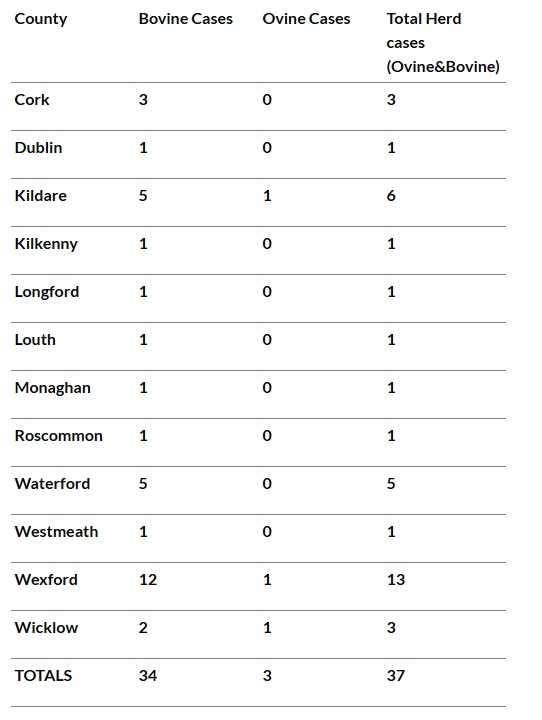
The department today (Friday, October 16) confirmed that the number of bluetongue cases in the country has risen to 37.
The majority of these have been bovine, while there has also been three bluetongue cases identified in sheep.
Latest figures show that Co. Wexford is currently the worst impacted county with 12 bovine cases and one sheep case.
Bluetongue virus is spread by infected biting midges.
The high-risk period for bluetongue spread is when midges are most active which is usually between April and November.
But DAFM has warned that because of rising global temperatures and mild weather conditions during winter midge activity could persist for longer, which would in turn extend the periods of potential disease transmission.
Farmers have been advised to be vigilant to the key clinical signs aasociated with the bluetongue virus including:
- Fever;
- Loss or lack of appetite;
- Drop in milk yield;
- Apathy, lethargy;
- Lesions, sores, reddening and/or ulcerations;
- Swelling of the face, lips and tongue.
DAFM has also reminded farmers that infected pregnant animals can also pass the virus to their unborn offspring in the womb, who can then be a source of infection when they are born.
Bluetongue
Separately two suspect cases of bluetongue are currently under investigation in Northern Ireland.
The Department of Agriculture, Environment and Rural Affairs (DAERA) told Agriland that samples have been sent to the laboratory for testing.
Further details on the locations or the animals involved have not been confirmed.
DAERA said no cases of bluetongue have been confirmed in Northern Ireland to date this year.
England
According to the Department for Environment, Food and Rural Affairs (Defra) there are currently 2,874 cases in England with 10 new cases confirmed yesterday.
There are also 484 cases in England and 50 cases in Scotland.